

Affiliate disclaimer: TravelForBusiness.org participates in affiliate programs, including Amazon Associates, and may earn a commission from qualifying purchases at no extra cost to you.
1. Quick Answer (TL;DR)
Most teams use the “4 Cs” as a simple way to balance business goals with traveler needs:
- Cost: Track your total travel expenses.
- Compliance: Ensure travelers book in accordance with policy and meet all legal and security requirements.
- Convenience: Reduce friction so that people can book, travel, and spend more quickly.
- Care: Protect travelers (duty of care), particularly during disruptions or high-risk trips.
Depending on the instructor, the fourth “C” could be Comfort, Control, Communication, or Customer.
2. Understanding the Question
If you’ve Googled “what are the 4 c’s of corporate travel management?” you’ve probably noticed different answers. That’s normal.
There isn’t one global standards body that “owns” the phrase. Many travel platforms, banks, TMCs, and consultants use their preferred version to emphasize what matters most to them (e.g., budget control, traveler experience, risk management, reporting).
A practical way to think about it:
- The 4 Cs are a decision framework, not a strict definition.
- A strong travel program still needs all four outcomes: spend control, policy adherence, low-friction user experience, and traveler safety/well-being.
3. Detailed Explanation
Cost: manage total spend, not just line items
Cost is more than “cheapest flight wins.” The goal is predictable, controlled spending while protecting productivity.
What cost management typically includes:
- Advance purchase guidelines (e.g., book 7–14+ days out where possible)
- Preferred suppliers and negotiated rates (air, hotel, car)
- Trip approval rules (especially for international or last-minute travel)
- Visibility into spending by team, project, client, or traveler
- Leakage control (stopping off-platform bookings and reimbursement surprises)
The hidden cost trap: A slightly cheaper flight that adds a 5:30 a.m. departure, two tight connections, and no carry-on might cost more in lost productivity than it saves. That’s why many programs tie “Cost” directly to “Convenience” and “Care” rather than treating it in isolation.
Quick “Cost” checklist
- Can you see the total spend by department and by trip purpose?
- Do you have supplier discounts that employees actually use?
- Is the booking flow easy enough that people don’t bypass it?
Compliance: make the right thing the easy thing
Compliance means travelers follow the travel policy and required procedures:
- Booking in approved channels
- Staying within rate caps or preferred hotels
- Using required payment methods and expense categories
- Following security/insurance rules (especially for international travel)
“Stricter rules” rarely lead to high compliance. It usually comes from:
- Clear policy language
- Simple booking paths
- Consistent enforcement (same rules for everyone)
- Communication and training that fits real traveler behavior
Common compliance failure points
- The policy is too long, too vague, or out of date
- Approvals are slow, so travelers book “whatever is available”
- Expense requirements aren’t precise, causing reimbursement delays (and angry travelers)
Convenience: reduce friction in booking, traveling, and expensing
Convenience is the user-experience layer of travel management:
- Fast, intuitive booking
- Reasonable options inside policy (not “one terrible flight”)
- Smooth changes/cancellations when plans shift
- Easy expensing and receipt capture
Convenience matters because it drives compliance. If your process is painful, travelers route around it.
Practical ways to increase convenience:
- Pre-approved preferred options (best-value bundles, flexible fares for frequent change roles)
- Clear “what’s allowed” filters inside the booking tool
- Automatic itinerary + receipt forwarding
- Fewer manual steps for expense reporting
Care: duty of care, safety, and traveler well-being
Care is your responsibility to protect travelers and respond when things go wrong:
- Disruptions (storms, strikes, cancellations)
- Medical issues
- Security risks
- Data protection risks (lost devices, unsafe Wi-Fi, etc.)
Many sources explicitly list “Care” as one of the 4 Cs, alongside cost/compliance/convenience.
Care typically includes:
- Knowing where travelers are (itinerary visibility)
- Emergency support or escalation paths
- Clear guidance for high-risk destinations
- Policies that prevent burnout (e.g., sensible flight times, rest considerations for heavy travelers)
4. Key Characteristics
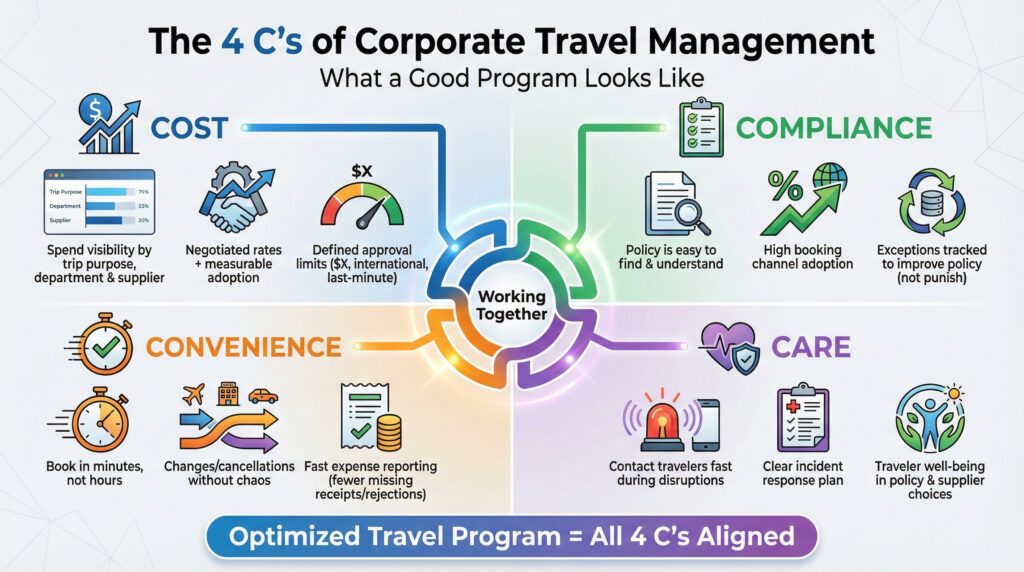
Here’s what a “good” program looks like when the 4 Cs are working together.
Cost characteristics
- Spend visibility by trip purpose, department, and supplier
- Negotiated rates + measurable adoption
- Defined thresholds for approvals (e.g., over $X, international, last-minute)
Compliance characteristics
- Policy is easy to find and easy to understand
- Booking channel adoption is high
- Exceptions are tracked and used to improve policy (not just punish travelers)
Convenience characteristics
- Travelers can book in minutes, not hours
- Changes/cancellations are supported without chaos
- Expense reporting is structured and fast (fewer missing receipts, fewer rejections)
Care characteristics
- You can contact travelers fast during disruptions
- You have a clear response plan for incidents
- Traveler well-being is considered in policy and supplier choices
5. Real-World Examples
Example 1: Sales team doing frequent domestic trips
- Cost: negotiated airline + hotel rates near key territories
- Compliance: require booking in the platform to track spending and traveler location
- Convenience: allow flexible fares for top road warriors who change meetings weekly
- Care: escalation path for same-day disruptions so client meetings don’t collapse
Example 2: Consultants traveling internationally for projects
- Cost: predictable “project travel budgets” with reporting by client
- Compliance: approval required for premium cabins; visa/insurance rules baked into the workflow
- Convenience: preferred hotels near client site; simplified expense categories
- Care: high-risk destination guidance and 24/7 contact plan
Example 3: Small business owner traveling on a lean budget
- Cost: strict caps but with “best value” logic (avoid cheap-but-ruinous itineraries)
- Compliance: lightweight policy (1 page) that still sets booking + receipt rules
- Convenience: templates for itineraries, receipts, and business purpose notes
- Care: simple contingency plan (backup hotel/flight rules, emergency contacts)
6. Benefits and Advantages
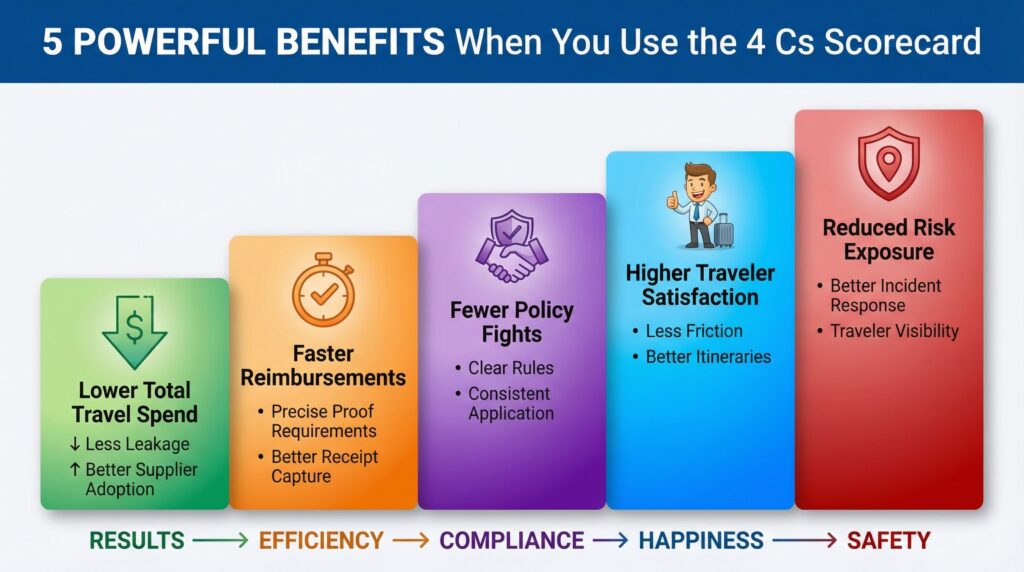
When you run corporate travel using the 4 Cs as your “scorecard,” you typically get:
- Lower total travel spend (less leakage, better supplier adoption)
- Faster reimbursements (precise proof requirements, better receipt capture)
- Fewer policy fights (because rules are clear and consistent)
- Higher traveler satisfaction (less friction, fewer miserable itineraries)
- Reduced risk exposure (better incident response and traveler visibility)
4C Travel Program Scorecard
Your Weakest Areas
3-Step Action Plan
Metrics to Track
Recommended Travel Tools
7. Related Concepts
Variations of the “4 Cs”
Depending on the source, you might see:
- Comfort instead of Care (emphasizes traveler experience and fatigue management)
- Control instead of Care (emphasizes oversight, reporting, and governance)
- Communication included (emphasizes policy awareness and stakeholder alignment)
- IATA’s travel manager advisory framing: Cost, Control, Customer, Care
Travel Management Companies (TMCs)
A TMC often supports:
- booking + policy enforcement
- traveler assistance
- reporting/analytics
- supplier negotiations
- duty of care support
Travel + expense (T&E) operations
Many “4 C” failures show up as:
- missing receipts
- unclear business purpose notes
- delayed approvals
- inconsistent expense rules
8. Conclusion
The “4 Cs” are popular because they’re simple—and because they map to the real tension in corporate travel: balancing business control with human reality.
If you anchor your decisions around Cost, Compliance, Convenience, and Care, you’ll build a program that:
- spends smarter,
- gets followed,
- runs smoother,
- and keeps travelers supported when things go sideways.
9. Frequently Asked Questions
What are the 4 C’s of corporate travel management?
Most commonly: Cost, Compliance, Convenience, and Care—a framework to balance spend control, policy adherence, traveler experience, and duty of care.
Are the 4 Cs “official”?
The term “official” does not refer to an industry standard. Multiple organizations teach slightly different versions (e.g., Comfort or Control). The value lies in using the framework consistently.
Which “C” matters most?
If you’re losing money: start with Cost + Compliance.
If travelers bypass your system: prioritize Convenience.
If you have international/high-risk travel or frequent disruptions: elevate Care.
How do I improve compliance without making travelers hate the policy?
Make the compliant option the fastest option (simple booking flow, clear rules, fewer approvals). Also communicate policy changes clearly and repeatedly.
What’s a quick KPI set for the 4 Cs?
- Cost: average trip cost, savings vs benchmark, supplier adoption
- Compliance: in-policy booking rate, exception rate, out-of-channel spend
- Convenience: booking time, change handling time, traveler satisfaction
Care: incident response time, traveler tracking coverage, disruption resolution outcomes