
If you travel often for work, your luggage stops being “a bag” and becomes part of your operating system. It’s the thing that protects your laptop-adjacent wardrobe, survives curb checks and overhead bins, and keeps you moving when you’re running late for a connection.
That’s the promise behind the Briggs & Riley Baseline collection: premium softside luggage built around two signature ideas—the CX® compression-expansion system and the Outsider® handle—backed by the brand’s lifetime guarantee.
Check the full Briggs & Riley Baseline collection on Amazon
This Briggs & Riley Baseline Review focuses on what matters most to corporate road warriors: true durability, day-to-day usability, carry-on practicality, and whether the price is reasonable when your calendar is full and your suitcase is constantly on the move.
Affiliate disclaimer: TravelForBusiness.org participates in affiliate programs, including Amazon Associates, and may earn a commission from qualifying purchases at no extra cost to you.
Features Overview
Baseline isn’t a single suitcase—it’s a full lineup (carry-ons, spinners, checked bags, garment-focused options). But the collection shares a consistent build philosophy: practical organization, rugged materials, and “business-first” design choices.
The two signature Baseline features
1) CX® compression-expansion (more space, then back to “carryable”)
Baseline’s CX® system provides extra packing capacity on demand and allows you to compress it back down when you’re finished. The brand describes it as “expand with a single button press, zip closed, and compress back.”
Why it is relevant for work travel: you can pack a slim profile for outbound travel, then expand for return (conference swag, client gifts, extra shoes) without permanently dragging a bulky bag through airports.
2) Outsider® handle (flatter interior, fewer wrinkles)
Instead of running the handle tubes inside the bag (creating ridges that wrinkle clothes), Baseline uses a low-profile external handle design. The brand emphasizes wrinkle reduction and more usable interior space.
Why it matters: suits, dress shirts, and structured outfits stay flatter. And packing feels more “rectangular,” which makes cubes and folders work better.
Material and construction: ballistic nylon + “built to be used”
Baseline is known for its ballistic nylon fabric (a key reason people buy softside at this price). On the Baseline Essential Carry-On Spinner spec pages, the material is highlighted for wear resistance and long-term durability.
Softside also buys you:
- A little forgiveness in tight overhead bins
- Exterior pockets that are genuinely usable
- Better “stuff-it-and-go” practicality than hard shells
Lifetime guarantee (a significant part of the value proposition)
Briggs & Riley markets its “Simple as That®” lifetime guarantee as covering all functional repairs, with no receipt required, and explicitly discusses airline damage coverage in its materials.
Important nuance: the brand also spells out exclusions, such as cosmetic wear (scuffs, stains, etc.) and other non-functional issues.
For frequent flyers, that guarantee isn’t a nice-to-have—it’s a core economic argument: if you keep the bag for years, repairs don’t become a recurring tax on your travel life.
Performance Analysis
Let’s translate Baseline’s features into the only question that matters on the corporate road:
Does it make travel easier—reliably—trip after trip?
1) Airport mobility: wheels, handling, and “hurry-proof” behavior
Baseline spinners are built to be stable and predictable when you’re moving fast (think: laptop bag on shoulder, phone in hand, boarding pass open). The Baseline line leans into function over flash—not the lightest, not the sleekest, but intentionally robust.
Tradeoff: Baseline carry-ons can be heavier than midrange competitors. For example, the Essential Carry-On Spinner is listed at 10 lb / 4.6 kg.
That weight buys you structure and durability, but if you fly with airlines that have strict cabin weight limits, it matters.
2) Packing efficiency: where Baseline shines
Baseline’s interior and expansion system are designed for people who pack “work outfits,” not just T-shirts.
Essential Carry-On Spinner specs (useful benchmark):
- Exterior: 22 x 14 x 9 in (expands up to 11.5 in)
- Capacity: 37–48 liters (varies by expanded state)
In practice, that means:
- Outbound: 2–3 days of business outfits + gym gear (depending on how shoe-heavy you are)
- Return: expand for extras, then compress to keep the bag manageable
The Outsider handle effect is real if you travel with structured clothing. A flatter interior surface + compression strategy = fewer “why does my shirt look like it slept in a ball?” surprises.
3) Checked-bag practicality: medium sizes that don’t feel clumsy
If you’re moving beyond carry-on, Baseline’s Medium Expandable Spinner is positioned as a mid-sized suitcase for longer trips, built around the same CX® and Outsider® systems.
A third-party listing commonly cites specs like:
- Exterior: 26 x 18 x 12–14.5 in
- Weight: 12.5 lb / 5.7 kg
- Capacity: ~80–97 L
That is a lot of capacity, but it also serves as a reminder that Baseline is designed to be used as equipment rather than an ultralight accessory.
4) Durability under real abuse
Baseline’s reputation is built on surviving:
- Rough sidewalks and curbs
- Hotel bell carts
- Trunk Tetris
- Gate-check roulette
The ballistic nylon and reinforced build are meant to keep your bag “operational” even after it stops looking perfect. And because cosmetic wear isn’t the priority, the durability story is mainly about zippers, handles, wheels, and frame integrity—the functional stuff the lifetime guarantee is aimed at.
5) Corporate travel policy realities
If your company pushes you toward carry-on-only (fewer baggage fees, fewer lost-bag disasters), Baseline’s carry-on sizing is intentionally aligned to common standards.
But here’s the corporate reality: your company policy and your airline mix can punish heavy bags. If you routinely fly strict carriers (especially in Europe), you may find the Baseline carry-on weight eats into your allowed cabin limit quickly. (This isn’t a Baseline flaw—it’s a “premium softside durability costs weight” truth.)
Pros and Cons
Pros
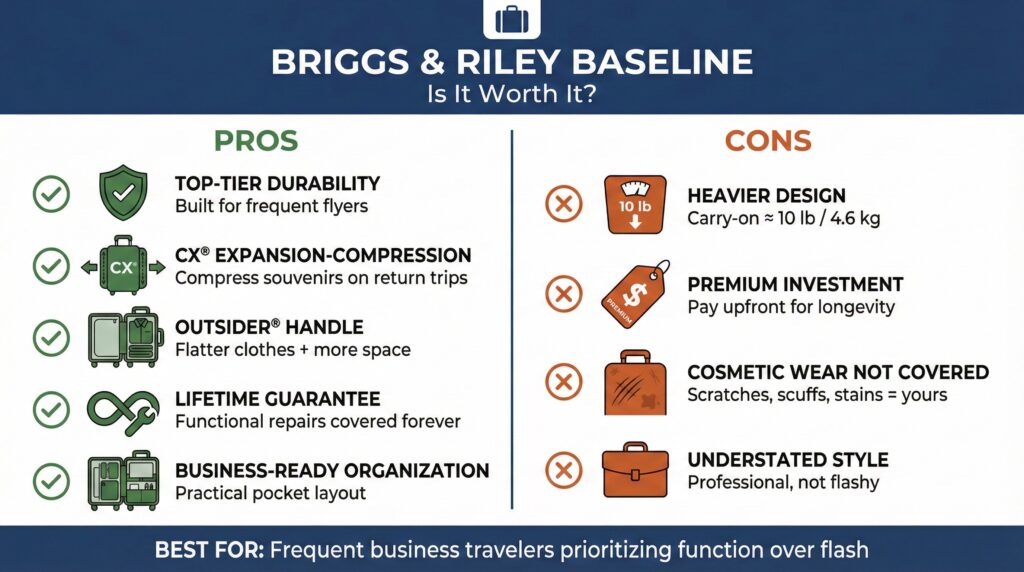
- Top-tier durability mindset (built for frequent use)
- CX® expansion-compression is genuinely helpful for return trips
- Outsider® handle helps keep clothes flatter and the interior space more usable
- Lifetime guarantee focused on functional repairs; strong peace-of-mind factor
- Practical organization for business travel routines
Cons
- Heavier than many alternatives (e.g., carry-on around 10 lb / 4.6 kg)
- Premium price (you pay upfront for longevity)
- Cosmetic wear isn’t covered (scratches/scuffs/stains are on you)
- Style is classic/understated (not for “look at my luggage” energy)
User Experience
Let’s make this concrete by focusing on the three most significant pain points you mentioned—compliance/reimbursement friction, loyalty fragmentation, and staying productive (and human) on the road.
1) Compliance + reimbursement: fewer “travel chaos” moments
Baseline helps indirectly here: the more reliable your bag, the less likely you are to:
- Replace luggage mid-trip
- Lose time shopping for emergency gear
- Show up wrinkled or disorganized and scramble for solutions
That said, if reimbursement delays are a recurring headache, the bigger win is building a repeatable capture routine (receipts, folios, mileage logs). Luggage won’t fix finance… but the right accessories can.
Tool that pays for itself fast:
2) Loyalty/status across fragmented bookings
Baseline doesn’t magically unify points across airlines, but it does support the “be ready for anything” travel style that frequent flyers live by:
- Expand when you need to.
- Compress when you have to.
- Keep clothing presentation consistent, even on back-to-back trips.
3) Jet lag + productivity: reducing friction matters
When you’re tired, you don’t rise to the occasion—you sink to your knees.
Baseline’s value is that it behaves predictably:
- You know where things are
- Your bag rolls the way you expect
- You pack the same way every time
That reduces decision fatigue—one of the quiet killers of productivity on frequent travel for business schedules.
Value for Money
Baseline is expensive. So the value question is really:
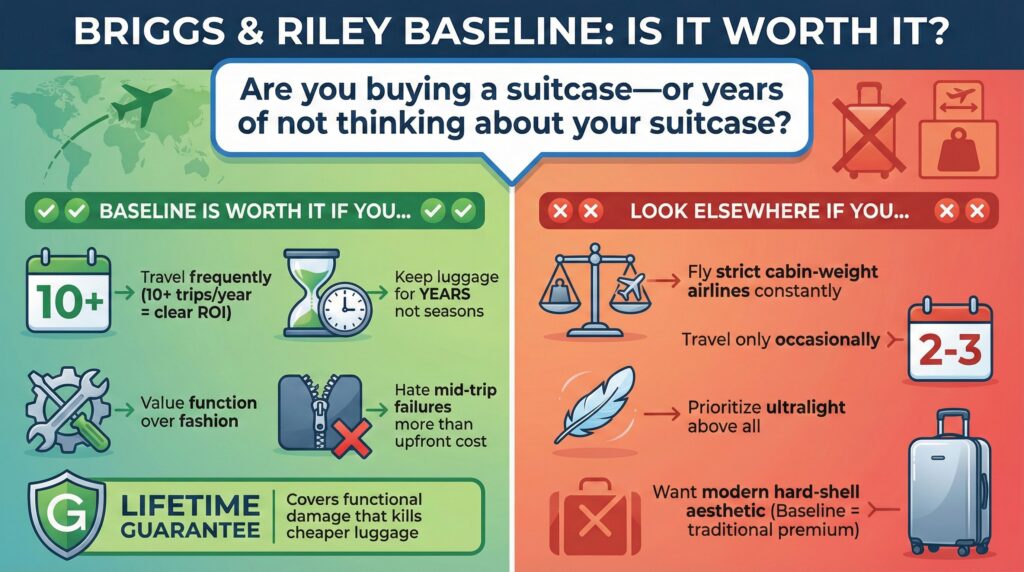
Are you buying a suitcase—or buying years of not thinking about your suitcase?
When Baseline is worth it
Baseline makes sense if you:
- Travel frequently (10+ trips/year is where ROI becomes obvious)
- Keep luggage for years (not seasons)
- Value function over fashion
- Hate “mid-trip failures” more than you hate paying upfront
The lifetime guarantee is a big part of that equation—especially when functional damage is the thing that ends the life of cheaper luggage.
When it’s not worth it
You may want something else if you:
- Fly strict cabin-weight airlines constantly (bag weight matters a lot)
- Travel only a few times a year
- Prefer ultralight luggage above all else
- Want a modern hard-shell look (Baseline is premium… but traditional)
Recommended Baseline Picks (Most Common Use Cases)
Best for 2–4 day work trips: Baseline Essential Carry-On Spinner
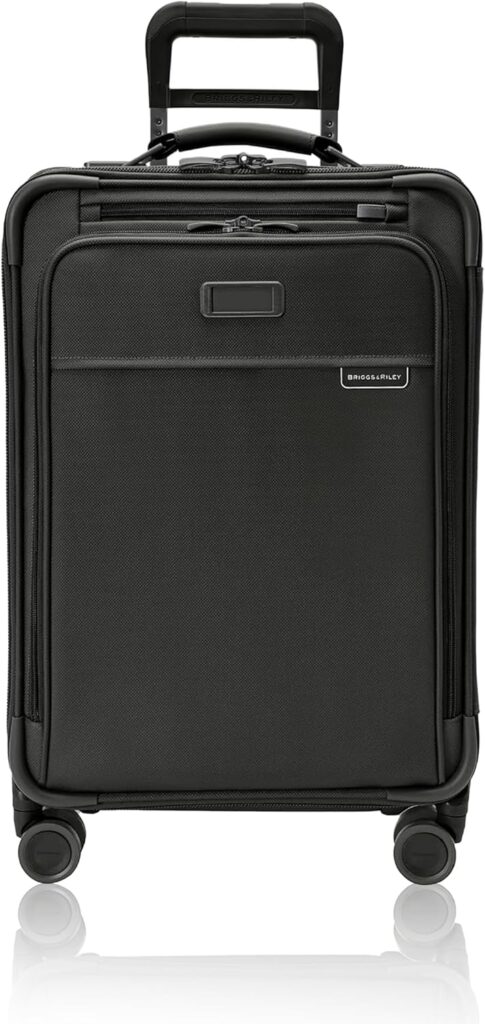
A “default” choice for frequent flyers who want a carry-on that can flex:
- 22 x 14 x 9 in, expands to 11.5 in
- 37–48 L capacity range
Briggs & Riley Baseline Essential Carry-On Spinner (check price)
Best for 3–8 day trips (or bulky packers): Baseline Medium Expandable Spinner
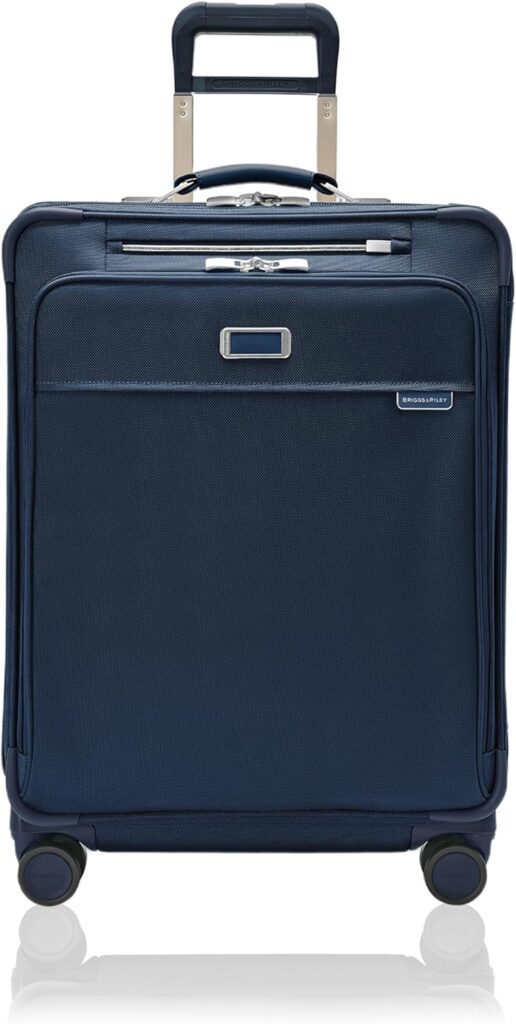
If you’re checking a bag or packing heavier:
- Designed around CX® expansion and “flat packing” with the Outsider handle
Briggs & Riley Baseline Medium Expandable Spinner (check price)
Best supporting accessory: packing cubes (make Baseline even better)
Baseline packs beautifully with cubes because the interior stays flatter and more rectangular.
Packing Cubes (make business packing faster)
Smart Alternative (If You Want Premium But Lighter on the Wallet)
If Baseline is more than you want to spend right now, but you still want a reliable “business-class” carry-on experience:
(You lose the Baseline guarantee story and CX system, but you may gain a more budget-friendly on-ramp to durable travel.)
Final Verdict
Briggs & Riley Baseline is for people who travel enough to be tired of luggage drama. It’s a deliberately practical, long-haul system—ballistic nylon durability, an innovative expansion mechanism, a handle design that protects your clothing, and a lifetime guarantee built to keep it operational.
If you’re a frequent flyer—especially a consultant, sales pro, or executive who can’t afford “broken wheel energy”—Baseline is one of the safest premium buys you can make.
If you’re a lighter traveler, fly with strict cabin weight limits, or just don’t want a 10 lb carry-on before you’ve packed a single item, you may be happier with a lighter (and cheaper) option.
My recommendation in one line
If you do 10+ work trips a year and want a bag that can take real punishment for years, Baseline is worth the premium—because it’s less of a purchase and more of a decision to stop thinking about luggage.
CTA recap (pick the one that matches your travel style):