

Affiliate disclaimer: TravelForBusiness.org participates in affiliate programs, including Amazon Associates, and may earn a commission from qualifying purchases at no extra cost to you.
Quick Answer (TL;DR)
If you’re asking, “Is business travel worth it?” It can be—when the career upside (promotions, relationships, deal flow, visibility) clearly beats the personal costs (fatigue, missed time at home, health disruption) and you have systems to make travel smoother (policy compliance, points strategy, recovery routines).
A fast rule of thumb:
- Worth it if: travel directly drives revenue/results, and you’re protected by good reimbursement, reasonable schedule control, and recovery time.
- Not worth it if: you’re constantly “catching up” on life/work, your expenses are a headache, and travel doesn’t meaningfully move your career or income forward.
Not sure if business travel is actually paying off for you? Use the quick calculator below to get a “Worth-It Score” and a personalized recommendation in under a minute.
Understanding the Question
“Worth it” is different for everyone because the payoff isn’t just money. It’s a trade between:
- Career acceleration (visibility, trust, leadership opportunities)
- Income impact (commission, billable hours, client retention, bonuses)
- Lifestyle perks (points/status, premium upgrades, lounge access)
- Personal costs (sleep debt, stress, relationships, routines, health)
Business travel becomes frustrating when the hidden costs pile up: late flights, policy restrictions, reimbursement delays, jet lag, and the constant feeling of being behind.
What “worth it” looks like in real life
Business travel is usually worth it when it:
- Gets you in rooms you can’t access remotely
- Speeds up trust and decision-making
- Helps you earn more (directly or indirectly)
- Builds long-term career capital (reputation + network)
What “not worth it” looks like
It’s usually not worth it when:
- You’re traveling “because it’s expected,” not because it’s effective
- You’re missing essential life moments without a meaningful upside
- Your health and productivity are declining
- You’re spending hours on admin (receipts, reports, approvals) every trip
Detailed Explanation
Here’s a simple framework you can use to decide (and re-decide) if business travel is worth it for your role.
The “Worth It” Scorecard
Think in two columns:
Upside (benefits)
- Revenue/results impact (sales, retention, delivery speed)
- Career growth (visibility, leadership trust, promotion track)
- Network compounding (mentors, peers, decision-makers)
- Skill growth (negotiation, stakeholder management, industry fluency)
- Points/status (if you actually capture and use them well)
Downside (costs)
- Time loss (airports, delays, commute, unpacking, recovery)
- Health impact (sleep, diet, workouts, stress)
- Relationship strain (family, social, mental load)
- Productivity drag (jet lag, low-quality work time)
- Admin burden (expense reports, compliance, receipts, approvals)
If the upside column isn’t clearly more substantial, travel starts to feel like punishment.
Comparison: when travel is worth it vs not worth it
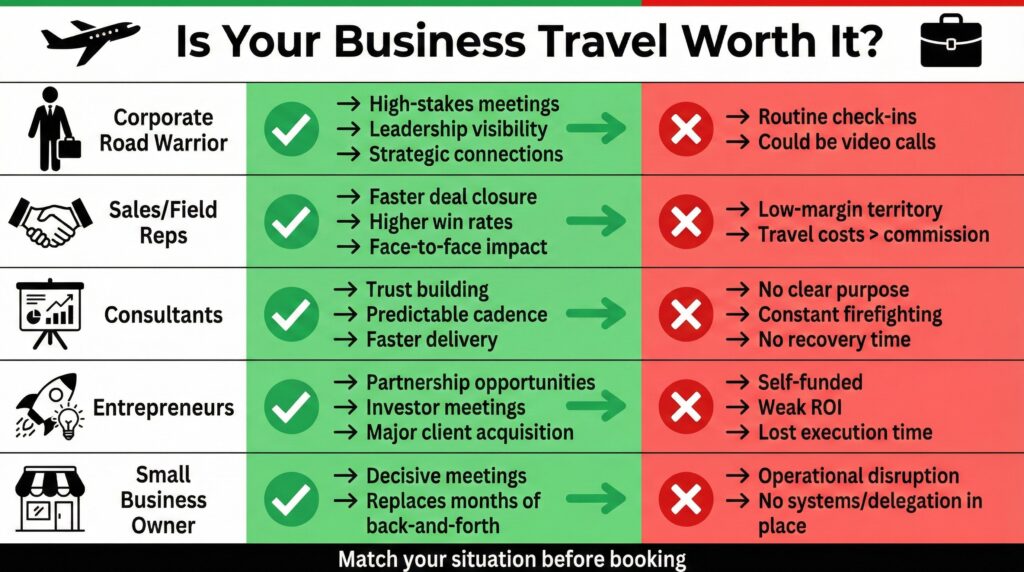
| Situation | Usually Worth It When… | Usually Not Worth It When… |
| Corporate road warrior | Trips unlock visibility, leadership, and high-stakes meetings | You’re traveling for routine check-ins that could be calls |
| Sales/field reps | In-person closes deals faster and increase the win rate | Territory is low margin, and travel eats commission |
| Consultants | Travel boosts trust and delivery speed, with a predictable cadence | You’re onsite “just because,” with constant fires and no recovery |
| Entrepreneurs | Travel creates partnerships, investors, and major clients | You’re self-funding with weak ROI and losing execution time |
| Small biz owner | Travel replaces months of back-and-forth with one decisive meeting | Travel disrupts operations, and you don’t have systems/delegation |
The most significant “make-or-break” factors
1) Control over your schedule
Travel is dramatically more tolerable when you can:
- Avoid the worst flight times
- Build buffer time (no same-night red-eyes before big meetings)
- Add a recovery morning after late returns
If you’re always squeezed, burnout can set in quickly.
2) Reimbursement speed and policy clarity
Slow reimbursement turns travel into financial stress, especially for:
- Self-funded entrepreneurs
- Contractors waiting on client reimbursements
- Anyone who floats hotels/airfare on personal credit
Even with good pay, it feels awful to chase money you already spent.
3) Whether travel replaces or adds work
Travel is worth it when it replaces weeks of delays and improves outcomes.
It’s not worth it when it adds extra work on top of an already full workload.
4) Health systems (sleep, food, movement)
Business travel punishes inconsistency. If you don’t have a routine, your:
- Sleep quality drops
- Food choices get worse
- Training consistency collapses
- Stress stays elevated
The goal isn’t perfection. It’s a minimum effective routine you can repeat anywhere.
Key Points
- Business travel is worth it when it creates leverage: faster decisions, stronger relationships, better outcomes.
- It’s not worth it when it’s performative primarily: showing up without measurable impact.
- Your experience is shaped by systems: points strategy, packing systems, reimbursement workflow, and recovery routines.
- The best travelers don’t “tough it out.” They engineer the trip: fewer friction points, faster admin, better sleep.
Examples and Case Studies
Case Study 1: Corporate road warrior (Director-level, 2–4 trips/month)
Problem: Great career momentum, but constant fatigue and “airport Mondays.”
What changed: They stopped doing early flights the same day as key meetings, started protecting sleep, and built a repeatable packing + expense workflow.
Outcome: The exact amount of travel, a lot less burnout, and better meeting performance.
Why it became worth it: Traveling helped leaders be seen and have an impact across departments.
Case Study 2: Consultant (project-based, client onsite weekly)
Problem: The client wanted someone on-site, even when the work was deep-focus and could be done from anywhere.
What changed: They worked out a schedule that included two focused on-site days a week and days of deep work from home.
Outcome: Better output, fewer late nights, improved client satisfaction.
Why it became worth it: On-site time was used for workshops, stakeholder alignment, and decisions—not “working quietly in a different building.”
Case Study 3: Sales rep (regional, budget-conscious)
Problem: Travel costs were eating commissions; trips weren’t moving deals.
What changed: They only focused on late-stage opportunities and put meetings together into "deal days."
Outcome: Fewer trips, a higher closing rate, and a better margin.
Why it became worth it: Travel was connected to events that led to conversions, not maintenance visits.
Case Study 4: Entrepreneur (self-funded travel)
Problem: High travel costs, unclear return on investment, and constant interruptions to execution.
What changed: They set a hard rule: travel must produce a measurable result (a signed deal, a partnership, an investor introduction, or a major content asset).
Outcome: Travel dropped by ~40%, and revenue per trip increased.
Why it became worth it: They treated travel like an investment with a required return.
Expert Insights
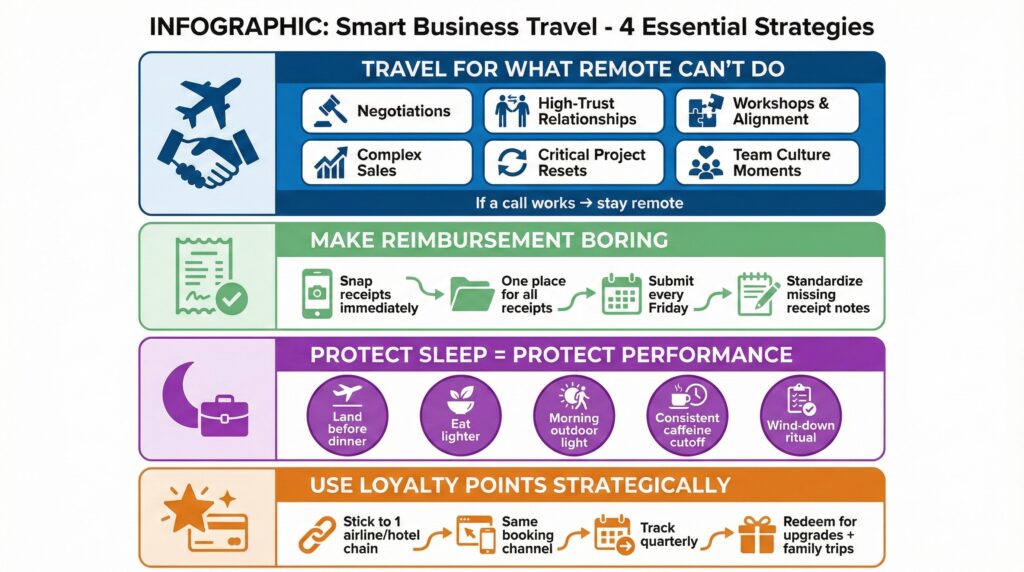
Use travel for what remote can’t do
The highest-value business travel is:
- Negotiations
- High-trust relationship building
- Workshops and alignment sessions
- Complex sales cycles
- Critical project resets
- Team culture moments that prevent attrition
If a call, default to remote can do it.
Make reimbursement boring (the best compliment)
Expense reports become painful when you “save it for later.” Make it automatic:
- Snap receipts immediately
- Keep one place for all receipts
- Submit every Friday (or after every trip)
- Standardize your “missing receipt” habit (notes, attendee names, business purpose)
If you want a shortcut, use your internal tool:
Expense Report Pass-First-Time Generator
Protect sleep like it’s part of the job
A simple travel sleep protocol:
- Land before dinner when possible
- Eat lighter at night
- Get outside light in the morning
- Keep caffeine cut-off time consistent
- Use a “wind-down” ritual (same order every night)
Business travel isn’t just meetings—it’s performance.
Use loyalty points strategically (don’t let them leak)
You don’t need perfection—just consistency:
- Stick to one primary airline/hotel chain when possible
- Use the same booking channel where your rewards actually track
- Track your points and elite status goals quarterly
- Redeem points for meaningful wins (upgrades, family trips, peak seasons)
Additional Resources
Travel gear that makes business trips easier
- Lightweight carry-on for frequent flyers (easy on your back, reliable and straightforward)
Travelpro Maxlite 5 Carry-On Spinner - Premium softside carry-on for professionals (polish + comfort, built for heavy use)
Travelpro Platinum Elite Carry-On Spinner - Business-travel laptop backpack upgrade (organized, professional, built for airports)
Bellroy Transit Workpack Pro 28L - Packing cubes to cut stress and stay organized (faster packing, cleaner suitcase)
Packing Cubes - Faster expense reports with cleaner receipts (tiny tool, huge payoff)
Portable receipt scanner
Conclusion
Business travel is worth it when it creates leverage: stronger relationships, faster decisions, and better outcomes you can’t replicate remotely. It’s not worth it when it drains your health, steals your time, and adds admin—without meaningful career or income upside.
The best move isn’t “travel more” or “travel less.” It’s travel smarter:
- Make trips outcome-driven
- Reduce friction with repeatable systems
- Protect sleep and recovery
- Automate receipts and reimbursement
- Use points as a bonus, not the main reason
Frequently Asked Questions
How is business travel actually helping my career?
Track outcomes for 90 days: promotions/visibility, deal velocity, stakeholder trust, project speed. If nothing moves, the travel is probably noise.
What’s the #1 reason business travel feels miserable?
Lack of control. When you can’t influence flight times, recovery time, or workload expectations, travel becomes constant stress.
Is business travel worth it if I’m paying out of pocket (entrepreneur/contractor)?
Only if you can clearly tie trips to revenue, partnerships, or opportunities that would take far longer remotely, set a required return per trip, and be ruthless.
How can I reduce jet lag and stay productive?
Prioritize sleep timing, morning light, hydration, lighter dinners, and a consistent routine. Don’t schedule high-stakes work immediately after landing if you can avoid it.
How do I stop expense reports from ruining my weekends?
Capture receipts immediately, submit on a fixed cadence (weekly or post-trip), and standardize your “business purpose” notes while they’re fresh.
What if my company requires travel that feels pointless?
Ask for clarity on the objective (“What outcome does this trip need to produce?”). If there isn’t one, propose a remote alternative or reduced cadence.
How do I make frequent travel healthier?
Minimum effective routine: walk daily, protein-forward breakfasts, one short workout style you can do anywhere, and consistent sleep guardrails.
Should I chase points and status?
Only if it supports your real goals (comfort, flexibility, upgrades, personal travel), if it causes worse schedules or more stress, it’s not worth it.