
Affiliate Disclaimer: TravelForBusiness.org participates in affiliate programs, including Amazon Associates, and may earn a commission from qualifying purchases at no extra cost to you.
Introduction
A 3-day business trip sounds simple—until you’re rushing through security, your charger is missing, your shirt is wrinkled, and you’re digging for receipts after a long client dinner. The goal isn’t to pack more. It’s to pack right: fast mornings, polished outfits, fewer “I forgot…” moments, and a clean path to reimbursement.
These essential packing tips for a 3-day business trip are built for real business travelers—people with tight schedules, corporate policy constraints, and the need to stay productive from airport to hotel to meeting room.
Essential Tips
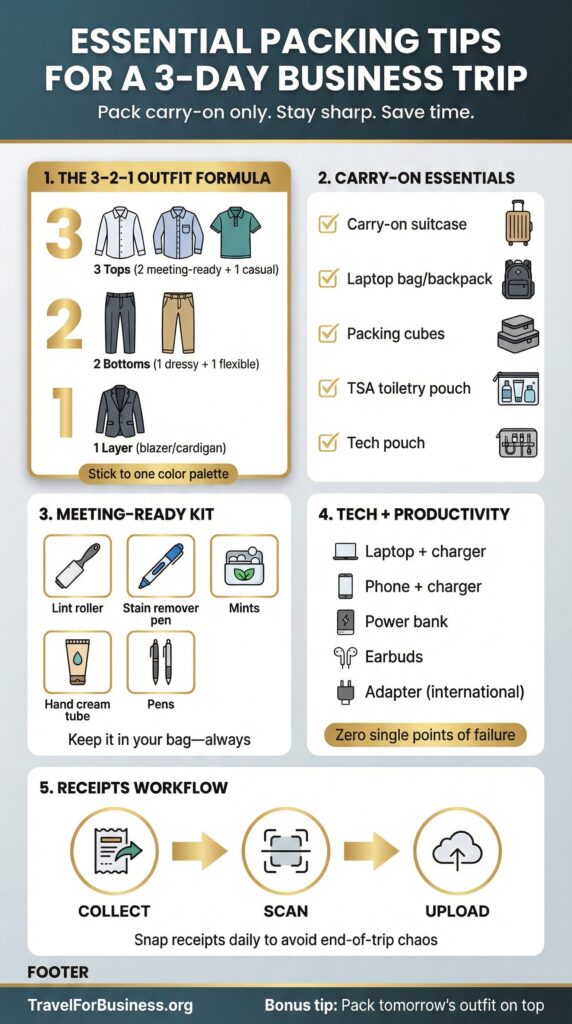
Pack with a “3-2-1” outfit formula
For most business travelers, the biggest packing win is reducing decision fatigue while still looking sharp. Use this simple formula:
- 3 tops (2 meeting-appropriate + 1 travel/after-hours)
- 2 bottoms (1 dressier + 1 flexible)
- 1 layer (blazer, cardigan, or lightweight jacket)
Add one accessory (belt/tie/scarf) that upgrades every outfit, and you’ve got variety without bulk.
Quick example (men):
2 dress shirts + 1 polo, 1 dress trouser + 1 dark chino, 1 blazer
Quick example (women):
2 blouses + 1 knit top, 1 tailored pant + 1 dark jean, 1 structured blazer
Micro-tip: choose a single color palette
Pick neutrals (navy/black/gray) and one accent color. Everything matches, and you can swap pieces without thinking.
Commit to carry-on only (unless you must check).
For a 3-day trip, carry-on is the sweet spot:
- no baggage claim delay
- fewer lost luggage risks
- easier airport transfers
- faster hotel check-in/out
If your company policy allows it, this is the single most reliable way to protect your schedule.
Carry-on essentials checklist:
- 1 primary carry-on
- 1 personal item (laptop bag/backpack/underseat roller)
- 1 slim packing system (cubes + tech pouch)
Carry-on upgrade:
Travelpro Maxlite 5 Carry-On Spinner — Check price & availability on Amazon
Use packing cubes like a “portable filing system”
Packing cubes aren’t just about saving space—they’re about speed. When you land late and need to be ready in the morning, cubes keep you from unpacking your whole suitcase.
Simple cube setup for 3 days:
- Cube 1: business outfits (tops + bottoms)
- Cube 2: underwear/socks/gym/sleep
- Small pouch: chargers/cables/adapters
- Slim folder or garment sleeve: blazer/shirts (optional)
Organization that actually sticks:
Packing Cubes (business-travel friendly) — Check price & availability on Amazon
Want to pack in 2 minutes without overthinking it? Use my 3-Day Business Trip Packing List Builder to generate a clean, carry-on-friendly checklist based on your dress code, weather, and trip add-ons.
Build My 3-Day Packing List →Tip: Pack tomorrow’s outfit on top so you’re meeting-ready even after a late arrival.
Pack a “meeting-ready” kit that lives in your bag
A small kit prevents the most common professional travel problems: wrinkles, dry hands, bad breath, and “I needed a pen.”
Meeting-ready kit (keep it small):
- stain remover pen
- travel-size lint roller
- mints or gum
- hand cream
- pen + backup pen
- pain relief + a couple of bandages
Keep it in the same pocket every trip so you don’t waste time searching.
Win the toiletries game: one pouch, travel rules compliant
The fastest way to lose time is a messy toiletries situation. Standardize it.
Toiletries rules of thumb:
- Use one dedicated pouch (always packed)
- Refill travel bottles after each trip
- Keep liquids TSA/EU security-friendly
- choose multipurpose products (shampoo + body wash, moisturizer + sunscreen)
Pro move: duplicate your basics
If you travel often, buy duplicates (toothbrush, deodorant, chargers) and keep them in your travel kit permanently.
Don’t let tech be your failure point
Tech issues are the #1 productivity killer on short trips. Your goal is “zero single points of failure.”
Tech essentials for 3 days:
- laptop + charger
- phone + charger
- power bank
- universal adapter (if international)
- earbuds (calls + flights)
- 1 cable that covers multiple devices (or a tiny multi-cable)
Add a 2-minute “preflight tech check”
Before you leave home:
- Confirm laptop charges
- Confirm phone charges
- Confirm your hotspot works (or you know hotel Wi-Fi access)
Build a personal item that protects your workday
Your personal item should be a “mobile office,” not a black hole.
Best practice layout:
- front pocket: ID, boarding pass, gum, sanitizer
- quick-access: laptop + notebook
- small pouch: cables + chargers
- side pocket: water bottle
If you prefer rolling instead of carrying (especially with a heavy laptop), an underseat roller can be a back-saver.
Aasy personal item option:
Travelpro Maxlite 5 Underseat Rolling Carry-on — Check price & availability on Amazon
Keep receipts and reimbursement simple from day one
If reimbursement delays annoy you, treat receipts like mission-critical documents. The easiest method: capture each receipt immediately and store it in one place.
Two proven options:
- digital first: scan and upload the moment you get it
- hybrid: keep a single envelope + scan later at the hotel
A portable scanner can drastically reduce the “end-of-trip paperwork pile.”
Tiny tool, huge reimbursement payoff:
Portable receipt scanner — Check price & availability on Amazon
Advanced Strategies
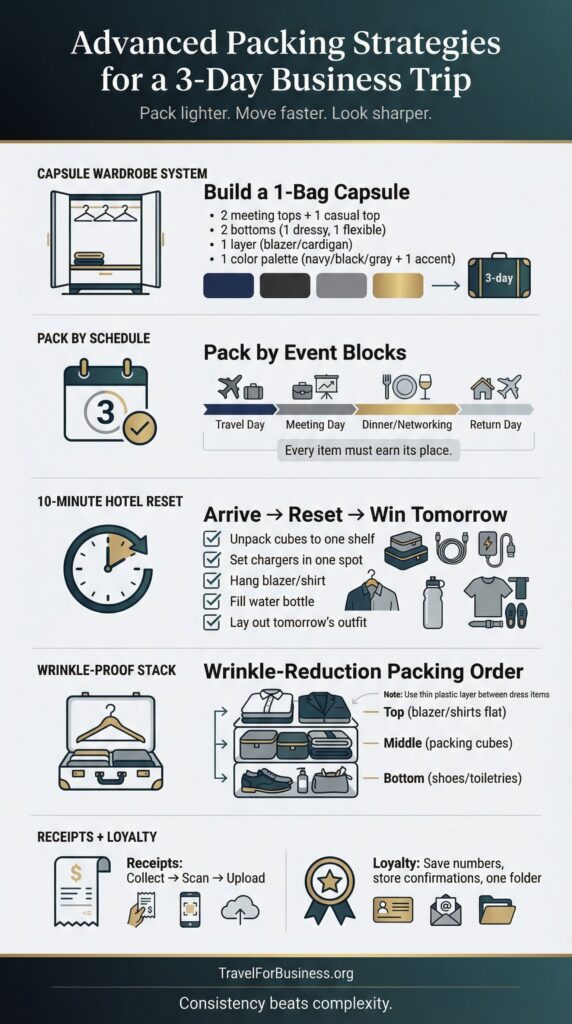
Create a “one-bag capsule wardrobe” that repeats across trips
Frequent travelers don’t pack per trip—they pack a system.
Capsule wardrobe principles:
- 1–2 pairs of shoes max (one dress, one walkable)
- wrinkle-resistant fabrics when possible
- one “upgrade piece” (blazer, structured jacket, polished sweater)
- avoid “maybe” items
Shoe strategy that works
- Wear your bulkiest shoes on travel days
- Pack the lighter pair (or skip the second pair unless you genuinely need it)
Pack for your schedule, not your destination
A 3-day business trip often includes:
- travel day
- 1–2 meeting days
- dinner/networking
- return day
Pack by event blocks:
- “Meeting block” outfit (x2)
- “Travel block” outfit (x1)
- “Dinner block” add-on (one nicer top/accessory)
That’s how you stay light without being underprepared.
Tip: Read the Essential Packing Tips for a 3-Day Business Trip article.
Use a “reset routine” to beat jet lag and stay sharp
Even short trips can wreck your rhythm. Pack with your energy in mind:
Low-effort items that help:
- sleep mask (especially if hotel curtains are weak)
- earplugs
- magnesium (if you already use it at home)
- a small protein snack for late arrivals
- hydration plan (especially on flight days)
10-minute hotel reset (do this on arrival)
- Unpack cubes into drawers (or one shelf)
- Set chargers in one place
- Hang blazer/shirt
- Fill water bottle
- Lay out tomorrow’s outfit
You’ll feel like you gained an hour of life the next morning.
Keep your suitcase “meeting-safe” with wrinkle prevention
Wrinkles happen when clothing shifts and compresses. Fix it with structure:
Wrinkle-reduction stack:
- Heavier items at the bottom (shoes, toiletry bag)
- Cubes in the center
- Blazer/shirts in a folder or laid flat on top
- Use dry-cleaner bags (or a thin plastic layer) between dress items to reduce friction
Optimize loyalty points without overpacking
Loyalty strategy is often lost to “random bookings.” You don’t need a complex setup—just consistency.
Simple loyalty habits:
- Keep one primary airline/hotel when possible
- Store numbers in your phone notes (or wallet card)
- Take photos of booking confirmations
- Keep a single folder for receipts and confirmations
This reduces last-minute scrambling and helps when you need changes mid-trip.
Common Pitfalls
Overpacking “just in case” items
The most common mistake is packing for imaginary scenarios.
Fix: Use a rule:
If you’re not 90% sure you’ll use it, leave it.
Examples:
- extra shoes, “maybe”
- bulky hoodie you won’t wear in meetings
- three backups of the same item
Forgetting the “small but fatal” items
It’s rarely the suit that ruins a trip—it’s the missing adapter, charger, or belt.
Fix: Keep a “never unpack” travel kit:
- chargers + cables
- adapter
- toiletries duplicates
- basic meds
- pen + notepad
This is how frequent travelers stay consistent.
Packing without checking policy and logistics
Corporate travel policies, airline carry-on limits, and client dress expectations matter.
Fix (2-minute pre-check):
- carry-on size allowance
- meeting dress code
- weather (for outerwear and shoes)
- any required ID/security access (mainly on-site visits)
Letting receipts become a post-trip nightmare
Reimbursement delays often come from missing details: dates, amounts, or proof.
Fix:
Capture receipts daily, and label them (hotel, taxi, meals). If your company uses an expense system, upload as you go.
Ignoring comfort and recovery
A 3-day trip is short, but it’s intense. If you don’t sleep well, you’ll feel it.
Fix: Pack one small comfort item:
- sleep mask
- earplugs
- travel pillow (only if it’s truly worth it)
- compression socks on flight days
Expert Advice
Use a “standard packing list” you never rewrite
Rather than creating a new list for each trip, create a master list and make necessary adjustments.
Master list categories:
- clothing (3-2-1 formula)
- toiletries (one pouch)
- tech (with backups)
- documents (ID, cards, confirmations)
- meeting kit (lint, mints, pen)
Copy it into your notes app and reuse it.
Pack your bag the same way every time
This is a productivity hack disguised as packing advice.
Consistency benefits:
- You find things faster
- You lose fewer items
- You reduce stress at security
- You unpack faster at hotels
Even if you change destinations, keep your layout the same.
Invest in gear that saves time (not just looks nice)
For business travel, gear is a tool. Prioritize:
- smooth wheels
- durable zippers
- organized compartments
- lightweight construction
If you want a business-focused “do-it-all” carry-on option beyond a standard spinner, choose one built for work-travel organization.
Business-focused carry-on option:
Business Carry-On — Check price & availability on Amazon
Make day-one easy: pack for the first meeting on top
If you land late and have an early meeting, pack tomorrow’s outfit so it’s instantly accessible:
- top layer in the suitcase
- socks/underwear together
- accessories in the same pocket
You’ll avoid the “hotel unpack tornado.”
Build a “travel day uniform”
Travel days are not fashion shows—they’re logistics. Choose a comfortable, presentable uniform:
- dark jeans or chinos
- breathable top
- lightweight layer
- comfortable shoes
- minimal accessories
It keeps you looking professional while surviving airports and transfers.
Conclusion
A successful 3-day business trip isn’t about bringing everything—it’s about getting the right things in the right system. Use the 3-2-1 outfit formula, keep your kits standardized, make carry-on your default, and treat receipts like part of the job (because they are). When your bag is organized, your mornings get easier, your meetings feel smoother, and you get home with less stress—and fewer reimbursement headaches.
If you want the fastest “level up,” start with organizational tools (packing cubes), then upgrade the parts that save time on every trip: a reliable carry-on, a smart personal item, and a simple receipt-capture system.