
Introduction
If you travel for work, your luggage is part of your productivity system. The right wheels save your shoulders during long airport walks. The proper handle keeps you moving fast between gates. The right compartments prevent laptop scrambles at security, crushed shirts, and that “where’s my receipt?” panic when expense reports are due.
This is the ultimate guide to business travel luggage features—focused on the three things that matter most for real-world work trips: wheels, handles, and compartments (plus the supporting details that separate a “fine” bag from an actual road-warrior upgrade).
Affiliate disclaimer: TravelForBusiness.org participates in affiliate programs, including Amazon Associates, and may earn a commission from qualifying purchases at no extra cost to you.
Understanding the Basics
What “business travel luggage” really needs to do
Business luggage has a different job than vacation luggage. It needs to:
- Move smoothly on ugly surfaces (airport tile, sidewalks, train platforms, hotel carpet).
- Stay stable when loaded (laptop, chargers, shoes, and toiletries can shift weight quickly).
- Keep essentials accessible (ID, laptop, liquids bag, boarding pass, receipts).
- Protect work gear (laptop/tablet, cables, sometimes a second phone).
- Support fast packing/unpacking (1–3 day trips are all about efficiency).
Carry-on vs. checked: why features matter more in carry-ons
Frequent business travelers often prefer carry-on because it reduces time lost at baggage claim and lowers the risk of delays. That makes carry-on features especially important:
- Wheels get used more (you roll it everywhere).
- Handle comfort matters more (you steer constantly).
- Compartments matter more (you live out of them for short trips).
If you want a lightweight spinner that’s popular with frequent flyers because it’s easy to lift into overhead bins, consider the Travelpro Maxlite 5 Carry-On Spinner—Check price & availability on Amazon.
Key Considerations
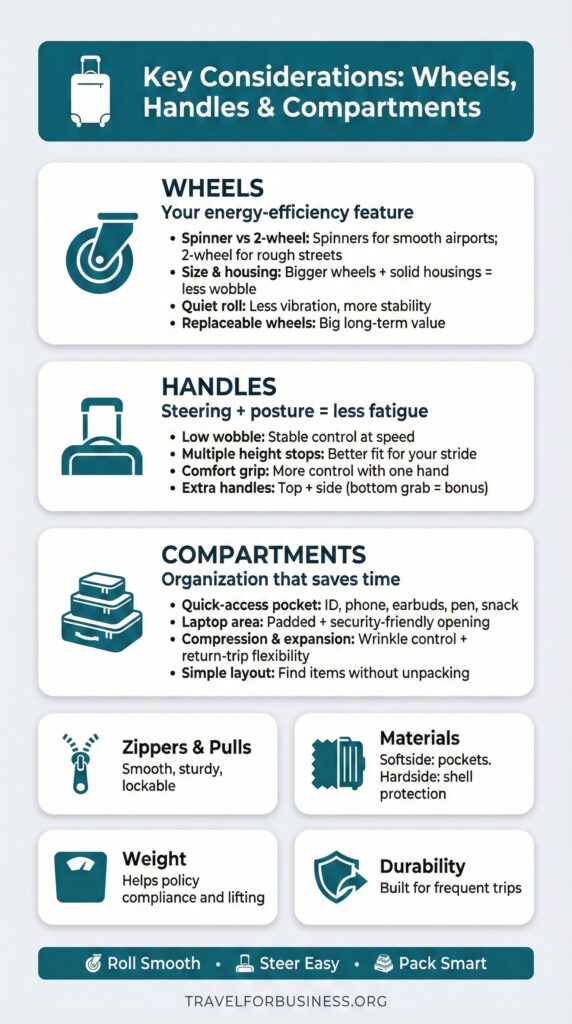
Wheels: your “energy efficiency” feature
Spinner (4 wheels) vs. two-wheel (inline) — which is better for business?
- Spinner (4 wheels): Best for airports, hotels, smooth floors, and tight aisles. You can set it beside you while holding a coffee or responding to a quick message.
- Two-wheel (inline): Often better on rough sidewalks and curbs because larger wheels can handle cracks better (but you’ll pull it behind you, which can fatigue your shoulder/wrist).
Business traveler rule of thumb:
If most of your trips are airport → rideshare → hotel → office, a spinner usually wins. If you regularly walk long city blocks on uneven pavement, a strong two-wheeler can be a more intelligent choice.
What to look for in great wheels
- Wheel size: Slightly larger wheels tend to roll over thresholds and carpet better.
- Wheel housing: Reinforced housings reduce wobble and protect wheels from impact.
- Bearing feel: When you lightly push the bag, it should roll smoothly without grinding or sticking.
- Replaceability: The best long-term value bags often allow wheel replacement (huge ROI).
Quiet wheels matter more than you think
Quiet wheels aren’t just “nice.” They:
- reduce fatigue (less vibration),
- feel more stable at speed,
- and are less annoying in hotels and conference venues.
Handles: the overlooked feature that can ruin a trip
Telescoping handle: the “steering column” of your luggage
A good handle should feel like part of your arm—not a loose antenna.
Look for:
- Minimal wobble when extended (wobble = poor steering and more strain).
- Multiple height stops (2 is okay; 3–4 is better for different body heights).
- Comfortable grip (especially if you often carry a laptop bag on top).
- One-handed control (you should be able to steer while holding a phone).
Handle height and posture = less back and shoulder pain
If the handle is too low, you hunch. If it’s too high, you lose control. The “right” handle height lets you stand upright and walk naturally—key if you’re sprinting between connections or walking long terminals.
Secondary handles are a big deal for real travel
Check for:
- Top carry handle: comfortable and robust (you’ll use it constantly at security and overhead bins).
- Side carry handle: essential for lifting into trunks or train racks.
- Bottom grab handle (optional but great): helps you pull the bag out of overhead bins without awkward twisting.
Compartments: organization that saves time (and shirts)
Your ideal layout depends on your work style
Ask yourself: do you travel like a minimalist, or do you carry “just in case” items?
A minimalist traveler usually needs:
- quick-access pocket,
- laptop/tablet area,
- main compartment with compression straps.
A prepared traveler usually wants:
- a dedicated tech panel,
- separate shoe section,
- internal pockets for small items,
- a place for documents and receipts.
The “quick-access pocket” is the most crucial compartment
This pocket should hold:
- passport/ID,
- boarding pass,
- phone + charger,
- earbuds,
- pen,
- maybe a snack.
The goal: one pocket you can open 20 times per travel day without making a mess.
Laptop compartment: separate, padded, and security-friendly
If you travel with a laptop:
- Look for a padded sleeve that doesn’t dump the laptop when the bag tips.
- Prefer a layout that’s easy to open at security without exposing your entire suitcase.
- Make sure it fits your device, and use a thin case if you have one.
Compression and expansion: the short-trip cheat code
- Compression straps/panel keep clothing tight and reduce wrinkles.
- An expansion zipper is practical when you return with extra items (or when you pack a jacket).
A bag designed for organization-heavy travel can be a significant time-saver—Travelpro’s VersaPack line is built around a smart internal layout, and you can see it here: Check price & availability on Amazon.
Supporting features that still matter
Zippers and pulls: the “failure point” to respect
Frequent use destroys weak zippers. Look for:
- smooth operation (no catching),
- sturdy pulls you can grab quickly,
- lockable zipper pulls if you want to use a TSA-approved lock.
Materials: softside vs. hardside (in one minute)
- Softside: flexible, often has better external pockets, and can squeeze into tighter spaces.
- Hardside: stronger shell protection, often better against crushing, typically fewer exterior pockets.
For a polished, professional softside feel with comfort-forward features, the Travelpro Platinum Elite Carry-On Spinner is a popular upgrade option—Check price & availability on Amazon.
Weight: policy compliance + less fatigue
Airlines and corporate travel policies can be strict. A lighter suitcase gives you more usable capacity (especially when you carry a laptop, charger, and work shoes).
Step-by-Step Guide: Choose the Right Features for Your Trips
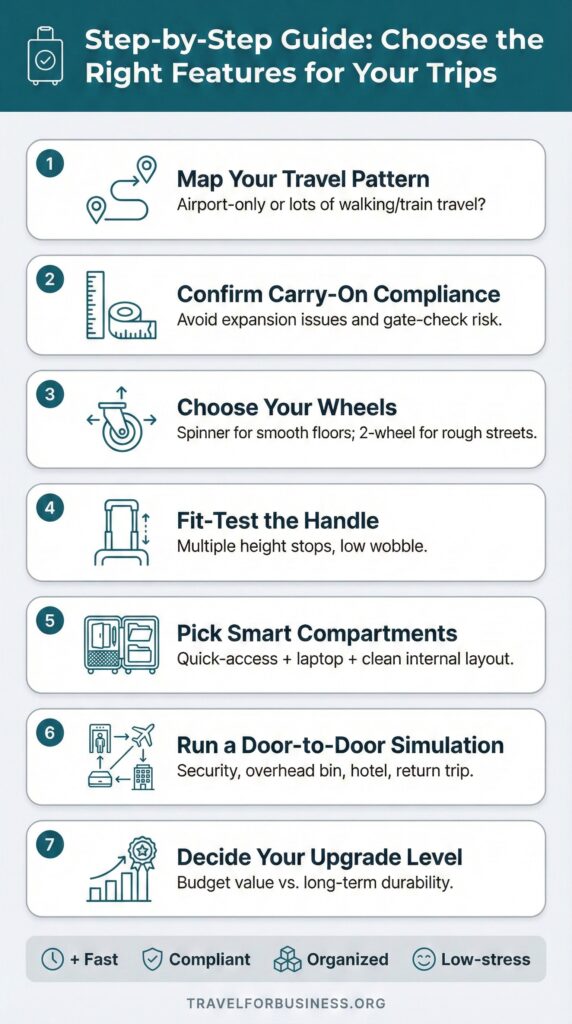
Step 1: Map your real travel pattern (not your ideal one)
Write down your last 5 business trips:
- Did you walk on rough sidewalks?
- Did you take trains?
- Did you have tight connections?
- Did you check a bag or carry on every time?
Your pattern decides your wheel type and handle priorities.
Step 2: Match size and structure to compliance
To reduce gate-check risk:
- choose a bag that’s designed as a carry-on (not “almost carry-on”),
- avoid overstuffing external pockets when boarding (it can push the bag beyond size limits),
- watch expansion zippers—expanded bags can become non-compliant.
Step 3: Pick your wheel system based on surfaces and speed
- Mostly airports/hotels: prioritize a stable spinner.
- Lots of outdoor walking: consider a strong two-wheel.
- Mixed travel: choose a spinner with a solid wheel build and good stability.
Step 4: Fit-test the handle like you fit-test a chair
If you can’t test in person, use these checks:
- Are there multiple height stops?
- Does the handle wobble a lot in reviews?
- Is the grip comfortable-looking and wide enough?
A wobbly handle is one of the fastest ways to hate a suitcase.
Step 5: Choose compartments based on your “grab list”
Make a list of what you pull out during travel:
- laptop
- liquids bag
- headphones
- passport/ID
- receipts
- chargers
Now make sure the bag has:
- a quick-access pocket that fits your grab list,
- a dedicated laptop space if you travel with one,
- internal organization that doesn’t require unpacking everything to locate a single item.
Step 6: Run a “door-to-door simulation”
Imagine the full trip:
- Leaving home (lifting into trunk)
- Airport security (opening laptop/toiletries)
- Gate area (charging devices)
- Overhead bin (lifting and removing one item)
- Hotel (unpacking quickly)
- Return trip (extra items + receipts)
The best luggage features feel invisible during this simulation.
Step 7: Decide if you want an “upgrade-for-life” bag
If you travel often, you may value durability and repair support more than upfront savings. In that “buy once, travel forever” category, Briggs & Riley is a common benchmark—here’s the Baseline Essential Carry-On Spinner if you want to compare: Check price & availability on Amazon.
Expert Tips (Road-Warrior Level)
Use packing systems to make compartments work better
Even the best compartments struggle if your clothing shifts. Packing cubes:
- reduce wrinkles,
- keep shirts separate from gym gear,
- make hotel unpacking take 60 seconds.
If you want a simple, high-impact upgrade that works with almost any suitcase, grab a set of packing cubes—Check price & availability on Amazon.
Build a “ready-to-go” tech pouch
Keep:
- charger + cable,
- multi-port adapter,
- spare earbuds,
- small power bank (if you use one).
This reduces the time you spend digging through compartments during boarding and in rideshares.
Make reimbursement painless with a receipt system
Reimbursement delays are often a process problem, not a policy problem. A dedicated receipts pocket helps—but a fast capture habit helps more.
If you’re tired of losing receipts (or photographing them in bad lighting), a portable receipt scanner is a small tool that can speed up expense reporting—Check price & availability on Amazon.
Jet lag + productivity: let luggage support your routine
A smart compartment layout helps you keep routines on the road:
- a quick-access pocket for sleep mask/earplugs,
- a dedicated spot for toiletries,
- a predictable place for meds/supplements (if relevant to you).
Less friction = better sleep and fewer “where did I put that?” moments at midnight.
Common Mistakes (and How to Avoid Them)
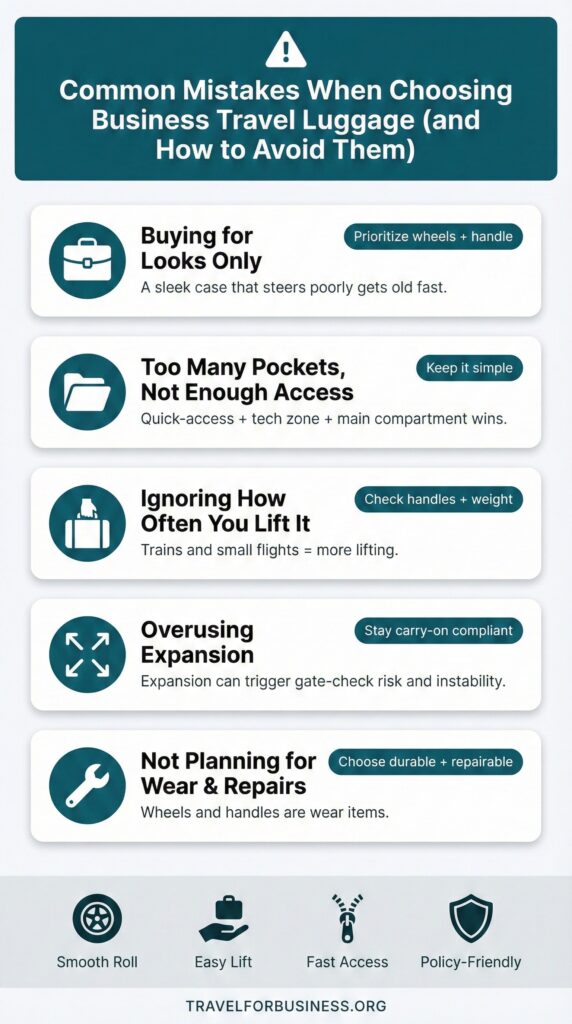
Mistake 1: Buying based on looks instead of wheel/handle quality
A sleek suitcase that steers poorly will annoy you every single trip. Prioritize:
- wheel smoothness,
- handle stability,
- practical compartments.
Mistake 2: Over-optimizing compartments and under-optimizing access
Too many pockets can become a scavenger hunt. You want:
- one fast-access pocket,
- one tech zone,
- one central compartment system.
Mistake 3: Ignoring how you actually lift the bag
If you frequently travel with trains or small regional flights, you’ll lift your bag more often. That makes:
- top and side handles,
- overall weight,
- balance and stability
…far more critical.
Mistake 4: Relying on expansion as your primary packing strategy
Expansion is helpful, but overusing it can:
- break carry-on compliance,
- make the bag unstable,
- stress zippers.
Mistake 5: Not planning for repairs
Wheels and handles are wear items. If you travel often, consider:
- replaceable wheels,
- strong warranty support,
- a brand known for durability.
Conclusion
The best business luggage isn’t the most expensive or the most “premium-looking.” It’s the one that makes travel feel easier: wheels that glide, a handle that steers cleanly, and compartments that keep your work and wardrobe organized without effort.Use this checklist mindset, and you’ll end up with a setup that supports policy compliance, speeds up expense reporting, and reduces travel fatigue—precisely what the ultimate guide to business travel luggage features is meant to help you do.