

Affiliate disclaimer: TravelForBusiness.org participates in affiliate programs, including Amazon Associates, and may earn a commission from qualifying purchases at no extra cost to you.
Navan Review 2026: What It Gets Right (and Where It Doesn’t)
If you’re juggling travel policy, spend visibility, and traveler safety across multiple teams, Navan is designed to remove the “glue work” between booking, paying, and expensing. In this Navan review, I’ll break down what Navan is, how the platform performs in real-world corporate travel scenarios, and which teams are most likely to see ROI.
One quick win that often gets overlooked: expense friction isn’t only software—it’s also the receipt mess and missing documentation that slow approvals. If your travelers still end up with crumpled paper at the end of a trip, a pocket-size scanner can dramatically reduce back-and-forth with finance (drop the portable receipt scanner into your policy “how to expense” section as a practical add-on).
Brand Overview and History
Navan is a business travel and expense management platform (T&E) that consolidates travel booking, payments, and expense reporting into a single experience. The company started as TripActions and later changed its name to Navan, calling itself a “super app” for managing business travel and expenses.
A few credibility signals matter for corporate buyers in 2026:
- Scale & market maturity: Navan says it powers travel programs for thousands of businesses and focuses on an integrated travel and expense model instead of add-on modules.
- Public-company scrutiny: Navan’s IPO and news coverage of it have made it easier to see how the company is growing, losing money, and competing in its category. This is helpful information if you’re trying to figure out how stable a vendor is for a multi-year rollout. (Reuters)
Why the TripActions → Navan change matters: rebrands are often cosmetic, but here it aligned with consolidating the experience (travel + expense + payments) into one workflow—which is exactly where many corporate programs leak time and policy compliance.
Product Range Analysis
Navan is best understood as three tightly connected layers:
1) Navan Travel (booking + policy + reporting)
What it covers: Flights, hotels, and other business travel booking inside a policy-controlled environment with admin tooling around approvals, budgets, and traveler experience.
Policy configuration depth: Navan’s admin help content indicates policy rules can be set around cost, lead time, booking rules, and approval flows—this is key for travel managers who need predictable controls without creating a “call the travel desk” culture.
Approval workflows: If you’ve got different rules for execs vs. field teams (or client-billed vs. internal), the ability to tailor booking review flows by type is a real lever for compliance without slowing down every traveler.
2) Navan Expense (expensing + reconciliation)
Navan positions expense as a modern, automated experience—capture receipts, match transactions, and push clean data to finance. Navan also emphasizes virtual cards and integrated payments to reduce reconciliation gaps between “what was booked” and “what was paid.”
For small business owners and office managers, this matters because the biggest time sink is usually not creating the expense report—it’s fixing it after policy violations, missing receipts, or unallocated transactions show up at month-end.
3) Integrations (ERP/HR/security ecosystem)
This is where Navan can feel either “enterprise-ready” or “yet another silo,” depending on your stack.
Navan publishes a broad integrations catalog spanning HRIS provisioning, SSO/security, accounting/ERP, and duty-of-care tools (risk intelligence and traveler safety providers).
If your finance team lives in NetSuite, Workday, or similar systems, the quality of integration and data mapping is often the deciding factor between a smooth rollout and a long “expense clean-up” phase.
Quality and Performance Testing
Because “does it work?” depends on your policy complexity and traveler mix, here’s a practical way to evaluate Navan like a travel manager would—based on the workflows Navan highlights publicly and what verified-user reviews tend to praise.
Booking experience (traveler speed vs. policy control)
What good looks like: travelers can book quickly without encountering confusing policy friction, while admins still have guardrails (caps, thresholds, approvals, preferred options).
Navan’s policy documentation suggests granular rule settings and approval flows are supported. In practice, the real test is whether “out of policy” options are clearly labeled and whether the traveler understands how to get approval without abandoning the platform.
Field test scenario to run:
- Create a policy with a hotel nightly cap + preferred chain requirement
- Try booking in a high-cost city with limited inventory
- See whether travelers can still find reasonable options without repeated overrides
Expense performance (receipt capture + transaction matching)
Navan’s positioning is strongest when payments and expenses are connected: fewer unmatched transactions, less manual categorization, and faster submission.
Field test scenario to run:
- Book travel in Navan
- Add 5–10 out-of-pocket items (meals, transit, tips)
- Check how fast a traveler can submit a complete report
- Measure how much finance has to “fix” before export
If you want the fastest measurable improvement in submission quality, pair your expense SOP with a simple process tool—like a scanner for paper receipts when travelers can’t reliably photograph them (insert a portable receipt scanner where you explain expense submission standards).
Reporting and spend visibility
Travel managers usually want:
- policy compliance rate
- savings opportunities (preferred inventory usage)
- spend by department/project
- traveler behavior patterns (late booking, premium upgrades)
Navan’s integrated model should help unify these views. Still, your results will depend on consistent traveler adoption and the quality of your integrations in maintaining clean user data (departments, cost centers, projects).
Duty of care and traveler safety
Duty of care is now a board-level topic for many companies. Navan has published content on travel risk practices and references dashboard-style monitoring (e.g., disruptions such as strikes/weather/security incidents) and traveler location visibility via its app when booked through the platform.
What to test:
- Can you quickly identify who is impacted by a disruption?
- Can you message affected travelers immediately?
- Do travelers know where to go for help after-hours?
Customer Service Experience
For executive assistants and global teams, support is often the difference between “great platform” and “never again.”
Navan emphasizes human support and frequent-traveler usability in its public materials, and you’ll see the same themes echoed in user-review ecosystems—ease of booking, smooth expense submission, and a single place to manage both. (G2)
What you should validate during a pilot:
- Response time under pressure: cancellations, missed connections, last-minute changes
- Coverage for international itineraries: time zones and complex routing
- Admin support quality: policy configuration and troubleshooting integrations
If you support high-frequency travelers, consider adding one “traveler-ready” packing standard to your program launch—basic organization tools (like packing cubes) reduce lost items and last-minute rebuys that show up as messy expense noise.
Pricing and Value Assessment
Pricing is where many buyers want a straight answer—and the reality is that “travel + expense” vendors often vary pricing based on headcount, modules, and enterprise needs.
What Navan publishes openly:
- Navan Expense: free for the first 5 monthly expensing users, then $15 per user per month (for companies with 300 or fewer employees, per Navan’s pricing page).
- Navan Travel: Navan notes that for companies with 300 or fewer employees, there’s no cap on the number of trips booked; larger organizations are directed toward a demo-based approach.
For additional market context, third-party vendor marketplaces sometimes estimate “list” vs. “negotiated” pricing for larger deployments—useful as a sanity check when procurement starts negotiating. (Vendr)
How to think about value (by audience)
Corporate travel managers:
Value comes from policy compliance, reduced leakage, consolidated reporting, and duty-of-care confidence—especially if the platform improves adoption versus legacy tools.
Small business owners:
Value comes from time saved and fewer errors: less manual reconciliation, fewer reimbursement arguments, and faster month-end close.
Executive assistants/office managers:
Value comes from speed and reliability: quick changes, fewer approval headaches, clean itineraries, and predictable support.
Project-based consultants/field teams:
Value comes from booking travel quickly, expensing it correctly, and allocating it to the right client/job code without after-the-fact rework.
Pros and Cons Summary
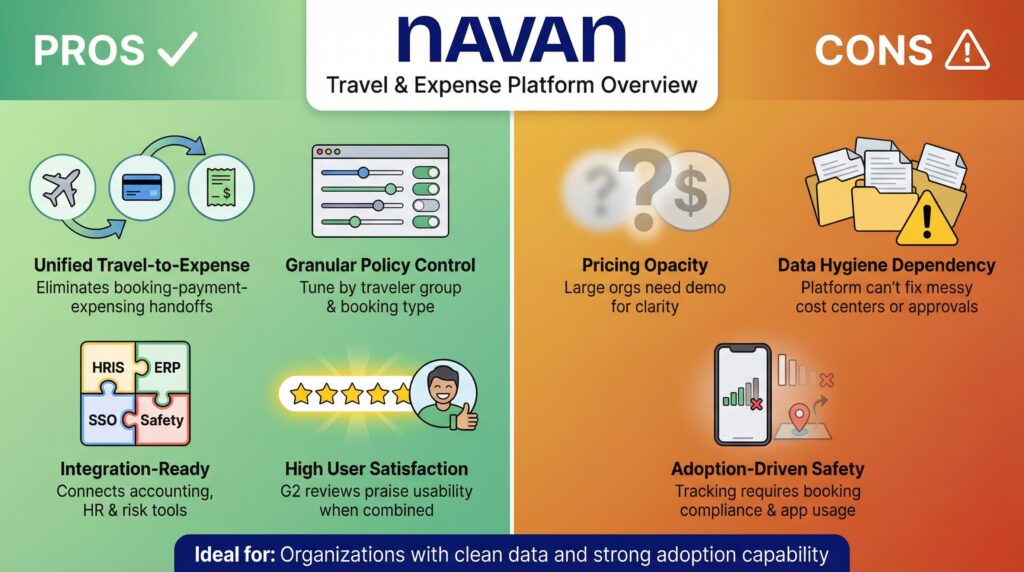
Pros
- Unified travel and expense workflow that targets the most painful handoffs (booking → payment → expensing).
- Granular policy and approval configuration that can be tuned by booking type and traveler group.
- Strong integration story across HRIS, ERP/accounting, SSO, and safety/risk tools.
- Positive user sentiment in review platforms around usability and convenience (especially when travel and expense are used together). (G2)
Cons
- Pricing clarity can be limited for larger orgs until you enter a demo/procurement process (common in this category).
- Implementation success depends on data hygiene (cost centers, departments, approval chains) and integration mapping—if those are messy, the platform can’t “auto-fix” governance.
- Duty-of-care outcomes depend on adoption (traveler tracking and impact dashboards are only as good as booking compliance and mobile usage).
Final Recommendation
Navan is a strong fit for 2026 for companies looking to modernize T&E by making travel booking and expense reporting feel like a single, connected workflow—not two systems held together by policy PDFs and month-end cleanup.
I’d recommend Navan if you are:
- Managing multi-department travel spend and needing consistent policy enforcement without slowing travelers down
- Trying to reduce expense reconciliation time (especially with frequent travel)
- Prioritizing duty of care, real-time visibility, and faster disruption response for traveling teams
- Ready to invest in a structured rollout (SSO, HRIS provisioning, ERP integration) so the platform can automate instead of just “recording” spend
I’d hesitate if:
- You need fully transparent enterprise pricing upfront before any conversations
- Your organization can’t commit to adoption (because incomplete booking compliance limits reporting and safety visibility)
Bottom line: Navan is most compelling when you treat it as a program change—not just a tool swap. Pair the software rollout with small operational upgrades (like a standardized carry-on that keeps tech + documents consistent across trips—see this business-friendly carry-on and you’ll typically see faster compliance and cleaner expense data.