

Affiliate Disclaimer: TravelForBusiness.org participates in affiliate programs, including Amazon Associates, and may earn a commission from qualifying purchases at no extra cost to you.
Quick Answer (TL;DR)
Travel management is the end-to-end process of planning, controlling, booking, supporting, and reporting on business travel to ensure trips run smoothly, costs remain predictable, and travelers remain safe and compliant with company policy.
In practical terms, travel management combines:
- Policy and approvals (who can book what, when, and why)
- Booking and supplier programs (air, hotel, car, rail, ground transport)
- Expense capture and reconciliation (receipts, coding, reimbursement)
- Reporting and analytics (spend visibility, compliance, savings)
- Duty of care (traveler support, risk procedures, disruptions)
A lot of teams discover that their biggest bottleneck isn’t booking—it’s the post-trip receipt chaos that slows reimbursements and wrecks reporting.
Scan receipts in seconds, keep everything organized, and make expense reports faster and audit-proof.
Get the Portable Receipt ScannerUnderstanding the Question
When people ask about travel management, they’re usually experiencing one (or more) of these problems:
Travel spend feels “invisible”
If employees book across different websites and cards, you can’t see total costs clearly—until finance has to close the month.
Booking takes too long
Comparing options, checking policy, aligning schedules, and chasing approvals can turn a simple trip into a time drain.
Policy compliance is inconsistent
Without clear rules (and a process that makes the right choice easy), people book whatever is fastest—even if it’s out of policy.
Travelers need support when disruptions happen
Last-minute cancellations, delays, missed connections, hotel issues, or safety concerns can quickly derail productivity and increase costs.
If you’re wondering what is the meaning of travel management, the simplest way to define it is: a system that makes travel repeatable, governable, and measurable—instead of improvised every time.
Detailed Explanation
Travel management works best when you think of it as a workflow from request → booking → travel support → expenses → reporting.
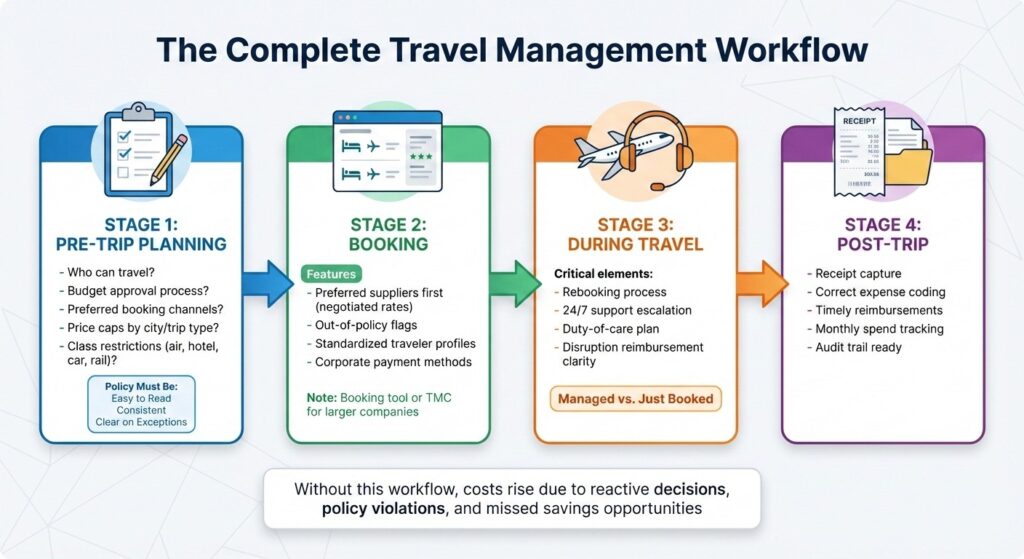
Pre-trip: Planning, Policy, and Approvals
Before anyone books, a strong program answers:
- Who is allowed to travel and for what reasons?
- What’s the budget owner’s approval process?
- What’s the preferred booking channel?
- Are there price caps (by city or trip type)?
- What’s allowed for airfare class, hotels, car categories, and rail?
Why this matters: Many travel cost problems come from avoidable behavior—late booking, premium selections without approval, or bookings outside preferred suppliers.
A solid travel policy doesn’t need to be long. It needs to be:
- easy to read
- consistent
- clear on exceptions (client demands, mission-critical travel, medical needs)
Booking: Reserving the Trip Efficiently (and Within Policy)
Booking is where travel management becomes visible. A well-run booking process:
- pushes preferred suppliers first (negotiated rates, better terms)
- flags out-of-policy choices early
- standardizes traveler profiles (names, loyalty numbers, seat preferences)
- uses consistent payment methods (corporate card, where appropriate)
For small businesses, this might be a simple SOP: “book through X,” “use these filters,” “send approvals to Y,” “attach confirmations to Z.”
For larger companies, it’s typically supported by an online booking tool and, in some cases, by a travel management company (TMC).
During the Trip: Support, Changes, and Duty of Care
This is the part that separates “we book travel” from “we manage travel.”
Travel management includes:
- a process for rebooking and changes
- 24/7 support escalation (even if internal)
- a duty-of-care plan (what happens if a traveler is stranded or unsafe)
- clarity on what’s reimbursable during disruptions
When disruptions hit, teams without travel management pay more because decisions become reactive rather than guided by a playbook.
Post-trip: Expenses, Reconciliation, and Reporting
After the trip, travel management protects your business by ensuring:
- Receipts are captured.
- Expenses are coded correctly (project, client, department).
- Reimbursements are timely and consistent.
- pend is trackable month over month.
- Auditors can follow the trail.
This is where simple organizational tools can meaningfully reduce friction, especially for frequent travelers on multi-city trips.
Packing cubes keep outfits, chargers, and documents separated—so travelers stay organized and productivity stays high.
Shop Packing CubesKey Characteristics of Travel Management
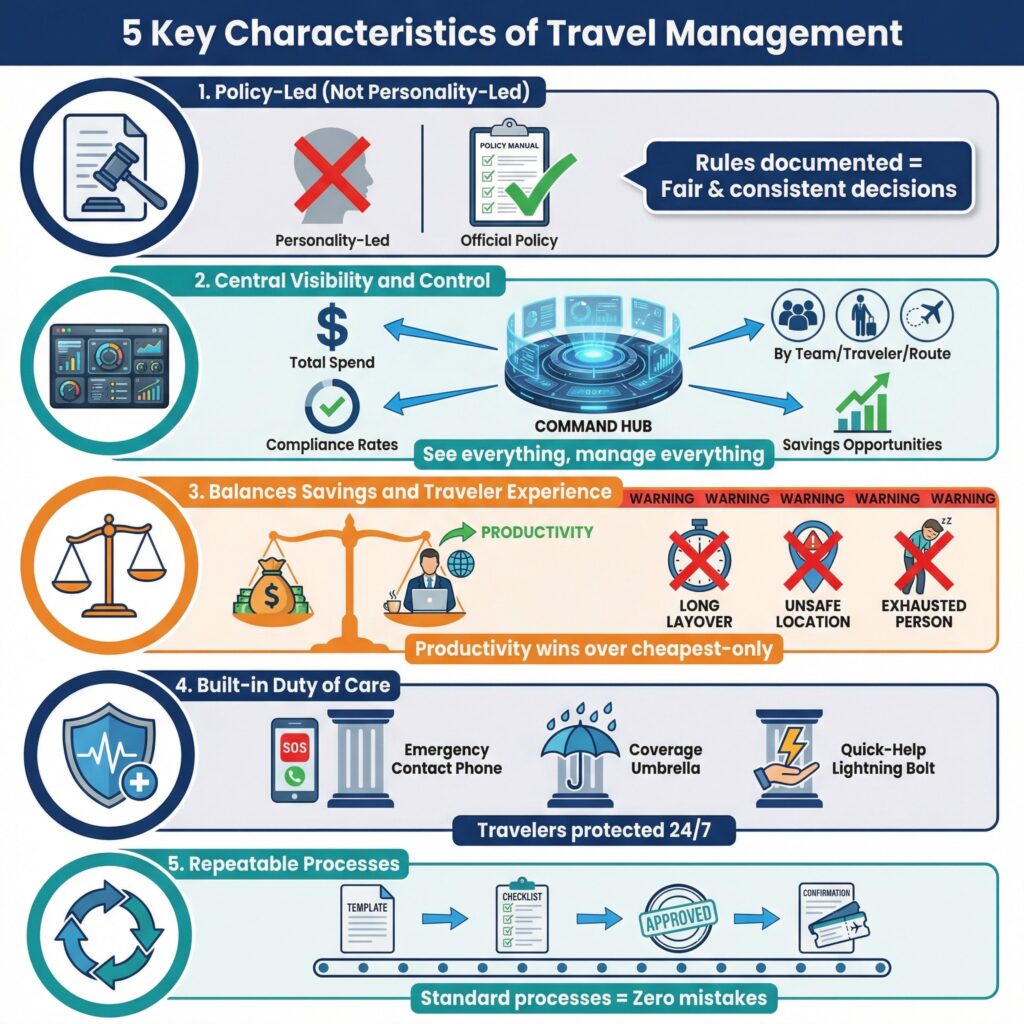
Policy-led (not personality-led)
If rules live in someone’s head, decisions become inconsistent. Travel management documents policies and applies them fairly.
Central visibility and control
You can’t manage what you can’t see. Mature programs centralize data for:
- total spend
- spend by team, traveler, and route
- compliance rates
- savings opportunities
Balances savings and traveler experience
Travel is about productivity. A “cheapest only” approach can backfire—long layovers, unsafe areas, and poor sleep reduce performance.
Built-in duty of care
Travel management makes sure travelers know:
- Who to contact during disruptions.
- What the company will cover.
- How to get help quickly.
Repeatable processes
Repeatability is the hidden advantage—templates, checklists, approvals, and standardized booking behavior prevent mistakes.
Many teams think they’re managing travel well until they measure it. Use the scorecard below to quickly see where your program is strong—and what to fix first for the biggest impact.
Travel Management Maturity Scorecard
Evaluate your corporate travel program in 3 minutes
Step 1: Program Basics
Step 2: Control and Reporting
Step 3: Duty of Care and Support
Your Top 3 Next Actions
Recommended Tools for Travel Managers
Real-World Examples
Example 1: Corporate travel manager (mid-size company)
Problem: Departments book differently; spending reporting is messy; out-of-policy bookings rise.
Solution: Clear policy + preferred suppliers + standardized booking + monthly reporting.
Result: Better compliance and stronger leverage for negotiated rates.
Example 2: Small business owner (10–50 employees)
Problem: Founder approves everything; travelers book inconsistently; reimbursements are chaotic.
Solution: One-page policy + consistent booking channel + receipt rules + simple reporting.
Result: Less admin time and more predictable budgets.
Example 3: Executive assistants and office managers
Problem: VIP preferences, frequent changes, complex itineraries, and last-minute disruptions.
Solution: Traveler profiles + standardized trip briefs + escalation plan + consolidated confirmations.
Result: Faster bookings, fewer mistakes, smoother travel days.
Example 4: Consultants and field service teams
Problem: Multi-stop travel changes often; travel costs spike from last-minute rebooking.
Solution: Flexible policy for critical travel + change playbook + spend reporting by client/project.
Result: Fewer delays, cleaner client billing, and better outcomes.
If your travelers are on the road constantly, the operational basics matter more than most people expect—especially luggage reliability and daily workflow.
A lightweight, dependable carry-on is a simple upgrade that improves every trip—especially for frequent flyers.
Check Travelpro Maxlite 5Benefits and Advantages
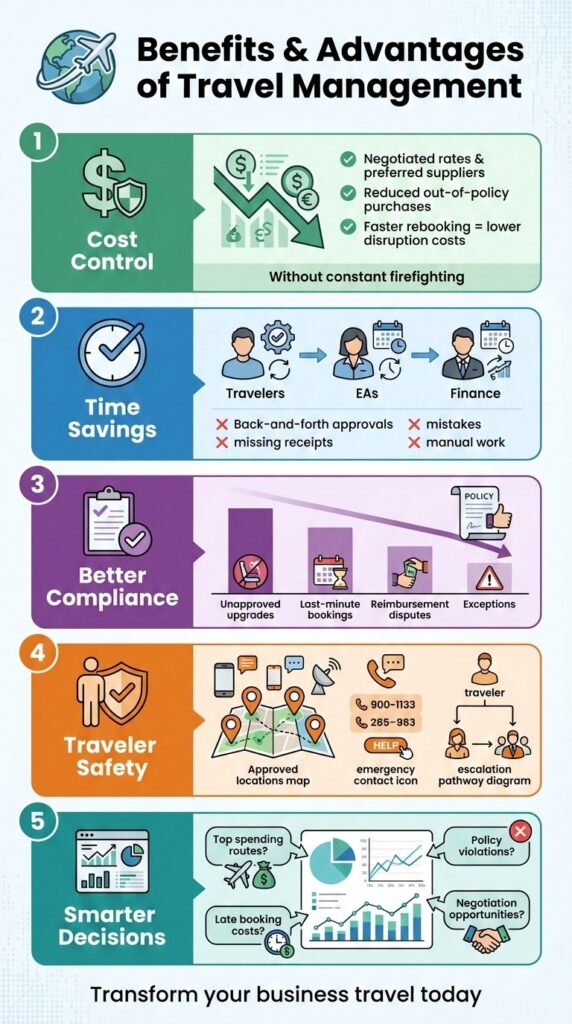
1) Cost control (without constant firefighting)
Travel management reduces spend by:
- increasing booking
- using negotiated rates and preferred suppliers
- reducing out-of-policy purchases
- lowering disruption costs through faster rebooking decisions
2) Time savings for travelers, EAs, and finance
Standard processes reduce:
- approval back-and-forth
- itinerary mistakes
- missing receipts
- manual reconciliation time
A reliable carry-on reduces delays, protects your gear, and keeps frequent travelers moving without friction.
See the Business Carry-On3) Better compliance and fewer “surprises”
When policy is clear and consistently followed, you reduce:
- unapproved upgrades
- last-minute expensive bookings
- reimbursement disputes
- “we didn’t know” exceptions
4) Stronger duty of care and traveler safety
Travel management strengthens safety by defining:
- approved accommodations and locations
- expected communication during disruptions
- escalation paths and emergency procedures
5) Better reporting and smarter decisions
With clean data, you can answer:
- Which routes and cities drive the most spending?
- Are late bookings inflating costs?
- Who is frequently out of policy?
- Where should we negotiate rates next?
If travel costs feel unpredictable, it’s usually because a few small “leaks” add up fast (late bookings, out-of-policy hotels, and changes). The calculator below estimates your monthly leakage and shows which lever will save you the most.
Travel Cost Leak Finder
Discover how much your company may be losing due to avoidable travel management issues
Your Travel Profile
Policy Compliance
Estimated Monthly Cost Leak
Cost Breakdown
Top 3 Recommendations
- Implement advance booking policies (14+ days) to capture better rates
- Negotiate preferred hotel contracts with rate caps
- Use a travel management platform with real-time policy compliance
Recommended Tools to Reduce Travel Costs
Estimates are directional and depend on your travel patterns and supplier rates.
Related Concepts
Travel booking vs. travel management
- Booking = making reservations.
- Travel management = the entire operating system around travel: policy, support, expenses, reporting, and safety.
Travel Management Company (TMC)
A TMC can provide:
- booking support and agent assistance
- after-hours help
- supplier programs and negotiated rates
- reporting and policy tools
Not every business needs a TMC immediately, but as volume grows, it often becomes a practical upgrade.
Corporate travel policy
A good policy is clear on:
- booking channels
- spending limits
- approval rules
- exceptions
- reimbursement and receipt requirements
Expense management
Expense rules and tools turn travel from a financial headache into a measurable, transparent category.
Duty of care/travel risk management
This covers traveler support and safety procedures—especially during disruptions, emergencies, or elevated-risk travel.
Conclusion
Travel management is how organizations make business travel controlled, efficient, compliant, and safe—without turning every trip into a custom project. It integrates policy, booking behavior, support systems, expense workflows, and reporting into a repeatable program that scales with travel volume.
If your team travels frequently, consider where the biggest friction points are. For many organizations, it’s post-trip admin (receipts, reconciliation) and on-the-road reliability (delays, disruptions, and travel gear that fails at the worst time).
If you want stronger materials and a more executive feel, this upgrade is built for frequent business trips.
View Travelpro Platinum EliteFrequently Asked Questions
What’s included in corporate travel management?
Usually: travel policy, approvals, booking, preferred suppliers, traveler support, duty of care, expense reconciliation, and reporting/analytics.
Who owns travel management in a company?
Depends on size. Common owners include procurement, finance, operations, HR, office management, executive assistants, or a dedicated travel manager.
Do small businesses need travel management?
Yes—just a lighter version. A one-page policy and consistent receipt/expense rules can quickly resolve most issues.
What is the duty of care in travel management?
It’s the organization’s responsibility to take reasonable steps to keep travelers safe and supported before, during, and after trips—especially during disruptions.
What’s the difference between a TMC and an online booking tool?
A TMC is a service provider (often including agents and support). An online booking tool is software that helps travelers book in accordance with policy. Many programs use both.
How do you measure whether travel management is working?
Track booking lead time, compliance, change/cancellation frequency, traveler satisfaction, and spend vs. budget—then improve the biggest bottleneck first.
Does travel management include local travel and ground transport?
Yes. Rail, car rental, rideshare, mileage, and local hotel stays are all part of managed travel—especially for regional and field teams.