
Affiliate Disclaimer: TravelForBusiness.org participates in affiliate programs, including Amazon Associates, and may earn a commission from qualifying purchases at no extra cost to you.
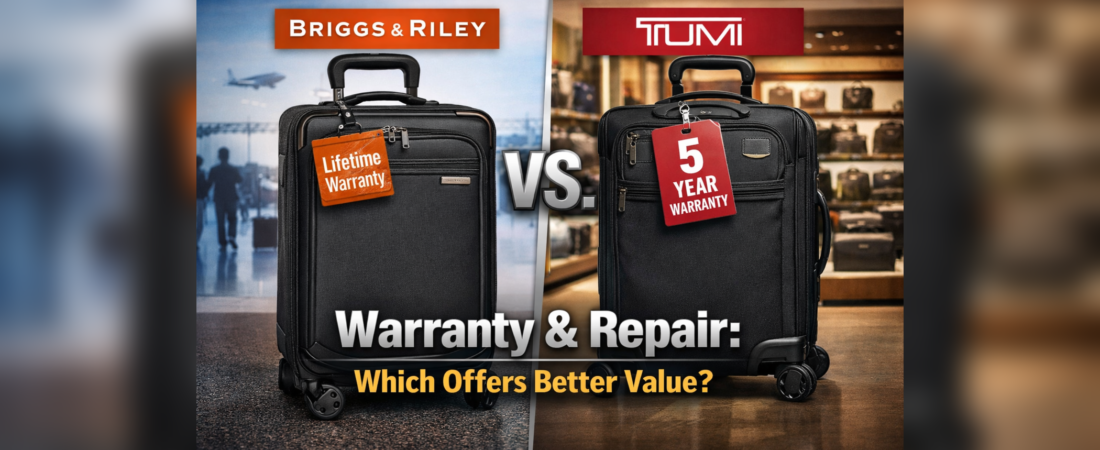
If you travel for work 10+ times a year, a warranty isn’t “nice to have”—it’s downtime insurance. One broken wheel before a client meeting can turn into a same-day scramble, lost time, and an expense report headache.
If you’re a “buy once, keep it for years” traveler, it’s worth checking current pricing on the Briggs & Riley Baseline Essential Carry-On Spinner here. And if you prefer the premium “brand ecosystem” experience (stores, repair intake, matching accessories), take a look at the TUMI Alpha International Office Expandable Carry-On.
Below is the real question this comparison answers: Which brand gives you the lowest total cost (money, time, hassle) over the life of the bag?
Overview
Warranties get marketed like perks, but for business travelers, they’re part of your travel risk management plan. The best value comes from the brand that minimizes:
- Trip disruption (how quickly you can get moving again)
- Out-of-pocket costs (shipping, fees, “not covered” surprises)
- Admin friction (receipts, proof of purchase, eligibility rules)
- Longevity risk (what happens in year 6, 8, 12… when issues show up)
Here’s the core difference in one sentence:
- Briggs & Riley offers a lifetime repair promise for functional damage (including airline damage, if you don’t pursue the airline).
- TUMI provides a time-limited warranty with the most generous coverage in year 1, then narrower rules through year 5—plus proof-of-purchase requirements.
Feature Comparison
Warranty length and eligibility
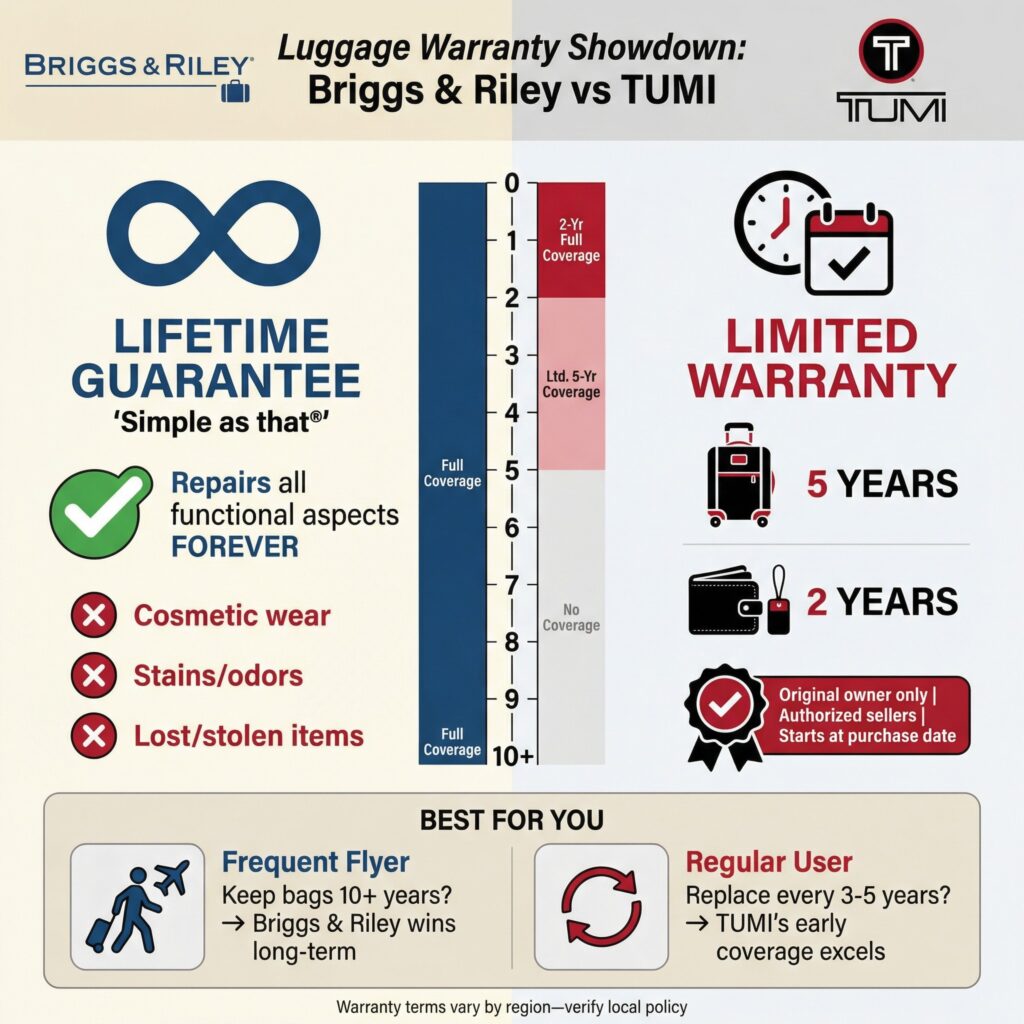
Briggs & Riley: “Simple as that®” lifetime guarantee (functional aspects, for life).
Briggs & Riley states its guarantee covers the repair of all functional aspects of your bag for life. Cosmetic wear, stains/odors, and lost/stolen bags (and contents) are excluded.
TUMI: Limited warranty (typically 5 years for luggage/bags; 2 years for accessories).
TUMI’s warranty terms commonly break down like this:
- Five-year limited warranty for wheeled luggage and many bags
- Two-year limited warranty for certain accessories/small leather goods
Coverage begins on the purchase/delivery date and applies to purchases from authorized sellers; warranty extends to the original owner.
What that means in practice:
- If you keep luggage for a decade (common for frequent flyers), Briggs & Riley’s value often increases over time.
- If you rotate luggage every 3–5 years or want strong “new owner” protection early on, TUMI’s first-year coverage is a standout.
Quick note: warranty rules can vary by region/site language. Always confirm your local policy before relying on a specific clause.
What’s covered (and what’s not)
Briggs & Riley coverage: functional repairs—even airline damage (with a choice).
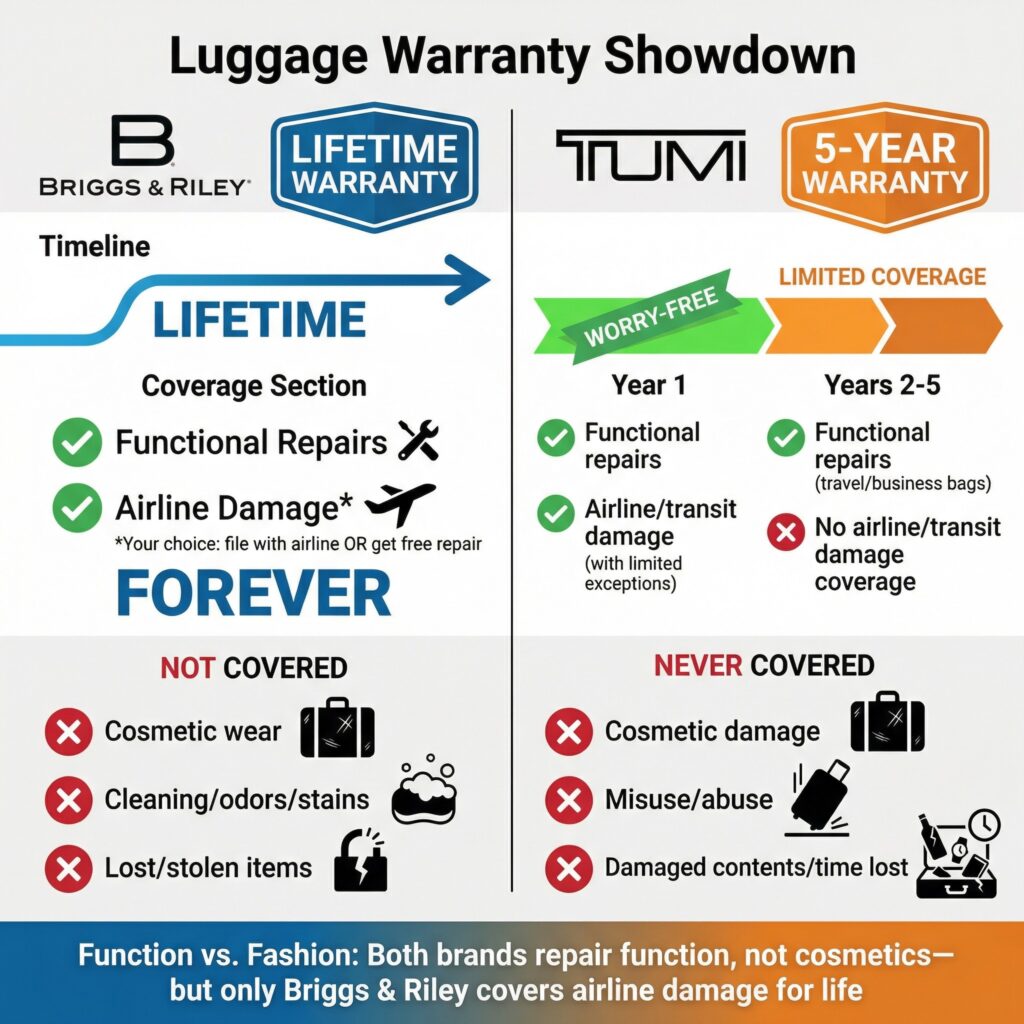
Briggs & Riley explicitly says that if your bag is damaged by an airline and you want to hold the airline responsible, you should file a claim before leaving the airport. If you choose not to and instead want Briggs & Riley to repair it, they’ll repair it at no charge.
Exclusions include cosmetic wear (scratches, dents, scuffs), cleaning due to odors/stains, and lost/stolen bags/contents.
TUMI coverage: strongest in the first year; changes after that.
TUMI describes the first year as “worry-free” coverage that can include airline/transit damage (with limited exceptions).
From years two through five, TUMI coverage continues for many travel and business bags, but transit/airline damage is not covered—those claims should be filed with the carrier.
Also, TUMI excludes cosmetic damage (stains, dents, scratches), misuse/abuse, and incidental/consequential loss (like damaged contents or time lost).
Bottom line: both brands focus on function, not cosmetics—but Briggs & Riley keeps that promise going for life, while TUMI’s scope narrows after year 1 and ends (as warranty) after year 5 for most bags.
Repair network and how repairs actually happen
Briggs & Riley: global repair network + options.
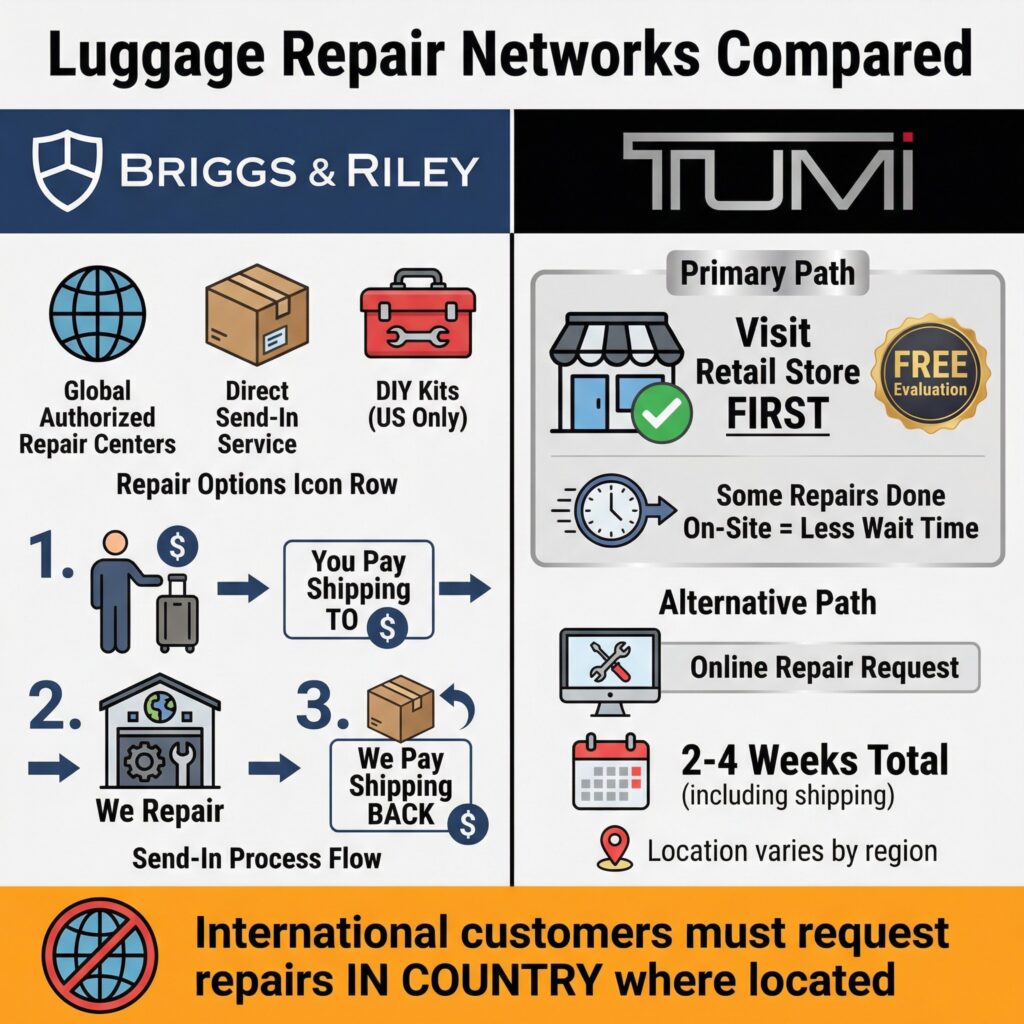
Briggs & Riley lists multiple repair paths, including a global network of authorized repair centers and sending it in to their repair center (and DIY kits for US customers).
For send-in repairs, Briggs & Riley notes you’re responsible for shipping the bag to them, but they return-ship it back to you.
TUMI: store-based intake + online repair flow (often very convenient).
TUMI encourages visiting a retail store first for a complimentary repair evaluation, with some repairs handled on-site to reduce separation time. Online repair requests are also available, and TUMI notes the full process (including shipping) often takes 2–4 weeks, depending on location.
For international situations, TUMI indicates repair requests must be serviced in the country where the request is made.
Proof of purchase and documentation burden
This is where many business travelers feel the difference.
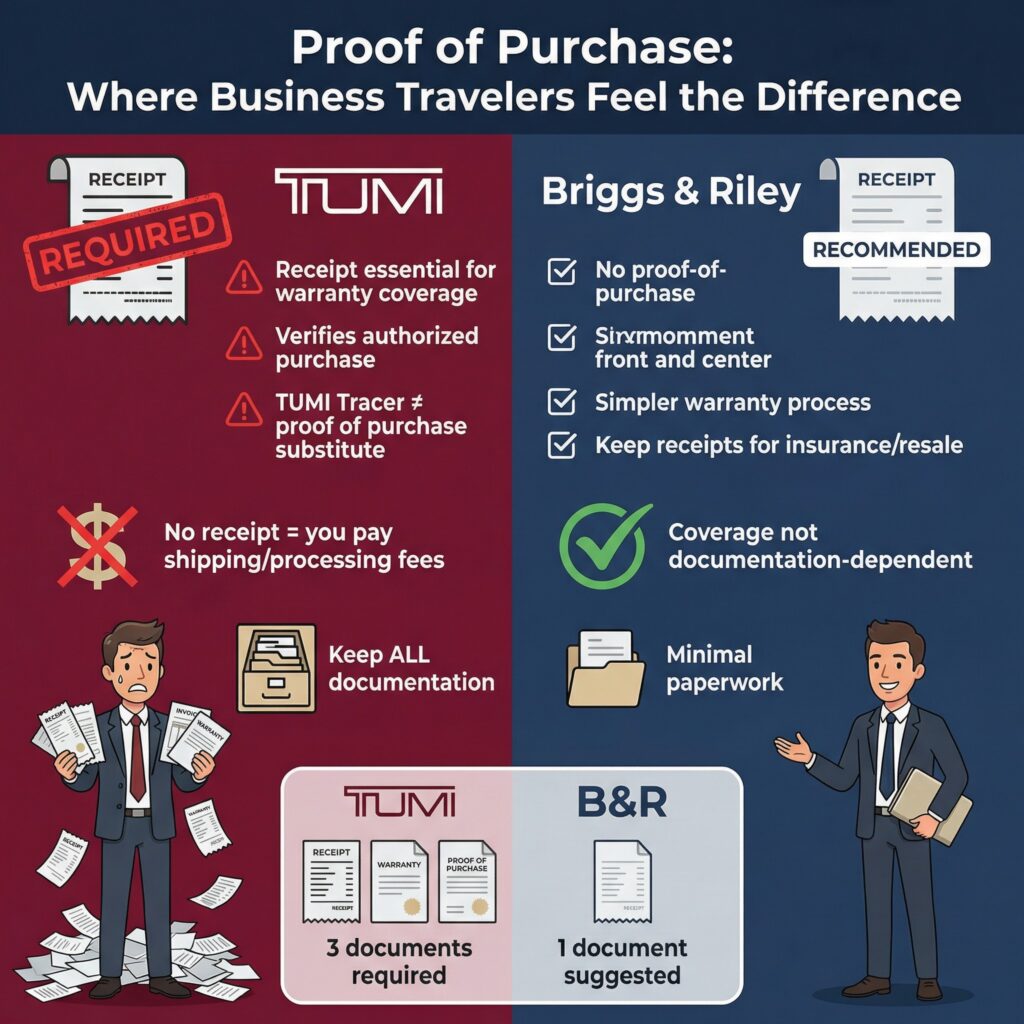
TUMI: Proof of purchase matters.
TUMI’s EU/UK warranty page clearly advises that retaining your receipt is essential to confirm coverage and verify an authorized purchase. TUMI Tracer registration can help record ownership history, but it’s not a substitute for proof of purchase in many situations.
TUMI’s FAQ also notes that without proof of purchase, you may be responsible for shipping/processing fees.
Briggs & Riley: The official warranty language emphasizes coverage rules and repair options, but it doesn’t put proof-of-purchase front and center in the same way. Practically speaking, you should still keep receipts (especially for corporate reimbursement, insurance claims, and resale), but B&R’s promise is designed to be simpler to use over the long haul.
Performance Analysis
Scenario 1: Airline mishandling (the frequent-flyer reality)
If you check bags even occasionally, you know how this goes: cracked wheel housing, bent handle rails, busted corner guard.
Briggs & Riley: gives you a clear fork in the road:
- file with the airline first if you want them responsible, or
- skip the airline hassle, and Briggs & Riley will repair it at no charge.
TUMI:
- Year 1: covers many cases of airline/transit mishandling (limited exceptions).
- Years 2–5: airline/transit damage is not covered; you’re directed to file against the carrier.
Which feels better for road warriors?
If you fly constantly and want fewer “airport paperwork” moments, Briggs & Riley tends to win on stress reduction—because it keeps the option open to bypass the airline claim dance even years later.
Scenario 2: Wear-and-tear failures (wheels, handles, zippers, locks)
This is the most common business-travel failure class: not dramatic, just annoying and disruptive.
Briggs & Riley: covers functional aspects for life (excluding purely cosmetic issues).
TUMI: state coverage includes functional/structural failures due to defects, workmanship issues, and wear-and-tear damage that compromise functionality—especially clear in year 1 and continuing (with limits) through years 2–5 for many bags.
The practical difference:
- If you’re on year 7 and a handle fails: TUMI may still offer repair services, but you should expect costs.
- Briggs & Riley is built for that “year 7, year 12, year 15” reality.
Scenario 3: Repair turnaround and downtime
Time is money—especially when you’re juggling client work, travel rules, and maybe a reimbursement portal that hates surprises.
- Briggs & Riley notes that it takes around 2–3 weeks for repair and return (in the context of submitting a repair).
- TUMI says the complete process (including shipping) typically takes 2–4 weeks, but also highlights that some fixes may be completed in-store.
How to reduce downtime (regardless of brand):
- If you travel weekly, keep a lightweight backup carry-on (even a cheaper one) as an “oh no” option.
- Photograph the damage immediately (at the airport and at the hotel).
- Store receipts and serial/tracer details in a folder you can access on your phone.
Scenario 4: Shipping fees and surprise costs
Here’s where “total cost of ownership” gets real.
Briggs & Riley:
You pay to ship the bag to them (or use discounted label options), and they return-ship it back to you.
TUMI:
- In year 1, TUMI says it covers repair expenses, including shipping to/from the repair facility (with limited exceptions).
- After year 1, TUMI’s FAQ indicates you may be responsible for shipping to TUMI, with return shipping covered if the repair falls under warranty coverage.
- Out of warranty, TUMI notes that you may be responsible for repair/refurbishment costs, plus shipping and processing fees.
The “expense report” angle:
If you’re self-funded or your company reimburses only certain categories, Briggs & Riley’s lifetime repair promise can reduce unpredictable repair bills over many years. If your company reimburses repairs easily and you prefer premium store support, TUMI’s process can feel very smooth.
Price Comparison
To compare values honestly, we need at least one real pricing reference point. Here are the current list of prices from official brand pages (these change, but they show positioning).
Briggs & Riley (Baseline line examples):
- Essential 22″ Carry-On Expandable Spinner: $729 (regular price shown on product page).
- Medium Expandable Spinner: $859 (regular price shown on product page).
TUMI (Alpha / Alpha Bravo examples):
- Alpha International Office Expandable Carry-On 22″: $1,050.00 .
- Alpha Bravo Search Backpack: $850 (leather version).
What this implies for “value”:
- TUMI often sits at a higher MSRP, especially in Europe, which means you’re paying for brand, materials, design, retail experience, and warranty support—but only for a defined period.
- Briggs & Riley sits firmly in the premium, but the lifetime repair guarantee can look better the longer you keep the bag (especially if you’re tough on gear).
If you’re considering a longer-trip spinner where repairability and longevity matter, you can compare the Briggs & Riley Baseline Medium Expandable Spinner here.
And if your “one bag” is actually a tech-heavy backpack that gets abused daily (commute + planes), check the TUMI Alpha Bravo Search Backpack here.
Best For Different Users
Best for corporate road warriors (10+ trips/year)
Pick Briggs & Riley if you:
- want lifetime functional repair coverage (especially beyond year 5)
- want the option to skip airline claim hassles and still get repaired
- treat luggage as a long-term tool, not a fashion cycle item
Pick TUMI if you:
- value store-based intake and the “first year worry-free” coverage (including transit mishandling)
- replace bags every 3–5 years and keep proof of purchase organized
Best for small business owners & entrepreneurs (self-funded travel)
Briggs & Riley often wins on predictability.
A lower chance of paying for major functional repairs years later can make budgeting easier.
TUMI can still win if your brand image matters (client-facing) and you’re comfortable upgrading within the 5-year window.
Best for consultants & independent contractors
If your luggage is a “mobile office,” downtime is brutal. TUMI’s in-store evaluation and potential on-site fixes can be a real quality-of-life advantage.
But if you keep gear forever and don’t want the anxiety of warranty expiration, Briggs & Riley’s lifetime guarantee is hard to beat.
Best for sales pros & field reps (regional travel, tight schedules)
Choose based on your failure pattern:
- Lots of short hops, overhead bin stuffing, daily handling → backpack/soft bag strain (TUMI’s year-1 coverage + store support can help early).
- Frequent checked bags, rough handling, years of wear → Briggs & Riley’s long-run repair promise often pays off.
Final Recommendation
If your definition of “better value” is lowest long-term risk, Briggs & Riley is usually the stronger bet. The lifetime functional repair guarantee—and the explicit stance that they’ll repair airline damage at no charge if you don’t pursue the carrier—maps perfectly to the realities of frequent business travel.
If your definition of “better value” is best early ownership protection + strong retail support, TUMI shines—especially in the first 12 months where coverage is most generous (including airline/transit mishandling in many cases), and with a repair flow built around store evaluation and managed repair intake.
My “choose in 30 seconds” checklist
Pick Briggs & Riley if:
- you keep bags longer than 5 years
- you want maximum long-run repair confidence
- you don’t want airline claims to be your problem
Pick TUMI if:
- you want the strongest first-year coverage and a polished service experience
- you keep proof of purchase and prefer structured warranty rules
- you upgrade luggage on a shorter cycle
And one last practical point for EU readers: TUMI’s EU warranty page explicitly notes your statutory consumer remedies from the seller remain in place regardless of the commercial guarantee.
If you want a “safe bet” carry-on that’s built to be kept, the Briggs option here is the one most travelers start with. If you want the premium “mobile office” carry-on experience, compare it to the TUMI here.