

Affiliate Disclaimer: TravelForBusiness.org participates in affiliate programs, including Amazon Associates, and may earn a commission from qualifying purchases at no extra cost to you.
Quick Answer (TL;DR)
A travel management agency (often called a TMC—travel management company) typically delivers five core functions for business travel:
- Travel policy + compliance management (rules, approvals, guardrails)
- Booking and supplier management (air/hotel/car access, negotiated rates, inventory)
- Expense capture and reconciliation support (receipts, itemization, reporting readiness)
- Traveler support and duty of care (24/7 help, disruptions, risk/safety workflows)
- Reporting and optimization (spend visibility, savings, vendor performance, KPI tracking)
If you’re trying to tighten reimbursement and audit readiness quickly, start with cleaner receipt capture on the road—something as simple as a portable receipt scanner can remove a huge amount of friction for travelers and finance.
Understanding the Question
When people ask “what are the 5 basic functions of a travel management agency?” they usually want the operational answer—not a vague “they book travel.”
A travel management agency sits between:
- Your travelers (employees/contractors),
- Your company rules (policy, budgets, approvals),
- Suppliers (airlines, hotels, rental cars, rail, rideshare),
- Finance/procurement (spend control, data, reconciliation),
- Risk/security (duty of care, traveler tracking, incident response).
The “five functions” are the repeatable jobs that make business travel predictable, compliant, safer, and measurable.
Detailed Explanation
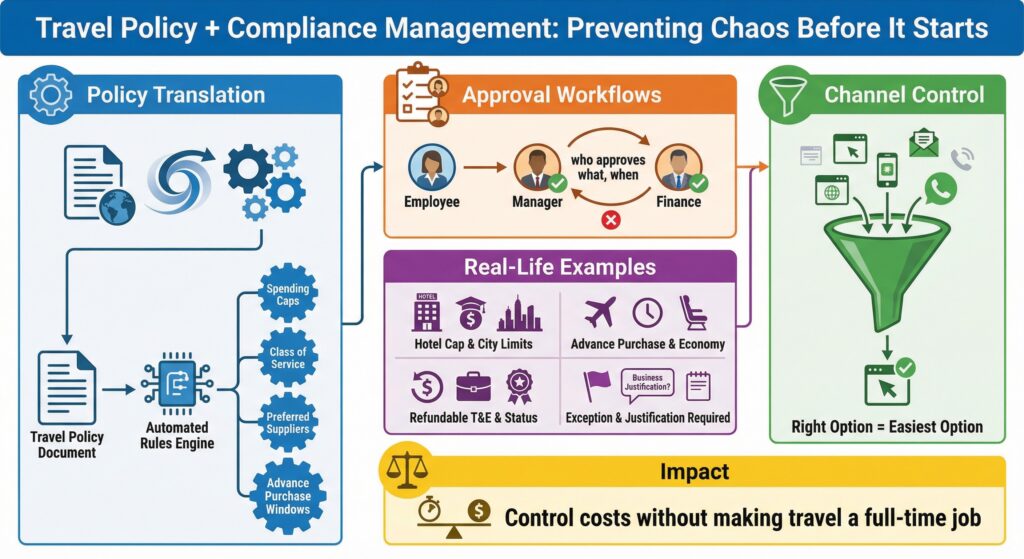
1) Travel policy + compliance management
This is the function that prevents chaos before it starts.
A strong travel management agency helps you:
- Translate your travel policy into bookable rules (caps, class of service, preferred suppliers, advance purchase windows).
- Implement approval workflows (who needs to approve what, and when).
- Reduce “off-channel” bookings, which are reservations made outside of preferred booking channels, by making the right option the easiest option.
What this looks like in real life
- Setting hotel nightly caps by city
- Enforcing economy class under X flight hours
- Requiring refundable fares for certain traveler types (execs, field service)
- Flagging out-of-policy choices with a business justification prompt
Why it matters
Policy is how you control cost without turning travel into a full-time job for your team.
2) Booking and supplier management
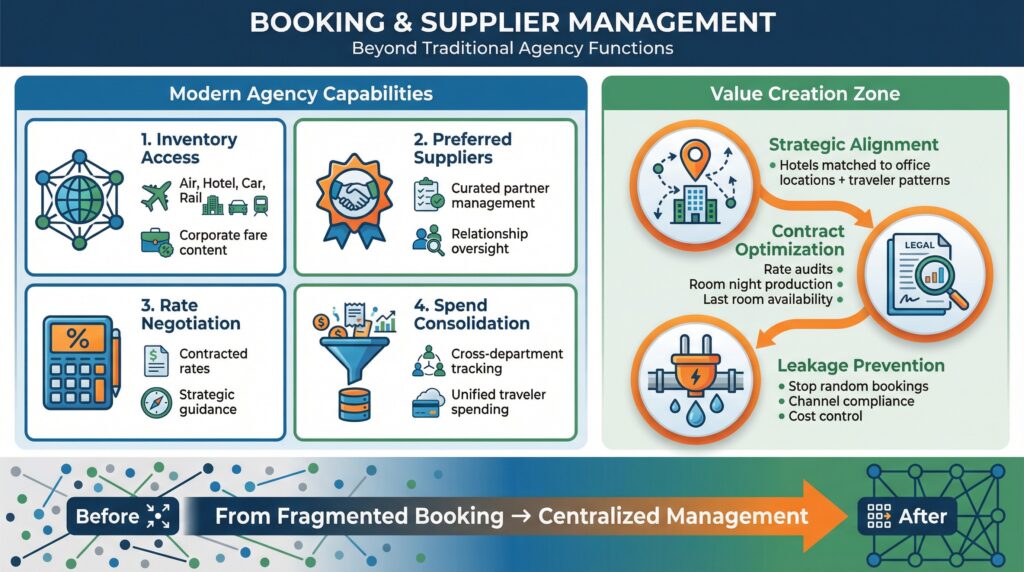
This is the traditional “agency” function—but modern agencies do far more than just booking.
A travel management agency typically provides:
- Access to inventory (air/hotel/car/rail) and corporate fare content
- Management of preferred suppliers
- Support for negotiated rates (or guidance on when it’s not worth negotiating yet)
- Consolidation of travel spending across departments and traveler types
Where they create value
- Aligning preferred hotels with office locations and traveler needs
- Helping you structure contracts and rate audits (e.g., room night production, last room availability)
- Fixing leakage (people booking random hotels because it “looked easiest”)
A practical travel-manager hack
Traveler adoption often improves when the agency helps standardize the “go-to” setup for frequent flyers: a dependable carry-on and organization system reduces missed items, late departures, and repacking stress. If your team lives out of a carry-on, a business-focused carry-on like this is a solid baseline, and packing cubes make standardizing “what goes where” ridiculously easier.
3) Expense capture and reconciliation support
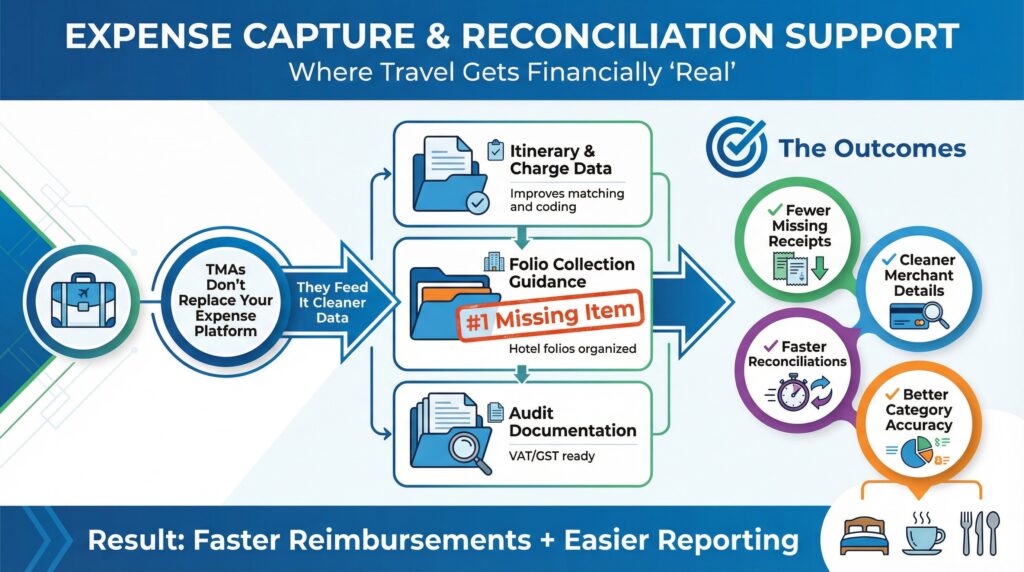
This is where travel gets financially “real.”
Most travel management agencies don’t replace your expense platform—but they feed it cleaner data and reduce the messy parts that slow reimbursements and reporting.
They help with:
- Itinerary and charge data that improve matching and coding
- Folio collection guidance (hotel folios are the #1 missing item in many orgs)
- Better documentation for audits and VAT/GST considerations (where relevant)
What do you want here
- Fewer missing receipts
- Cleaner merchant details
- Faster reconciliations
- Better category accuracy (hotel vs incidentals vs meals, etc.)
A simple operational upgrade
If travelers are constantly losing paper receipts, your policy can require “scan within 24 hours.” That’s realistic when travelers use a small scanner or even just a consistent capture habit—finance will feel the difference immediately.
4) Traveler support and duty of care
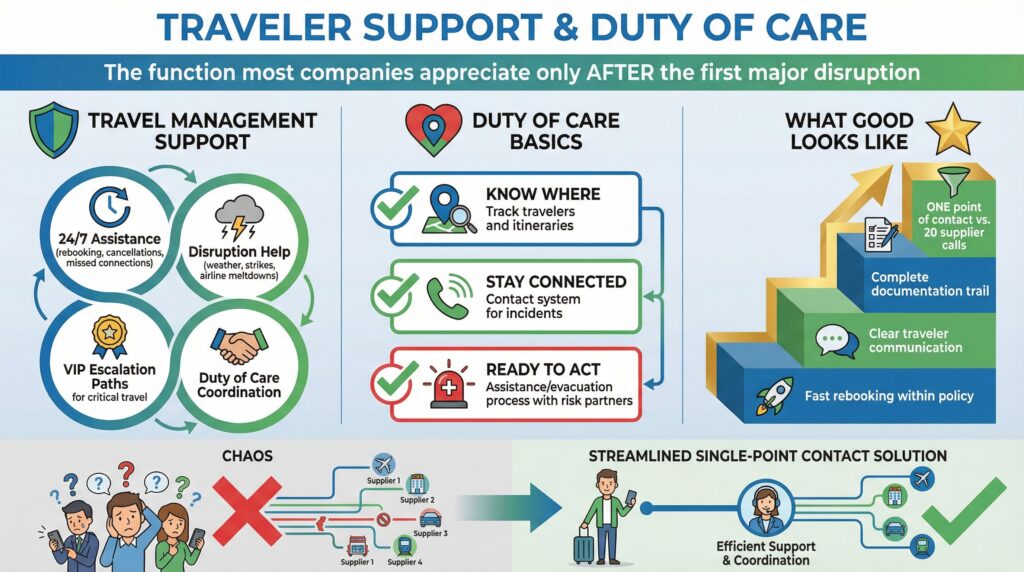
This is the function most companies only appreciate after the first major disruption.
Travel management agencies support:
- 24/7 assistance for rebooking, cancellations, and missed connections
- Help during disruptions (weather events, strikes, airline meltdowns)
- Escalation paths for VIPs or critical travel
- Duty of care coordination (depending on the provider and your setup)
Duty of care basics
Duty of care means you:
- Know who is traveling and where they are (at least at a “travel itinerary” level)
- Have a way to contact travelers in an incident
- Have a process to assist or evacuate when necessary (often in partnership with risk/security tools)
What good looks like
- Fast rebooking that respects policy
- Clear communication to travelers
- Documentation for what happened and why changes were made
- A “single throat to choke” during disruption (instead of 20 people calling 20 suppliers)
5) Reporting and optimization
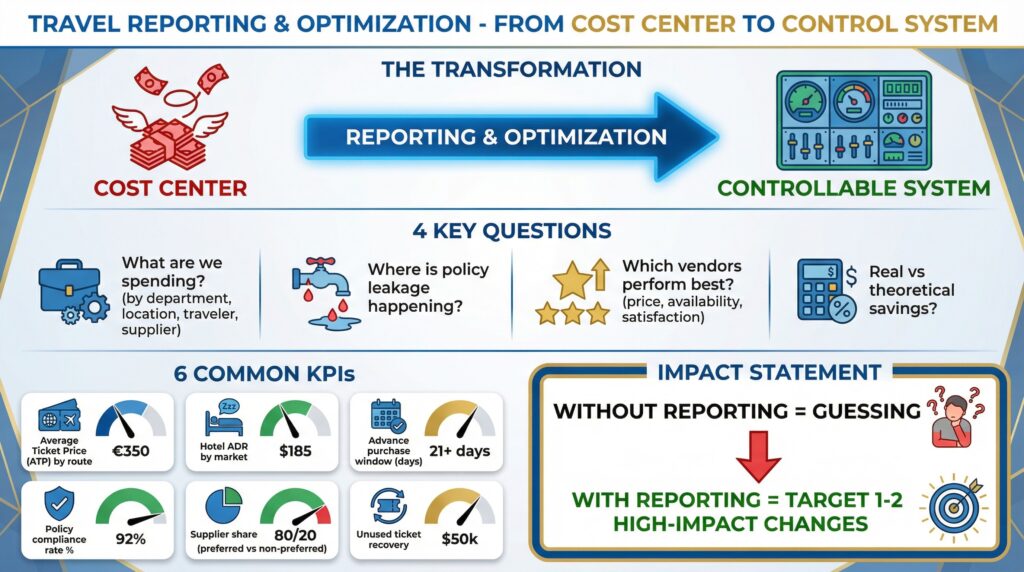
This is what turns travel from a cost center into a controllable system.
A travel management agency should help you answer:
- What are we spending per department, location, traveler, and supplier?
- Where is policy leakage happening?
- Which vendors are performing well (price, availability, traveler satisfaction)?
- What savings are real vs. theoretical?
Common KPIs
- Average ticket price (ATP) by route
- Hotel average daily rate (ADR) by market
- Advance purchase window (days booked before travel)
- Policy compliance rate
- Supplier share (preferred vs non-preferred)
- Unused ticket value recovery (where applicable)
Why it matters
Without reporting, you’re guessing. With reporting, you can target the 1–2 changes that drive the biggest impact.
Key Characteristics of a High-Quality Travel Management Agency
Proactive (not reactive)
They don’t wait for problems; they build guardrails (policies, approvals, preferred options) so problems happen less often.
Tech-enabled (but human when it counts)
You want automation for routine bookings and a real expert for complex trips and disruptions.
Transparent on fees and service levels
Clear service definitions: what’s included, what costs extra, what happens after hours, and what SLA you get.
Strong supplier ecosystem
They should be able to explain how they access content, manage rates, and reduce leakage.
Reporting that matches how your business runs
If reporting can’t map to your cost centers, departments, projects, or travelers, it won’t drive action.
Real-World Examples
Example 1: Small business with 25 travelers (owner and office manager running travel)
Problem: Too much time booking and chasing receipts; reimbursement delays.
How the 5 functions help
- Policy: Establish preferred hotels close to client sites and simple caps.
- Booking: Stick to 2-3 hotel brands and one airline strategy.
- Expense: Folios and receipts must be scanned within 24 hours.
- Support: After-hours support for disruptions saves workdays.
- Reporting: Create a monthly snapshot of each traveler and project to improve client billing.
Result: Less admin load and fewer “surprise” expenses.
Example 2: Consulting firm with project-based travel (200+ trips/month)
Problem: Fragmented spending, policy leakage, and inconsistent traveler experiences.
How the 5 functions help
- Policy: The approval process for premium cabins and short-notice bookings.
- Booking: Preferred hotel program by market, plus negotiated last-minute availability.
- Expense: Charges are more closely related to traveler and project codes.
- Support: Dedicated assistance for VIP/critical client travel.
- Reporting: Route-level airfare tracking, hotel ADR by city, and compliance scorecards.
Result: Spending becomes measurable, and leadership finally trusts the numbers.
Example 3: Field service team traveling to unpredictable sites
Problem: Safety, last-minute changes, and operational disruption.
How the 5 functions help
- Policy: Flexible fare rules for specific traveler profiles.
- Booking: Quick booking with supplier consistency to reduce delays.
- Expense: Standardized documentation avoids reimbursement chaos.
- Duty of care: A procedure for tracking travelers and escalating incidents.
- Optimization: Identify repeat routes/sites to pre-negotiate lodging and transportation.
Result: Less downtime and faster response during disruptions.
Benefits and Advantages
Cost control without micromanagement
Policy, preferred suppliers, and reporting create scalable guardrails.
Time savings for travel managers, EAs, and finance
Less manual shopping, fewer receipt chases, and faster reimbursements.
Better traveler experience
When travelers know the system will support them, adoption goes up—and so does compliance.
Reduced risk exposure
Duty-of-care workflows matter when things go wrong.
Better decisions through data
Reporting helps you focus on the few changes that drive the biggest savings.
Related Concepts (So You Don’t Get Tripped Up)
Travel management agency vs. traditional travel agency
- Traditional travel agency: leisure-focused, trip-by-trip service
- Travel management agency: business-focused, policy + reporting + risk + spend control
Online booking tools (OBTs)
Many travel management agencies pair their service with an online booking experience so travelers can self-serve within policy.
Expense management platforms
Your expense tool tracks and reimburses; the travel agency improves upstream data quality and compliance.
Duty of care and traveler tracking
Your expense tool may be delivered through partners, or it may be integrated into the stack. The important part is your process, not just the tool.
“Preferred suppliers”
Vendors you steer volume to because they deliver value (rates, flexibility, service, safety, consistency).
Conclusion
So, what are the 5 basic functions of a travel management agency? They manage policy, booking/suppliers, expense readiness, traveler support/duty of care, and reporting/optimization—the five jobs that turn business travel into a controllable system instead of a recurring fire drill.
If you want a quick, practical starting point while you evaluate agencies, standardize the traveler setup (carry-on + organization) and tighten receipt capture. A lightweight, reliable carry-on like the Travelpro Maxlite 5 plus packing cubes and a simple receipt scanner habit will immediately reduce friction for both travelers and finance—even before you overhaul your program.
Frequently Asked Questions
1) Is a travel management agency the same as a TMC?
In practice, yes. “Travel management agency” and “TMC” are commonly used interchangeably to refer to corporate travel providers that manage policy, bookings, support, and reporting.
2) Do we need a travel management agency if we only have 10–20 travelers?
If travel is frequent and messy—yes, it can be worth it. The break-even usually comes from saving time, fewer booking mistakes, and better compliance (not just lower prices).
3) Will a travel management agency always get cheaper fares?
Not always. The biggest wins are often policy compliance, reduced leakage, better supplier choices, and fewer disruption losses (missed meetings cost more than a $40 fare difference).
4) What should we ask when comparing providers?
Ask about: service levels and after-hours support, policy controls, reporting depth, supplier content access, traveler adoption strategy, and how they handle disruptions.
5) How do travel management agencies help with the duty of care?
They support itinerary visibility and traveler-assistance workflows and may integrate with risk providers. The key is to have a clear internal escalation process and a traveler communication plan.
6) What’s the fastest way to improve compliance without making travelers miserable?
Make the compliant option the easiest: pre-approved preferred hotels, clear booking paths, and simple receipt capture rules. Convenience beats enforcement.
7) What’s the biggest mistake companies make with corporate travel?
Treating travel as “just booking” rather than as a system is the biggest mistake companies make with corporate travel. Without policy, data, and support, you’ll always struggle with spending, compliance, and traveler experience.