

Introduction
Learning how to travel for work in a way that works for you can change your professional life, whether you are closing deals all over the country or running projects all over the world. In the U.S. alone, business travel costs more than $340 billion a year. However, many professionals struggle to follow corporate travel rules, track expenses, and remain productive when away from the office.
This complete guide to travel for business will teach you everything you need to know about business travel, from how to make the most of your loyalty points to how to stay healthy and productive while you are on the road. To maintain your health routines, consider packing portable exercise equipment, staying hydrated, and adjusting your sleep schedule to reduce jet lag. No matter how many business trips you have been on or how many you are about to go on, you will find helpful tips to make each trip easier, cheaper, and less stressful.
Understanding the Basics
What qualifies as Business Travel?
Business travel refers to any trip taken for professional objectives while away from the primary workplace. This includes customer meetings, conferences, training sessions, site visits, sales calls, and networking events. Understanding what qualifies helps ensure accurate expense classifications and tax deductions.
Corporate Travel Policies 101
Most companies have detailed travel policies that include how to arrange a trip, how much money you can spend, which vendors they prefer, and when you can get a refund. Get to know the following things before your first trip:
- Pre-approval requirements for flights, hotels, and rental cars.
- Per diem rates are provided for meals and incidental expenses.
- Preferred supplier programs that may offer corporate discounts.
- Documentation requirements for expense reports.
- Booking windows (how far in advance you must book).
Types of Business Travelers
Knowing your travel profile helps you plan your trip better:
Corporate travelers often use company-managed travel with established partnerships and premium class options. Their goal is to maximize efficiency while preserving elite status.
Small business owners pay for their travel and must balance keeping costs down with maintaining a professional appearance. The bottom line is immediately affected by every dollar spent.
Consultants and contractors often travel for work on a project basis and are paid by the client afterward. They need to track their expenses and offer flexible booking options carefully.
Sales professionals have to travel to different parts of the country on a limited budget, so they need to plan to get the most face time with clients while spending the least money.
Key Considerations
Booking Strategies That Save Time and Money
Smart booking is the first step to making business travel successful. If you book your tickets 21 to 60 days in advance, you will usually get the best rates for domestic travel, according to industry data. You should book your flights 60 to 120 days in advance if you are going abroad.
To keep all your bookings in one place, keep track of your spending, and make sure you follow company rules, you might want to use a full travel management tool like TravelPerk, Navan, or TripIt. When selecting these platforms, consider your company’s size and travel volume to choose the most effective solution. These platforms can help you find the best rates, manage itineraries, and automate expense tracking, saving you time and money. Companies can save 20–30% on travel costs with these tools.
Consider these booking strategies:
- Tuesday and Wednesday departures are often 15–20% less expensive than Monday flights.
- Midday flights are less likely to be delayed or cancelled due to bad weather in the morning.
- Direct flights save time and reduce stress, even though they are slightly more expensive.
- Airport hotels are ideal for early flights or tight connections.
Maximizing Loyalty Programs
Making reservations on different platforms can make your loyalty rewards less valuable. The most important thing is to focus strategically:
Hotel Programs: Pick one or two big chains where you can become an elite member. Complimentary breakfast, hotel upgrades, and late checkout are just a few of the perks that may make your trip much better.
Airline Programs: To reach a higher status faster, focus your spending on a single alliance, such as Star Alliance, OneWorld, or SkyTeam. Being an elite member means priority boarding, nicer seats, and not paying fees worth hundreds of dollars each year.
Credit Card Strategy: Use a premium travel rewards card for all business expenses to earn points on everything.
Get the most out of your business travel rewards with a high-end travel credit card like the Chase Sapphire Reserve or the American Express Business Platinum. These cards give you 3 to 5 times the points on travel purchases, let you into airport lounges, and give you other applicable travel protections.
Managing Expenses Efficiently
Poor expense management is one of the top frustrations for business travelers. Create a system that works:
- Photograph receipts immediately using your expense management app.
- Log expenses daily rather than waiting until you return.
- Separate business and personal charges using dedicated payment methods.
- Track per diem allocations to avoid overspending or leaving money on the table.
- Submit reports promptly to speed up reimbursement.
Modern expense management tools like Expensify and Concur can automate much of this work by scanning receipts, categorizing them, and verifying they comply with the rules.
Step-by-Step Guide to Planning Business Travel
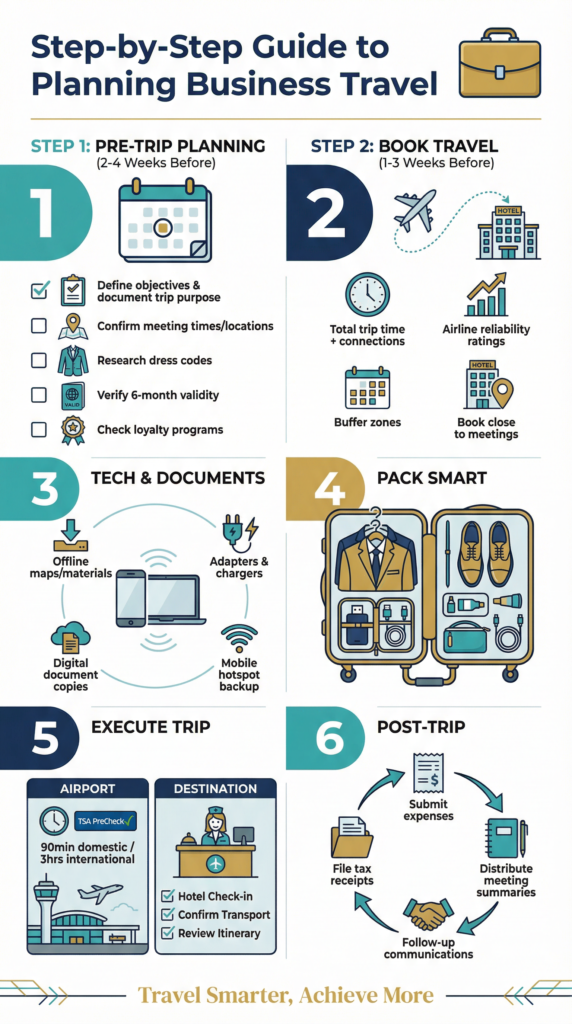
Step 1: Pre-Trip Planning (2-4 Weeks Before)
Begin with specific objectives. Why are you going on a trip? What results make the time and money worth it? For tax and expense report purposes, write down the reason for your business.
Create Your Checklist:
- Make sure you know when and where the meetings are.
- Look up the dress codes for the client or venue.
- Make sure your passport is still valid (it needs to be for at least six months for international travel).
- Go over the rules for corporate travel.
- Find out which airlines and hotels give you loyalty points.
Step 2: Book Your Travel (1-3 Weeks Before)
When you travel for business, strategic booking saves money and reduces stress. Start with flights, considering:
- Total trip time, including connections and ground transportation
- Airline reliability ratings for your route
- Meeting schedules with buffer time for delays
- Upgrade opportunities using miles or elite status
Book accommodations near your meeting locations to minimize commute time. Even if slightly pricier, the time savings and reduced stress justify the cost.
Use Booking.com for Business to benefit from exclusive corporate rates, user-friendly expense reporting tools, and flexible cancellation policies designed specifically for business travelers.
Step 3: Get your documents and technology ready
When technology doesn’t work, business trips can be ruined. Get ready:
- Download maps and other meeting materials to use when you don’t have an internet connection.
- Make sure that the presentation files will function on your device.
- Bring the required adapters and charging cables.
- Keep digital copies of your passport, insurance, and other essential documents.
- Set up a mobile hotspot so you can use the internet in case your primary connection goes down.
Step 4: Pack Strategically
Business travelers should master the art of smart packing:
The Carry-On Strategy: If your trip is less than 5 days, you only need a carry-on bag to avoid delays and extra fees. Put money into these:
- Business clothes that don’t wrinkle.
- Clothes that can be used for more than one thing.
- A clear bag with travel-sized toiletries.
- A small organizer for tech gadgets.
Professional Essentials:
- Two complete business outfits (in case of spills).
- Casual options for client dinners.
- Comfortable walking shoes.
- Backup chargers and cables.
Tip: Read the full article about Essential Packing Tips for a 3-Day Business Trip
Step 5: Execute Your Trip
During your travel:
At the Airport:
- Arrive 90 minutes before your domestic flight and 3 hours before your international flight.
- For frequent travelers, TSA PreCheck or Clear are worth every cent to speed up security.
- When you can, work in aircraft lounges for comfort and productivity.
At Your Destination:
- Check in with your team or family.
- Quickly investigate the hotel room.
- Look over the schedule and materials for tomorrow.
- Try to stick to your regular sleep routine as much as you can.
Step 6: Post-Trip Follow-Up
Your business trip isn’t complete until:
- Expense reports are submitted with all documentation.
- Meeting notes are distributed to stakeholders.
- Business contacts receive follow-up communication.
- Travel receipts are filed adequately for taxes.
Expert Tips for Business Travel Success
Combating Jet Lag and Maintaining Productivity
Business travelers cannot afford to waste days because of jet lag. Follow this evidence-based plan:
Before Travel:
- Gradually shift sleep schedule 2-3 days before departure.
- Stay hydrated and avoid alcohol 24 hours before flying.
- Book flights that arrive in the late afternoon when possible.
During Flight:
- Set your watch to the destination time immediately.
- Drink water to stay hydrated (8 ounces per hour is a good goal).
- To maintain circulation, move every 60-90 minutes.
- Use earplugs and eye masks for quality rest.
Upon Arrival:
- To restore your circadian rhythm, get some natural sunlight.
- Stay awake until it is time for the local bedtime.
- Do some modest exercise to get more energy.
- Eat meals on a local schedule.
Staying Healthy on the Road
When you travel for business, it might be difficult to stick to good habits. Fight this with:
Exercise Integration:
- Book hotels with 24-hour fitness centers.
- Bring resistance bands with you to work out in your room.
- When you can, have meetings while walking.
- Instead of using an elevator, use the stairs.
Nutrition Strategies:
- Pack healthy snacks (nuts, protein bars) to avoid airport food.
- Ask for hotel rooms with refrigerators so you can keep fresh food there.
- Choose restaurants near your hotel that have healthy choices.
Security and Safety Best Practices
Protect yourself and your company’s sensitive information:
- Use a VPN when you’re on public Wi-Fi.
- Turn on two-factor authentication for all accounts.
- Put your valuables in hotel safes.
- Always be aware of what’s going on around you, especially in cities you don’t know.
- Tell your coworkers or family about your plans.
- Sign up with the State Department if you want to travel abroad.
Use a trustworthy VPN service like NordVPN or ExpressVPN to keep your data safe. These services have military-grade encryption and global server networks, and they start at just $3–5 a month.
Building Relationships While Traveling
Business travel creates unique networking opportunities:
- Arrive early to events for informal conversations.
- Use shared transportation time for relationship building.
- Join colleagues for dinners rather than eating alone.
- Attend optional social functions at conferences.
- Connect with contacts on LinkedIn immediately after meetings.
Common Mistakes to Avoid
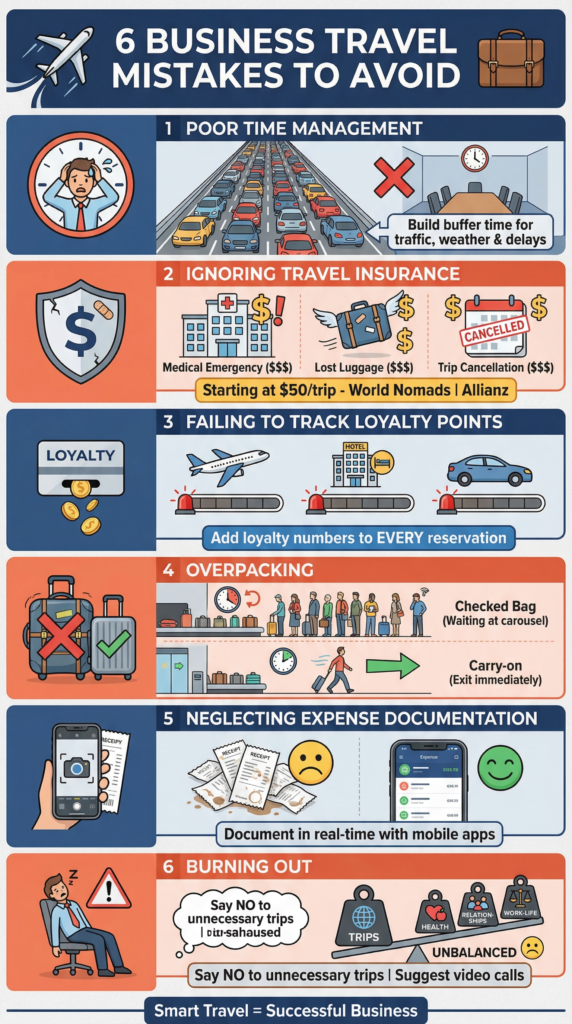
Mistake #1: Poor Time Management
Underestimating travel time between meetings or airports creates unnecessary stress. Always build in buffer time—traffic, weather, and delays are inevitable. Missing a critical meeting because you didn’t account for rush hour can damage your professional reputation.
Mistake #2: Ignoring Travel Insurance
Many business travelers do not buy travel insurance because they think it is unnecessary for short domestic trips. But canceling a trip, having a medical emergency, or losing your luggage might cost thousands. Check to see whether your credit card covers this, or get a comprehensive policy.
Get comprehensive travel insurance through World Nomads or Allianz Travel Insurance with coverage for trip cancellations, medical emergencies, and business equipment protection starting at $50 per trip.
Mistake #3: Failing to Track Loyalty Points
If you book through different sites without adding your loyalty numbers, you are missing out on savings. Make sure you provide your frequent flyer, hotel, and vehicle rental numbers with every reservation.
Mistake #4: Overpacking
Checking luggage takes more time, causes more stress, and costs more. For most work trips, a carry-on bag is all you need. The time saved at baggage claim and the reduced risk of missing luggage are much more important than the small benefit of having more outfit options.
Mistake #5: Neglecting Expense Documentation
If you wait until after your trip to sort through receipts and fill out expenditure reports, you will have to put in more effort and make more mistakes. It is easy to take pictures of receipts and track spending in real time with modern mobile apps.
Mistake #6: Burning Out
Burnout happens when you take every opportunity to travel without thinking about how it may affect your health, relationships, and work. It is fine to say no to unnecessary trips or suggest video calls instead.
Conclusion
Being able to travel for business in a way that works for you is a crucial skill that can affect your health, income, and career. By following the tips in this guide, such as booking strategically, using loyalty programs, and staying healthy and productive while traveling for work, you can turn business travel from a chore into a competitive edge.
Remember that the secret to successful business travel is not perfection, but finding ways to make things work for you. Choose one area where you have the most problems, such as managing your money, getting over jet lag, or making the most of your reward points, and start there.
All the best business travelers have one thing in common: they always learn from their mistakes and improve their approach. Every trip is a chance to practice new skills, see what works for you, and get better at things that will help you in your job for a long time.
Are you ready to improve your business trips? Use the tips in this book to see how your current method stacks up and uncover your biggest challenges. Then, on your next trip, modify one thing to correct them. These small changes add up over time to make travel easier and help you reach your business goals, rather than getting in the way.