
Affiliate disclaimer: TravelForBusiness.org participates in affiliate programs, including Amazon Associates, and may earn a commission from qualifying purchases at no extra cost to you.
1. Quick Answer (TL;DR)
Yes, business travel can be tax-deductible if it is normal and necessary and you are going away from your tax home for business (usually for long enough that you need to sleep or rest).
But the details are important:
- Self-employed (Schedule C / F): You can usually write off certain trip-related costs, such as travel, lodging, transportation, and other costs.
- W-2 employees: You usually can’t deduct unreimbursed employee expenses on your federal return. The best way to do this is usually through an employer reimbursement plan.
- Meals: You can usually deduct 50% of your travel meals, but there are some rules and paperwork that you need to follow.
- Mixed business + personal trips: You need to separate and allocate costs based on whether the trip was for business or personal use if you took both.
2. Understanding the Question
When people say “write off,” they usually mean:
- Can I deduct it from taxable income?
- What counts as “business travel” vs. personal travel?
- How do I prove it if I’m audited? (This is the part most people get wrong.)
The IRS frames deductible travel expenses as ordinary and necessary expenses of traveling away from home for your business/profession/job, and not lavish, extravagant, or personal. (irs.gov)
Business Travel Deductibility Checker
Quick decision tree for US tax considerations
Your situation
Are you traveling away from your tax home?
Your tax home is generally your main place of business or work location, not necessarily where you live. You must travel outside this area for business purposes.
Does the trip require sleep or rest (overnight)?
Generally, travel must be long enough to require substantial sleep or rest to be considered away from home for tax purposes.
Trip purpose and split
Be honest about your primary purpose and how many days were spent on each activity.
Your Results
What’s usually deductible on qualifying business travel
- Transport to destination (flight/train)
- Local transport (rideshare/taxi)
- Lodging
- Work-related incidentals (laundry, tips)
- Meals — often limited (e.g., 50%)
What to save (audit-proof checklist)
- Agenda / meeting calendar invites
- Client SOW/contract or emails confirming business purpose
- Lodging folio
- Itemized meal receipts & notes (who/why)
- Transportation receipts
Copyable trip note
Recommended travel tools
3. Detailed Explanation
What qualifies as “travel away from home” (the IRS test)
Two big rules show up repeatedly in IRS guidance:
- You’re away from your tax home (your principal place of business, not necessarily where your family lives).
- The trip is long enough that you need sleep or rest to meet work demands.
A classic “gotcha”: If you work in City B for months and that effectively becomes your tax home, your lodging/meals there may not be deductible. IRS examples make this very clear. (irs.gov)
What travel expenses are usually deductible
The IRS explicitly lists deductible travel expenses (when they otherwise qualify), including transportation to the destination, local transportation (taxis/rideshares), baggage shipping, business use of a car, lodging, non-entertainment meals, laundry, business calls, tips, and similar necessary expenses.
Meals: why they’re not “fully deductible”
Even if meals are legitimate business travel meals, the deduction is generally limited to 50% of the unreimbursed cost.
Furthermore, if a hotel includes breakfast in the room rate, you may need to allocate the meal portion separately.
Employees vs. self-employed (this changes your answer a lot)
- Self-employed: travel expenses are typically reported on Schedule C (or Schedule F for farmers).
- Most W-2 employees: unreimbursed business expenses generally aren’t deductible as miscellaneous itemized deductions (with limited exceptions for specific categories of workers).
What to do instead (for employees): push for (or use) an accountable plan reimbursement. With proper substantiation and the return of excess amounts, reimbursements can be non-taxable to the employee and deductible to the employer under the plan rules.
4. Key Points (the checklist you actually want)
1) Start with a simple “purpose” test
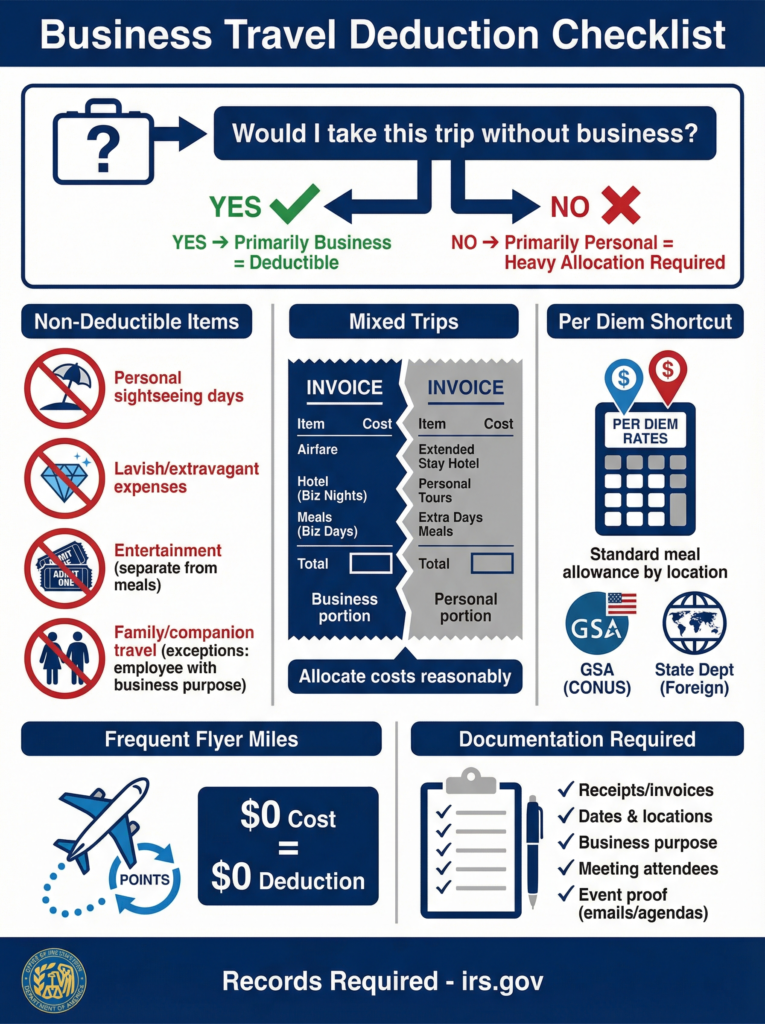
Ask: Would I have taken this trip if business weren’t involved?
- If the answer is yes, the trip is primarily for business purposes.
- If not, travel to/from the destination may be non-deductible, and you’ll be allocating heavily.
2) Know what’s not deductible
- Personal sightseeing days are not deductible because those costs are considered personal expenses.
- Lavish/extravagant expenses
- Entertainment expenses are in a different category than meals, so be sure to keep itemized receipts and separate charges.
3) Mixed trips: allocate with a “reasonable basis”
If a single bill includes both business and personal elements, you must allocate the costs reasonably (e.g., by bundling hotel and meals or combining invoices).
4) Family or companion travel: usually not deductible
If your spouse/partner tags along, you generally can’t deduct their travel unless strict requirements are met (e.g., they’re an employee with a bona fide business purpose).
5) Use per diem (if it fits your situation)
Instead of tracking every meal receipt, you can often use a standard meal allowance (varies by location).
Helpful official rate sources:
- CONUS per diem: GSA (U.S. General Services Administration)
- Foreign per diem: U.S. Department of State (U.S. Department of State)
- The IRS also cites these sources for per diem guidance. (irs.gov)
6) Frequent flyer miles + points: don’t overthink it
If you fly free using a frequent traveler program, your cost is zero, so there’s nothing to deduct for that ticket.
7) Documentation is not optional
At minimum, keep:
- Receipts/invoices
- Dates & locations
- Business purpose
- Who you met with (if meals)
- Agenda or conference proof (emails, event pages, calendar invites)
IRS guidance emphasizes keeping records/logs and documentation for travel expenses. (irs.gov)
Road-warrior Essential
If you travel often for work, a durable carry-on that protects laptops + holds up to weekly abuse can also simplify expense tracking (one bag, one receipt, years of use).
Recommended: Premium business carry-on suitcase (buy-it-for-years quality) — Check price on Amazon
Recommended article: Read the The Best Carry-On Luggage for Business Travelers in 2025 article here
5. Business vs Personal Split Allocator
Section A — Trip Basics
Section B — Costs (USD)
Section C — Advanced Options
Your Trip Allocation
Detailed Breakdown
| Category | Total | Business | Personal |
|---|
6. Examples and Case Studies
Case Study A: Self-employed consultant flying to a client (cleanest scenario)
Scenario: You’re a freelance consultant. You fly from Dallas to Chicago for a 2-day on-site project.
Likely deductible (if substantiated):
- airfare to/from Chicago
- hotel (2 nights)
- taxis/rideshares between airport/hotel/client
- 50% of qualifying meals
- laundry, tips, business calls/internet if needed
Pro move: Save the client’s SOW (Statement of Work), meeting calendar, and receipts in one folder labeled by trip.
Case Study B: Employee road warrior with reimbursement delays
Scenario: You’re a W-2 sales rep. You travel monthly, but your company reimburses you late.
Key point: You might be tempted to deduct unreimbursed costs personally—but for most employees, that’s generally not available federally.
Better solution: Ask finance/HR whether reimbursements are done under an accountable plan and ensure you’re submitting documentation and returning any excess advances correctly.
Case Study C: Conference trip + personal weekend (common, very audit-prone)
Scenario: You fly to Las Vegas for a 3-day conference, then stay two extra days for personal fun.
Typical treatment:
- Conference days: hotel and local transport are business-related
- Extra personal days: lodging/meals on those days are personal
- Flights: depend heavily on facts (primary purpose + incremental cost). Many people get this wrong, so document: conference agenda, badge/receipt, meetings scheduled, etc.
Case Study D: Temporary assignment that becomes “indefinite”
Scenario: You take a “temporary” assignment out of town, but it extends beyond a year.
IRS guidance treats assignments expected to last more than one year as indefinite, which can change whether travel expenses are deductible.
Productivity + sanity
If you do planes, lounges, and open offices, noise cancellation is one of the highest ROI “business travel tools.”
Recommended: Noise-canceling headphones — Check price on Amazon
7. Expert Insights (what the IRS “cares about” in real life)
The IRS uses plain-English concepts… but expects proof
Their definitions sound straightforward: “ordinary and necessary,” “away from home,” “not personal.” (irs.gov)
What trips people up is that audits are about substantiation:
- Can you show why the trip was business?
- Can you show when and where you traveled?
- Can you show how each expense ties to the business?
Meals are the #1 sloppy area
Travel meals are generally subject to the 50% limitation.
So keep:
- itemized receipts
- who attended (if client meal)
- business purpose note (1 sentence is enough)
Employees: plan around reimbursements, not deductions
With federal rules limiting unreimbursed employee deductions for most workers (with limited exceptions), your best “tax move” is often process, not paperwork: get reimbursements right and timely using accountable plan rules.
Keep devices alive on long days
Dead phone = missed Uber/meeting/boarding pass. A high-capacity power bank pays for itself fast.
Recommended: High-capacity travel power bank — Check price on Amazon
8. Additional Resources (official + practical)
- IRS Topic No. 511—Business travel expenses (irs.gov)
- IRS Publication 463—Travel, Gift, and Car Expenses (irs.gov)
- IRS Publication 529—Miscellaneous deductions (employee expense rules + exceptions) (irs.gov)
- GSA Per Diem Rates (CONUS) (U.S. General Services Administration)
- U.S. State Dept Foreign Per Diem (allowances.state.gov)
9. Conclusion
Can I write off travel as a business expense? Yes—if it’s legitimately business travel, you’re away from your tax home, and you document it properly.
The biggest “wins” come from:
- treating travel like a system (one folder per trip, consistent notes)
- separating business vs. personal in real time
- understanding whether you’re self-employed or an employee (and using reimbursement plans when applicable)
Stress reduction + faster packing
If you travel frequently, packing cubes help you pack faster, stay organized, and avoid last-minute chaos.
Recommended: Packing cubes set — Check price on Amazon
10. Frequently Asked Questions
Are hotel stays deductible for business travel?
If you’re traveling away from your tax home for business (sleep/rest requirement) and the lodging isn’t personal or lavish, lodging is generally a deductible travel expense.
Can I deduct meals while traveling for business?
Usually, yes, but the deduction is generally limited to 50% of the unreimbursed cost, and you need records.
What if my trip is partly business and partly personal?
You must separate and allocate expenses based on facts and circumstances (and allocate bundled costs reasonably).
Can I deduct Uber/taxis on a business trip?
Transportation between the airport/hotel/work sites, as well as other business-related local transport, may be deductible as part of business travel expenses.
Can employees deduct unreimbursed travel expenses?
For most W-2 employees, unreimbursed employee business expenses generally aren’t deductible federally (with limited exceptions for specific categories).
What’s the difference between “tax home” and where I live?
Your tax home is generally your principal place of business/work (the city or general area), not automatically your family residence.
Can I use per diem instead of saving meal receipts?
Often, yes—IRS guidance allows a standard meal allowance approach in many cases, and rates vary by location.
If I fly using points, can I deduct the ticket value?
If you fly free due to a frequent traveler program, your cost is zero, so there’s generally nothing to deduct for that ticket.