
Affiliate disclaimer: TravelForBusiness.org participates in affiliate programs, including Amazon Associates, and may earn a commission from qualifying purchases at no extra cost to you.
Introduction
Business travel is supposed to be simple: you go, you meet, you deliver, you come home. But the paperwork? That’s where trips get rejected, reimbursements get delayed, and tax deductions get questioned.
Finance teams and auditors don’t approve “good intentions.” They approve proof—a clear business purpose, a realistic itinerary, itemized receipts, and a trail that matches what actually happened.
If you’re searching for how to prove a trip is for business, you’re in the right place. In this guide, you’ll get an audit-proof checklist, a step-by-step process you can follow on every trip, and the exact notes to include so your expense report gets approved faster—with fewer back-and-forth emails.
Quick Answer (TL;DR)
To prove a trip is for business, you need a tight paper trail that connects:
- Business purpose (why you went)
- Business activities (what you did each day)
- Proof you paid (receipts/folios/tickets)
- Proof it wasn’t personal (separation + allocation when mixed)
In practice, that means: an approval/invite, a dated agenda or calendar, travel confirmations, itemized receipts, and a short daily log documenting who you met, where, and the outcome. Written records and receipts are always more reliable than simply saying, “I remember it was for work.” (irs.gov)
Understanding the Question
People ask this question for three reasons:
- Expense reimbursement: Finance wants evidence that the trip matches policy (and isn’t a disguised vacation).
- Tax deductions: You (or your employer) must show the travel was ordinary/necessary and connected to work—not personal.
- Audit defense: If questioned later, you need documents that stand on their own.
The trick is simple: auditors don’t “feel” your intent. They verify it. Your goal is to produce a “proof packet” that makes the business purpose obvious in 60 seconds.
Detailed Explanation
What “proof” really means (in plain English)
Proof is substantiation: reliable, preferably written documentation that supports each element of the expense and the trip.
For business travel, the IRS explicitly emphasizes keeping records (log/diary/notebook) and supporting documentation, and warns you can’t deduct amounts you approximate or estimate. (irs.gov)
Even outside the U.S., the same logic applies: employers need to keep records of when and why an employee traveled and retain receipts where possible. (GOV.UK)
What auditors typically want to see
Think “WHO / WHAT / WHEN / WHERE / WHY”:
- Why: business purpose (client meeting, conference, site inspection, negotiation)
- Who: client/colleagues you met (names, company)
- When: dates + daily schedule
- Where: destination + venues
- What happened: outcomes (signed proposal, project kickoff, training completed)
The golden rule: your calendar should match your receipts
If your calendar says “Client meeting 14:00,” but your receipts show a theme park and a cocktail bar all day, you’ll have a problem. If the receipts show hotel, taxi, conference badge, and client dinner with names noted—easy win.
Step-by-Step Process
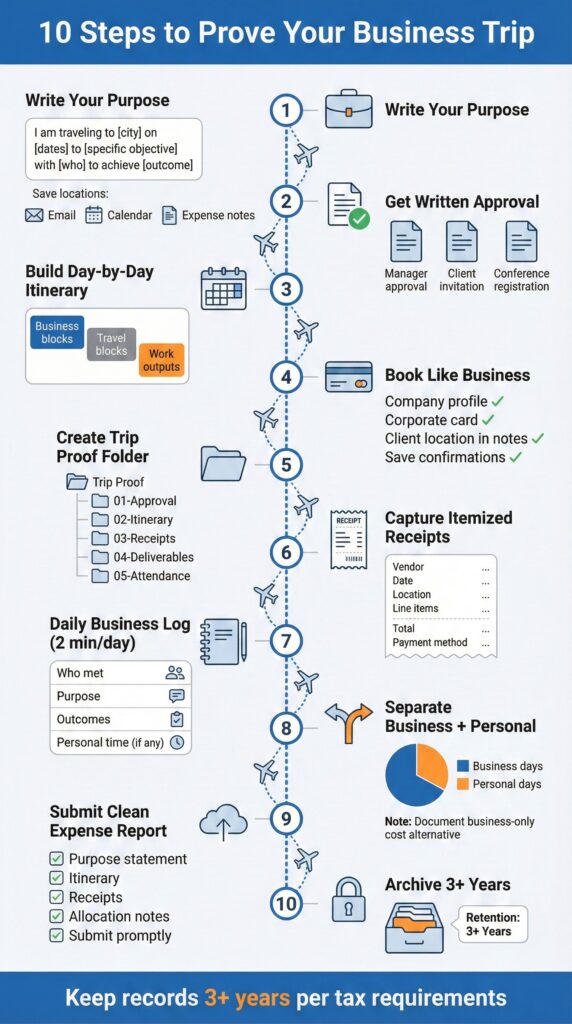
Step 1: Write a one-sentence business purpose (before you book)
Use this format:
“I am traveling to [city] on [dates] to [specific business objective] with [client/team/vendor] to achieve [outcome].”
Examples:
- “Meet Client X to finalize the Q2 rollout plan and sign the SOW.”
- “Attend [Conference] for mandatory certification training.”
Save this sentence in your email, calendar, and expense report notes.
Step 2: Get written confirmation (approval or invitation)
Any of these works:
- Manager approval email/travel authorization form
- Customer invitation email
- Conference registration confirmation
This becomes your “intent” proof.
Step 3: Build a day-by-day itinerary (even if it’s lightweight)
Create a simple schedule with:
- Business blocks (meetings, sessions, site visits)
- Travel blocks (flight/train times)
- Work outputs (deliverables, presentations, negotiations)
If you’re outside the U.S. and mixing business + personal days, you may need to allocate travel days between business and non-business activities depending on your facts—so a day-by-day schedule matters. (irs.gov)
Step 4: Book “like a business trip”
These tiny details reduce friction later:
- Book with your company profile (or business account)
- Use the corporate card (if you have one)
- Put the client/site location in the booking notes
- Keep confirmations (air, hotel, car, rail)
Step 5: Create a “Trip Proof Folder” before departure
Make one folder in Google Drive/OneDrive:
Trip Proof Folder
- 01 Approval & Purpose
- 02 Itinerary & Calendar
- 03 Receipts (Photo scans)
- 04 Deliverables (slides, notes, minutes)
- 05 Proof of Attendance (badges, certificates)
Want to get this approved fast? Use the Proof Packet Builder to generate a clean, audit-ready summary you can paste into your expense report.
Build Your Proof PacketTakes 2 minutes. Saves hours of back-and-forth with finance.
Step 6: Capture receipts the right way (itemized, not just totals)
Receipts/folios should show:
- Vendor name, date, location
- Itemized line items where possible
- Total paid and method (or match to card statement)
Affiliate tool (makes this ridiculously easier):
- Portable Receipt Scanner (travel-friendly) – scan and archive receipts fast.
Step 7: Keep a daily business log (2 minutes a day)
This is your secret weapon.
At the end of each day, write:
- Meetings attended (names + companies)
- Business purpose for the day
- Outcomes (decisions made, next steps)
- Any personal time (if mixed trip)
Written evidence is more reliable than oral explanations; a contemporaneous record strengthens your proof if challenged later. (irs.gov)
Step 8: If you mixed business + leisure, separate and allocate
Mixed trips are where people get burned.
Do this:
- Mark business days vs personal days
- Keep separate receipts (don’t bundle)
- If you added personal stopovers/upgrades, document what the business-only option would have cost
For U.S. taxpayers traveling internationally, Publication 463 describes scenarios where a trip can be “considered entirely for business” under certain exceptions (for example, being outside the U.S. for a week or less, or spending less than 25% of time on personal activities), and otherwise requires allocating travel time day-by-day. (irs.gov)
Mixed business + leisure trip? Don’t guess. Use the Allocation Calculator to label each day and generate a simple statement finance can’t argue with.
Use the Allocation CalculatorPerfect for weekend add-ons, conferences, and international trips.
Step 9: Submit your expense report so that an auditor can read it
Include:
- The one-sentence business purpose
- The itinerary attached (or linked)
- Receipts attached and labeled
- Notes on any mixed-use allocation
Also, submit promptly—late reports look messy and trigger questions.
Step 10: Archive the proof packet (don’t trust inbox search)
Retention requirements vary, but you should keep trip records long enough to satisfy company policy and any tax rules that apply. For example, UK employer guidance says to keep records for 3 years from the end of the tax year they relate to, and includes recording when and why an employee traveled. (GOV.UK)
Tips and Best Practices
Build “proof” into your workflow (so it’s automatic)
- Put the business purpose sentence in:
- Calendar event description
- Expense report header
- Trip folder “README.”
- Take receipt photos immediately (don’t batch later)
- Save meeting minutes or even a quick “what we agreed” note
Make your travel gear work for you (less chaos = fewer missing receipts)
When you’re tired, jet-lagged, and rushing, you lose paperwork. Systems beat motivation.
Affiliate picks that help you stay audit-ready:
- Packing Cubes (separate business clothes, receipts pouch, cables)
- Travelpro Platinum Elite Carry-On Spinner (business-grade organization for frequent flyers)
- Travelpro Maxlite 5 Underseat Rolling Carry-on (great for “proof packet” + laptop day trips)
Use the “calendar + receipts + outcomes” triangle
A trip is easiest to defend when you have:
- Calendar invites/agenda (planned business)
- Receipts/folios (actual spend)
- Deliverables/notes (business result)
Common Mistakes to Avoid
- No written purpose (you’ll get “looks personal” pushback)
- Receipts without context (a hotel receipt doesn’t say why you were there)
- Mixing personal days without allocating (the #1 audit trigger)
- Entertainment-looking charges with no attendee notes
- Late expense reports (lost receipts + fuzzy memory)
- Booking “vacation style” (weekend-heavy itinerary, no meetings, no outcomes)
Also note: The IRS is clear that travel expenses must be ordinary and necessary and not for personal purposes. (irs.gov)
Tools and Resources Needed
Must-haves
- Cloud folder (Drive/OneDrive)
- Receipt capture method (phone scan or scanner)
- A repeatable checklist (purpose → itinerary → receipts → log)
Nice-to-haves
- Expense app with mileage + receipt matching
- Template: “Daily Log” note
- A small travel pouch for paper receipts
One more affiliate option if you want a dedicated business carry-on setup:
Want your expense report approved the first time? Use the generator to create audit-ready notes in 60 seconds—no guessing, no missing details.
Use the Expense Report Generator →This tool is specifically designed for business travelers who don’t have the luxury of time to deal with rejections.
Conclusion
If you want reimbursements approved fast (and avoid tax headaches), don’t try to “explain” later. Document as you go.
Your winning formula:
- Clear business purpose (written)
- Agenda or calendar schedule
- Receipts + folios
- Daily business log
- Clean separation for personal add-ons
That’s how to prove a trip is for business without stress or second-guessing. Do that, and your trip reads like business on paper—because it is.
Frequently Asked Questions
What’s the single best piece of proof?
A day-by-day itinerary plus a short daily log tied to receipts. Written records are strongly favored because they’re more reliable than verbal explanations.
Do I need receipts for everything?
Often, you need receipts for key items (especially lodging) and supporting documentation for expenses; requirements vary by company and jurisdiction. The IRS emphasizes keeping records and documentary evidence, such as receipts/bills, to help with the costs. (irs.gov)
What if my spouse/partner came with me?
For tax deductibility, travel costs for another individual are generally not deductible unless strict conditions apply (for example, the person is an employee with a bona fide business purpose).
How do I handle a conference trip with a weekend added on?
Keep the conference registration, agenda, badge proof, business-day lodging, and allocate personal days cleanly. If you’re a U.S. taxpayer traveling internationally, Publication 463 lays out exceptions and allocation rules for mixed business/personal travel outside the U.S. (irs.gov)
How can employers prove employee travel was legitimate?
Maintain records showing when and why the employee traveled, and keep receipts where possible; UK employer guidance explicitly states this. (GOV.UK)