
Affiliate Disclaimer: TravelForBusiness.org participates in affiliate programs, including Amazon Associates, and may earn a commission from qualifying purchases at no extra cost to you.
1. Introduction to Navan
Navan is an all-in-one platform that brings business travel booking, expense management, and payments under one roof—built to give travelers a consumer-grade experience while giving finance and travel teams tighter, real-time control. Navan positions itself around “one place” visibility: bookings, card transactions, approvals, reimbursements, analytics, and traveler oversight all flow through the same system.
If you’re evaluating T&E tools because you’re tired of policy leakage, slow month-end close, or chasing receipts across departments, this Navan guide will walk you through the product stack, how to choose the right setup, and how to get value fast.
Quick credibility snapshot (why it’s on so many shortlists):
- Navan says it powers travel programs at 10,000+ companies and reports high satisfaction metrics (CSAT/NPS) in its materials.
- Navan (formerly TripActions) has also been in the public markets conversation recently (IPO in 2025), which matters to some buyers assessing vendor durability.
If you want the real-world pros/cons before you commit, read my Navan Review 2026 here.
2. Product Categories Overview
Navan Travel (Business Travel Management)
Navan Travel is the booking and trip-management layer: flights, hotels, car rentals, trains, plus traveler-facing tools for itinerary management and quick self-serve changes.
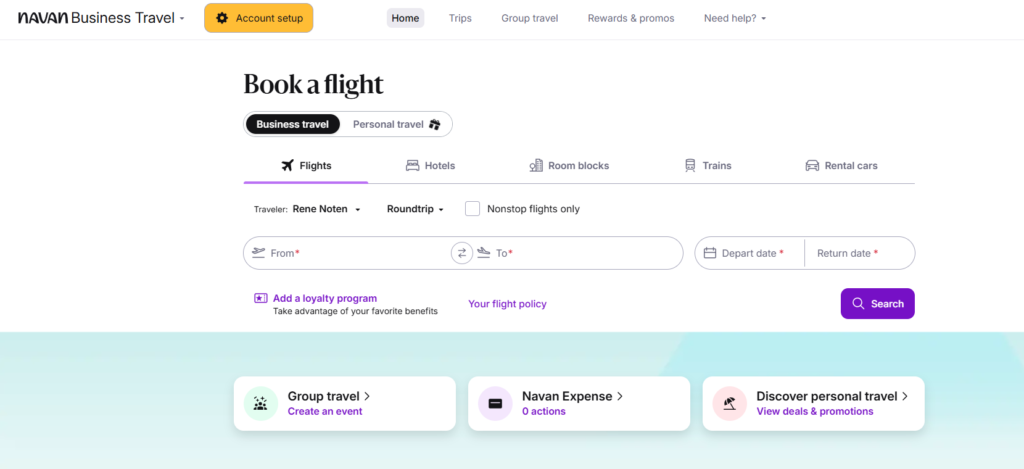
Key capabilities relevant to adoption and compliance:
- Broad inventory and negotiated rates embedded into search results for travelers.
- Built-in policies allow travelers to see what is allowed up front (rather than being rejected later).
- Easy changes/cancellations from the app (reducing reliance on help desk tickets).
- Calendar/Slack/email syncing (useful for busy EAs and frequent travelers).
For travel managers, the admin controls are the point:
- Policy control “without complexity” (role, trip type, cost center).
- Approval workflows are routed by thresholds/team structure/travel type.
- Automated employee management via HRIS connection (less manual provisioning).
- Real-time traveler tracking and location-based restrictions (duty of care + visibility).
Navan Expense (Expense Management)
Navan Expense connects transactions to policy, coding, and approvals in a single workflow, reducing the traditional “receipt chase” and reconciliation cycle.
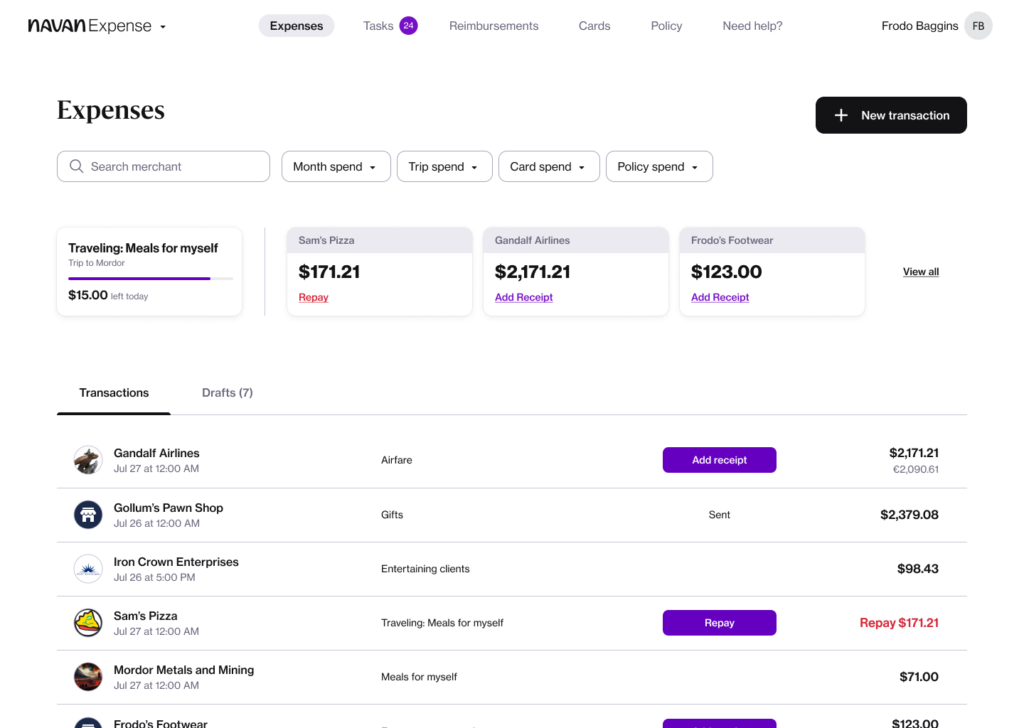
Notable features:
- Built-in expense policies and guardrails; out-of-policy flagged instantly.
- End-to-end automation from transaction to reconciliation, with ERP/accounting integration.
- Real-time visibility of spending as it occurs.
- Integration messaging explicitly references common accounting stacks (e.g., Oracle/QuickBooks/Xero/Sage).
Navan Payments (Cards, Virtual Cards, and Navan Connect)
Navan Payments is where the “no more expense reports” story becomes real: if transactions are captured at swipe, categorized, matched to trip/invoice context, and reconciled automatically, finance gets a faster close, and travelers get less admin work.
Options include:
- Navan corporate cards (physical + virtual) with up to 1.5% back and no annual fee, plus issuance in USD/GBP/EUR.
- On-demand virtual cards for travel bookings and virtual purchase cards with limits for subscriptions/spot buys.
- Navan Connect to keep existing eligible Visa/Mastercard/Amex corporate cards (and even preserve existing rewards/banking relationships).
- Global reimbursements (Navan states 25+ currencies across 49 countries).
Operational detail worth knowing: Navan notes Visa/Mastercard transactions report in real time, while American Express transactions are daily (for connected cards).
Navan Rewards
Navan Rewards is aimed at solving a real travel-program behavior problem: “traveler convenience vs company savings.” Instead of rewarding higher spend, Navan rewards travelers for booking business hotels at a “price to beat” shown in search results, and those rewards can be applied to personal hotel stays booked on Navan. Navan says rewards are funded by Navan (not the employer).
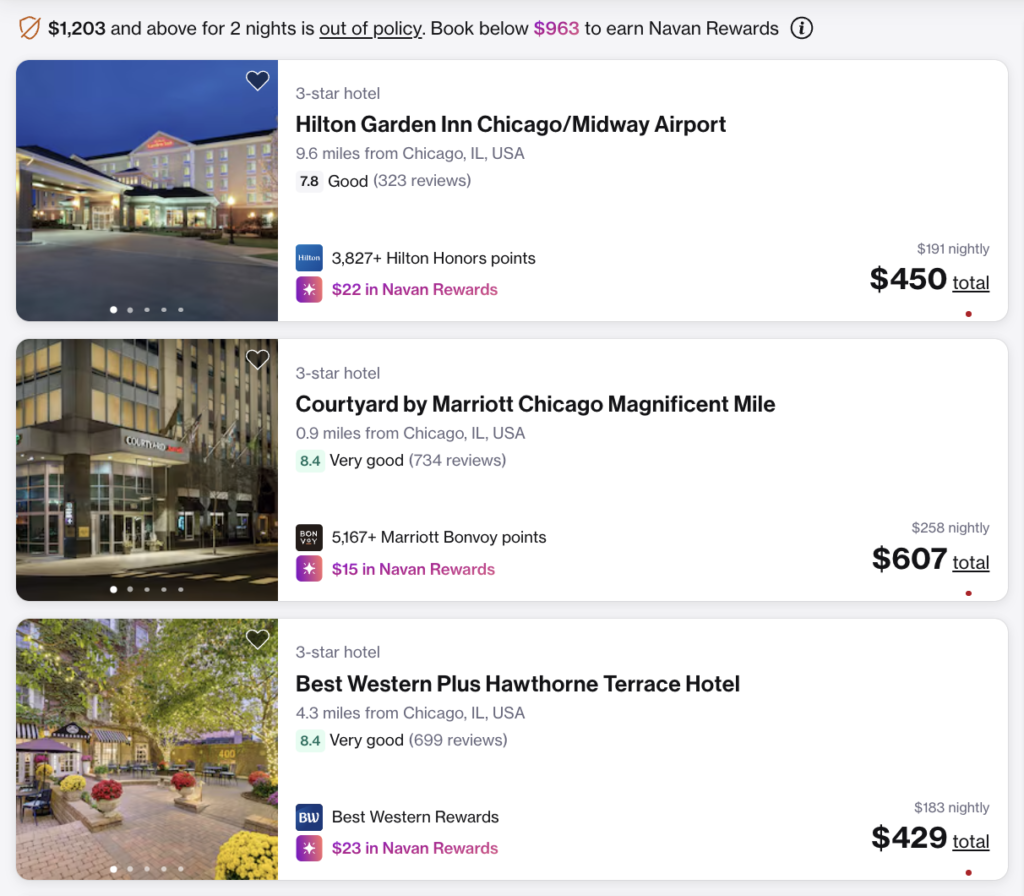
How people earn (examples Navan lists):
- Book below the price to beat and earn rewards.
- Delegates booking for others can earn up to 1.5% of the booking value (in-policy hotel stays).
- Group travel planners can earn up to $75 per event for room blocks.
Advanced Analytics
Advanced Analytics focuses on turning travel data into actionable insights through interactive dashboards, filters, trends, alerts, and notifications.
Navan highlights:
- Real-time insights via intuitive dashboards (no specialist required)
- Alerts + scheduled notifications for key metrics
- It’s described as powered by ThoughtSpot.
Sustainability Suite
Navan’s sustainability content centers on making emissions visible during shopping and reporting:
- Carbon calculation methods mentioned: DEFRA, ICAO, TREMOD
- CO2 dashboard with granular visibility
- Flight-shopping emissions visibility to nudge choices
- A rail alternative pop-up for trips under 650 km / 400 miles
- Carbon compensation via partnership with SQUAKE
Navan Intelligence (AI Layer)
Navan Intelligence is presented as AI that supports the whole T&E lifecycle: identifying savings opportunities, enforcing policy contextually, and reducing manual exceptions.
Navan describes AI agents that:
- See the “whole T&E picture” across inventory + transaction types
- Help stop out-of-policy spend using trip details + card data + policies
Integrations
Integrations matter because they determine whether Navan becomes your “system of record” or just another interface.
Navan’s integrations page highlights examples across:
- Accounting/Finance: Oracle NetSuite, Sage Intacct, Xero
- User management/HR: Workday, Rippling, Personio, HR-SFTP connection
- Security/SSO: Okta (SSO + SCIM), OneLogin, SAML 2.0, OpenID Connect
- Productivity: Slack notifications
- Expense automation: Uber for Business, Visa card connection
- APIs: Navan Expense API
Support and Security
- Travel support: Navan describes 24/7 global agent support (“follow-the-sun”), plus hiring/training benchmarks (3–5 years experience, 10-week certification).
- Security posture: Navan displays security badges including SOC 1 Type 2, SOC 2 Type 2, ISO 27001, and PCI DSS.
3. How to Choose the Right Product
Most teams don’t need “everything” on day one. The fastest win is to pick a starting point aligned with your biggest leak.
If your biggest problem is uncontrolled booking and traveler visibility
Start with Navan Travel + policy + approvals:
- Build policy rules (role/cost center/trip type) and approval routing.
- Turn on traveler tracking and communications for duty-of-care coverage.
If your biggest problem is month-end close and expense chaos
Begin with Navan Expense + accounting integration:
- Automate categorization/guardrails and deliver clean data to your ERP/accounting software.
If your biggest problem is card sprawl, missing receipts, and late coding
Start with Navan Payments (or Connect your existing cards):
- Corporate cards and virtual cards, or use Navan Connect to keep your existing Visa/Mastercard/Amex.
- Real-time transaction flow reduces “what was this charge?” and missing receipt follow-ups.
If adoption is low (travelers keep booking outside the platform)
Consider Navan Rewards as a behavior lever:
- Price-to-beat incentives can motivate compliance without threatening travelers with “no.”
Pricing reality check (for planning)
Navan’s public pricing page states:
- For companies with 300 or fewer employees, Navan Travel (Navan Business) has no trip limit and is powered by provider commissions.
- Navan Expense is free for the first 5 monthly expensing users, then $15/user/month.
- For larger orgs, Navan positions Enterprise as including additional support for implementation and scaling.
4. Setup and Getting Started
Here’s a practical rollout that minimizes friction for travel managers, finance, and EAs.
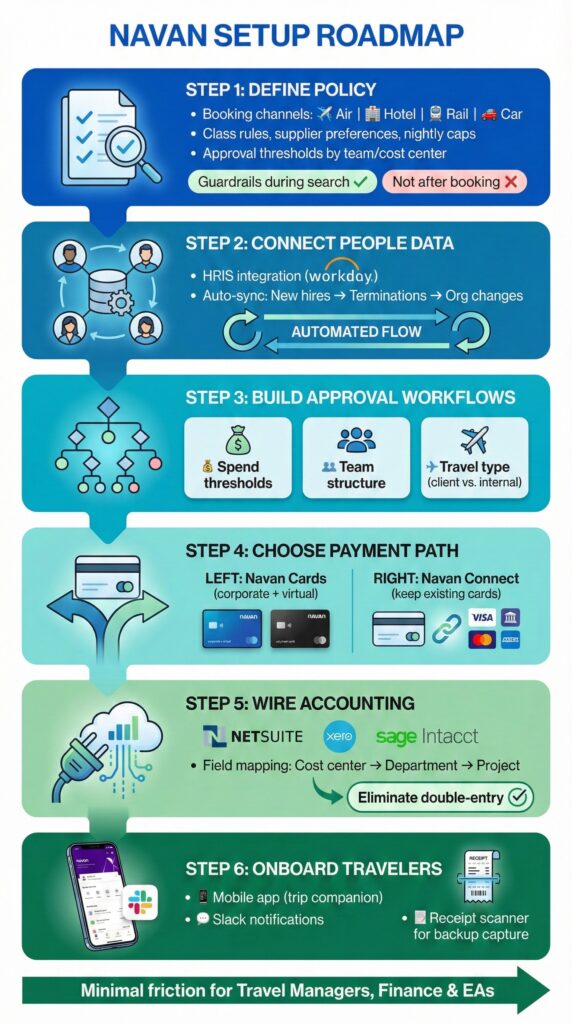
Step 1: Define what “in policy” means (before you configure anything)
Document:
- Booking channels allowed (air/hotel/rail/car)
- Class-of-service, preferred suppliers, nightly caps, and advance purchase rules
- Who approves what (thresholds by team/cost center)
Then configure those rules so travelers see guardrails during search, not after the purchase attempt.
Step 2: Connect your people data (so policy applies automatically)
If you have HRIS, connect it early so new hires, terminations, and org changes don’t become manual admin work. Workday is explicitly listed as an integration example, and Navan references HRIS syncing for automated employee management.
Step 3: Build approvals that match how your company actually works
Use approval workflows based on:
- Spend thresholds
- Team structure
- Travel type (client visit vs internal offsite)
Navan calls out workflow routing by structure/type/threshold.
Step 4: Choose your payment path (cards vs Connect)
- If you want maximum control and automation, consider Navan corporate cards + virtual cards.
- If switching cards is politically painful, use Navan Connect to keep eligible existing corporate cards.
Step 5: Wire up accounting + reporting
Pick the integration that reduces double entry (e.g., NetSuite/Xero/Sage Intacct) and confirm how fields map (cost center, department, project).
Step 6: Onboard travelers with the mobile app + Slack
Navan explicitly supports Slack integration for updates/notifications, and describes the mobile app as a core “trip companion.”
5. Advanced Tips and Tricks
Use Rewards to reduce leakage without adding policing
If travelers book outside the platform, you lose:
- visibility for the duty of care,
- accurate spend tracking,
- and negotiated-rate leverage.
Navan’s Rewards model aims to change behavior by displaying a “price to beat” and rewarding savings over higher spending.
Create exception-based admin work (so your team only touches what matters)
A high-performing setup makes “standard trips” self-serve and routes only exceptions to reviewers:
- Tighten guardrails (caps, preferred suppliers).
- Use approvals only for edge cases (high cost, last-minute, premium cabin).
This aligns with Navan’s “policy control without complexity” messaging and workflow design.
Set alerts in analytics for early warning signals
Instead of discovering a budget blowout at month-end, use:
- Dashboard monitoring for spend spikes.
- Alerts/notifications for outliers (routes, hotel rates, departments).
Navan highlights alerts and scheduled notifications in Advanced Analytics.
Turn sustainability into traveler-friendly choices (not extra steps)
Sustainability fails when it feels like extra work. The Navan approach emphasizes:
- Showing emissions next to flight options.
- Keeping rail options under 400 miles/650 kilometers.
- Exportable sustainability data and calculation methodologies for reporting.
That’s the difference between “a report” and “a behavior change.”
Make reimbursements fast enough that travelers stop going rogue
Nothing breaks compliance like slow reimbursement. Navan states reimbursements can be sent globally in 25+ currencies across 49 countries, and that reimbursements can run via payroll or bank account workflows (depending on setup).
6. Troubleshooting Common Issues
“Bookings are blocked” or “employees can’t see the options they want.”
Likely causes
- Policy rules are too strict (caps, preferred suppliers, cabin rules).
- Approval workflow misrouting (wrong reviewers, thresholds too low).
Fix
- Examine the policy logic based on role, trip type, and cost center, then test it with a traveler persona. Navan emphasizes granular policy creation and workflow routing.
“Card transactions aren’t showing up immediately.”
Likely causes
- Card type/connection impacts refresh timing.
Fix
- Confirm whether the card is Visa/Mastercard (real-time) or Amex (daily) for connected-card feeds.
“Receipts aren’t matching” or “coding is inconsistent.”
Likely causes
- Missing required fields (project/client/cost center).
- Weak merchant rules or inconsistent user behavior.
Fix
- Tighten the required fields and use automated categorization logic. Navan describes automated categorization according to merchant type, role, and category.
“User access / SSO problems”
Likely causes
- SSO misconfiguration, SCIM provisioning gaps, or user lifecycle mismatch.
Fix
- Validate the identity model by referencing Okta SSO/SCIM, SAML 2.0, OneLogin, and OpenID Connect as integration paths.
“Travelers need help right now.”
If changes are frequent (weather, cancellations, complex itineraries), make sure travelers know how to reach support and that admins understand the service model. Navan describes 24/7 global agent coverage and a follow-the-sun model.
7. Conclusion and Next Steps
Navan’s core advantage is architectural: fewer handoffs between booking, payment, expense, and reporting. For travel managers, this means increased adoption and visibility into duty of care (particularly when traveler tracking and policy controls are carefully configured). For finance, it’s about fewer surprises and a faster close because spending is visible and categorized earlier.
If you want the simplest path to value:
- Start with policy + approvals and get traveler adoption right.
- Add payments (cards or Connect) to reduce friction in expenses.
- Layer in analytics alerts and rewards once you have clean usage patterns.
And if you’re building internal documentation, you can reuse this Navan guide structure as your company’s rollout playbook.