

If you’ve spent any time in airport lounges, you’ve seen the pattern: the same sleek black carry-ons, the same understated “I travel for work” look, the same quiet confidence that the bag won’t fall apart mid-quarter. That’s TUMI’s lane—and it’s why people Google a tumi review right when they’re tired of cracked wheels, floppy handles, and messy packing.
But TUMI is expensive. The question isn’t, “Is TUMI good?” The real question is, is TUMI good for you—your routes, your company’s travel policy, how often you fly, and whether you need a bag that works like a mobile office?
This review is written for corporate road warriors, consultants, founders, and client-facing pros who want gear that reduces friction: faster security, smoother transfers, less packing stress, and fewer “bag problems” stealing time from sleep, workouts, and actual work.
Affiliate disclosure: This article contains affiliate links. If you buy through these links, I may earn a commission at no extra cost to you.
1. Introduction: What TUMI Is Best At
TUMI’s reputation was built on three things:
- Durability-first materials (especially their ballistic nylon options)
- Business-friendly design (pockets that make sense, quick access, tech organization)
- Premium experience (fit/finish, smoother hardware, cohesive design language)
For business travelers, that translates into less hassle: your laptop comes out quickly, your chargers aren’t tangled, your suit arrives in better shape, and your bag glides instead of fighting you through terminals.
Still, not every TUMI product is an automatic win. Some models feel heavy. Some are priced more for prestige than performance. And if you travel mainly by car or do 1–2 trips a year, you may be paying for durability you’ll never fully use.
So in this tumi review, we’ll break down features, real-world performance, and value—plus who should buy TUMI and who should skip it.
🧳 TUMI Finder: Pick the Right Bag
Answer 6 quick questions to find your best-fit business travel bag. Takes about 60 seconds.
How many business trips do you take per year?
What’s your typical trip length?
How do you prefer to travel with luggage?
What size laptop do you travel with?
What are your top priorities? (Choose up to 2)
Select your 1–2 most important features
What’s your typical travel environment?
Your Best Match 🎯
Also Worth Considering
2. Features Overview
2.1 Materials: Why FXT® Ballistic Nylon Is a Big Deal
One of the most consistent reasons people choose TUMI is the durability of its fabric, particularly FXT® ballistic nylon on many softside lines. TUMI itself positions FXT ballistic nylon as its most durable fabric option.
What that means in practice:
- Better resistance to abrasion (curbs, overhead bins, taxi trunks)
- Less visible “aging” versus cheaper nylon
- More structure than many softside bags, so it doesn’t slump when partially packed
TUMI also offers hardside polycarbonate, aluminum, and other materials depending on the collection, which can be great if you prefer a clean, rigid shell—but the brand’s softside DNA is still its strongest area for business use.
2.2 Organization That’s Built Around Work Travel
TUMI’s layouts are typically designed for people who carry:
- A laptop + tablet
- Chargers, cables, adapters, and a power bank
- Headphones
- Documents, badge, passport, receipts
- A backup outfit or gym kit
TUMI’s best business pieces feel like they are built by someone who actually travels: pockets placed where your hands naturally go, compartments that separate tech from clothing, and quick-access sections that reduce the “bag explosion” moment at security.
2.3 The TUMI Tracer® Program (Underrated Benefit)
Many TUMI products come with TUMI Tracer®, a unique code you can register. TUMI describes it as a way to track product history, help identify items if lost, and assist when discussing parts and warranty-related options.
It’s not magic GPS tracking—but it’s an extra layer that can be useful when your bag goes missing or when you need product identification for service.
2.4 Carry-On Convenience: Dual-Access + USB on Certain Models
Some popular carry-ons in the Alpha line include “dual access” designs and a built-in USB port (power bank sold separately).
For business travelers, this is practical—not gimmicky—because it supports:
- Quick access to a laptop or pouch without fully opening the case.
- Charging in transit during long gate holds or delays.
2.5 Warranty: What It Covers and Where People Misunderstand It
TUMI states that many products in its travel/business/bags collections are covered for five years, with accessories often having shorter coverage (commonly two years).
A key nuance: TUMI’s FAQ describes different coverage in year 1 vs. years 2–5, including limits on transit mishandling after the first year (cosmetic damage is also often excluded).
Bottom line: the warranty can be a real value—but you should expect it to cover functional failures more than scuffs.
3. Performance Analysis (Real-World Business Travel)
3.1 Airport Flow: Where TUMI Saves Time
If you fly frequently, the best bag isn’t the one with the most pockets—it’s the one that reduces friction at the exact moments that cause delays:
- Security screening: fast tech access, easy repacking.
- Gate changes: a bag that rolls smoothly and doesn’t tip.
- Overhead bins: predictable shape and strong grab handles.
- Tight connections: stable wheels + comfortable handles.
TUMI carry-ons are generally excellent here. The handle feel is often firmer and less “wobbly” than midrange luggage, and the bags tend to keep their shape.
3.2 Mobility: Wheels and Handling
Business travel usually involves “micro-stress”: weaving through crowds, crossing uneven pavement, and pulling the bag with one hand while you answer Slack with the other. Premium bags justify themselves when:
- Wheels don’t rattle or snag.
- The bag tracks straight.
- The handle doesn’t flex under load.
TUMI’s better models excel at this. It’s not the only brand with smooth-rolling luggage, but TUMI is reliably good at it.
3.3 Packing Efficiency: The “One-Bag Work Trip” Test
For a typical 2–4 day work trip, most travelers want to fit:
- 1 suit or blazer
- 2–4 shirts
- 1 casual outfit
- gym kit (optional)
- toiletries + tech kit
TUMI’s internal compression straps, garment features (on some models), and structured interiors help keep things neat. That matters when you’re arriving late, exhausted, and want to unpack in 90 seconds without wrinkling everything.
3.4 Corporate Policy Compliance and Reimbursement Headaches
If your company has a carry-on-only policy or tight expense rules, TUMI can be a clever long-term play because:
- You’re less likely to have a wheel failure that forces an emergency purchase.
- “Buy once, use for years” reduces replacement receipts and disputes over expenses.
- A professional-looking bag can matter in client-facing roles.
That said, if your policy caps luggage spending, you may need to buy during sales or choose a lower-priced TUMI line to stay within your policy limits.
3.5 Productivity, Jet Lag, and Health Routines
This is the part people don’t connect to luggage, but it’s real: energy is a limited resource on the road.
A bag that:
- Keeps your essentials organized,
- reduces physical drag through terminals,
- and prevents packing chaos at night,
…gives you a better chance of doing the “boring wins”: hydration, decent meals, quick workouts, and earlier sleep. In other words, excellent gear protects your routine.
4. Pros and Cons
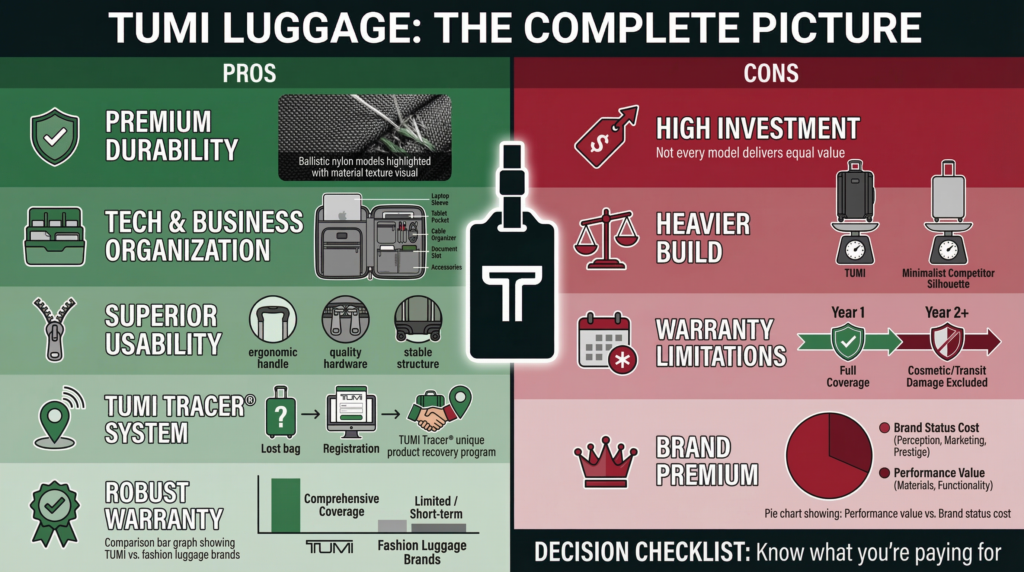
Pros
- Premium durability options, especially ballistic nylon models.
- Excellent organization for tech and business essentials.
- Smooth real-world usability (handles, hardware feel, structural stability).
- TUMI Tracer® adds a helpful layer for product identification and recovery workflows.
- Solid warranty framework compared with many fashion-first luggage brands.
Cons
- Price is high, and not every model feels “worth it”.
- Some pieces can feel heavier than minimalist competitors.
- Warranty has limits (especially around cosmetic/transit damage after year one).
- You’re partly paying for brand status—which is fine, but should be intentional.
5. User Experience: What It’s Like to Live With TUMI
5.1 The “Professional Signal” (Yes, It Matters)
If you’re walking into client meetings, conferences, or executive environments, TUMI hits the sweet spot:
- premium but not flashy
- modern but not trendy
- clean lines that work with business attire
For sales professionals and consultants, appearance can be part of your “mobile brand.” TUMI plays well in that context.
5.2 Day-to-Day Convenience
TUMI’s best user experience trait is simple: you waste less time looking for things.
When your bag has a dedicated place for:
- Passport + boarding pass
- laptop + tablet
- chargers + cables
- pens, cards, documents
…it reduces the constant low-level friction that makes travel exhausting.
5.3 Repairs and After-Sales
No bag is indestructible—wheels wear, handles loosen, and zippers eventually get frayed. TUMI’s warranty terms emphasize coverage windows and what qualifies as a functional or structural failure.
Practical tip: keep proof of purchase, and register your bag if it has Tracer. It helps you move faster when you need support.
6. Value for Money: Is TUMI Worth It?
Here’s a simple way to decide.
If you travel 10+ times per year
TUMI often becomes cost-effective because:
- Cost per trip drops quickly.
- Durability reduces “surprise replacement” purchases.
- Organization saves time (and time is your scarcest asset).
In this scenario, a premium carry-on is a productivity tool.
If you travel 3–9 times per year
TUMI can still be worth it—especially if you:
- Value professional aesthetics.
- Carry tech daily.
- Hate replacing bags every couple of years.
You’ll want to focus on the models with the strongest reputation (often ballistic nylon softside) and consider buying during promotions.
If you travel 0–2 times per year
TUMI is probably not your best ROI unless:
- You’ll also use the bag as a daily work bag.
- You strongly care about design/brand.
- You prefer owning one premium piece rather than upgrading later.
What to Buy: Best “First TUMI” Picks
To make this tumi review actionable, here are safe starting points (choose based on your travel style):
- Softside carry-on (ballistic nylon) for flexibility and business organization.
- Dual-access carry-on if you love quick entry and frequent short trips.
- Business backpack if you commute + travel and want one system.
If you’re ready to compare options, here are quick shortcuts (replace with your affiliate links):
- TUMI Carry-On (business-focused softside)
Check current price on Amazon - TUMI Business Backpack (great for laptop + tech)
See today’s best deals - TUMI Accessories (packing cubes/tech organizer/travel kit)
Browse top-rated TUMI add-ons - Compare: TUMI vs alternative premium carry-ons
Compare options and prices
7. Final Verdict
So, is TUMI worth it?
Yes—if your bag is part of your workflow. If you travel often, carry tech daily, and want gear that reduces friction, TUMI is one of the most reliable “buy once, use for years” brands in the premium business travel category. The ballistic nylon lines in particular have a reputation for durability that matches the price more often than not.
Maybe—not if you’re paying mainly for the logo. Infrequent travelers can get 80% of the function for far less. And some TUMI pieces are priced in a way that only makes sense if you value the brand experience and design language.
If you want a simple recommendation from this tumi review:
- Choose a ballistic nylon softside carry-on if you want the most “TUMI-like” performance.
- Add a business backpack for a cohesive travel system that makes work trips smoother.
- Register your Tracer (if your item includes it) and keep your proof of purchase for faster support later.
And if you’re still deciding, re-read the value section and ask yourself one question:
Do I want a bag that simply holds items—or a bag that makes travel easier every single trip?
That’s when TUMI becomes worth it.