
Business travel sounds simple—“traveling for work”—until you’re juggling policy rules, receipts, client meetings, airport delays, and the pressure to perform like you never left the office. So, what is travel for business? It’s any work-related trip taken to achieve a business objective—meeting clients, attending conferences, visiting job sites, closing deals, or supporting projects—where the primary purpose is professional, not personal.
This guide is easy to understand, with real-life examples, key features, benefits, related ideas, and valuable tips for frequent flyers, business owners, consultants, and field reps.
Affiliate disclaimer:
TravelForBusiness.org participates in affiliate programs, including Amazon Associates, and may earn a commission from qualifying purchases at no extra cost to you.
1. Quick Answer (TL;DR)
What is travel for business?
It’s travel that you do primarily for work, like going to meetings, making sales calls, going to training sessions, going to conferences, visiting sites, or working on a project. It usually means staying overnight or working from a location other than your usual workplace.
In real life, business travel usually includes:
- A specific business reason for the trip (client, project, training, conference)
- A set amount of time for the trip (a set itinerary)
- Keeping track of expenses for tax, reimbursement, or accounting purposes
- Following a policy (for a business) or documentation standards (for a self-employed person)
2. Understanding the Question
People ask, “What is travel for business?” for several reasons:
- Corporate road warriors want to know what counts, what they can get reimbursed for, and how to stay in compliance.
- Small business owners want to know what paperwork is needed and what counts as real business travel.
- Consultants/contractors want to avoid arguments over payments and know what clients expect when it comes to billing.
- Sales pros and field reps need a system they can use over and over again to travel quickly and not spend too much money.
The confusion usually comes from the “gray areas”:
- Day trips vs. overnight trips
- Remote work travel vs. commuting
- Mixed trips (business + leisure)
- Conferences that include personal time
- What expenses are legitimate and how to prove them
3. Detailed Explanation
The core definition
At its simplest, what is travel for business?
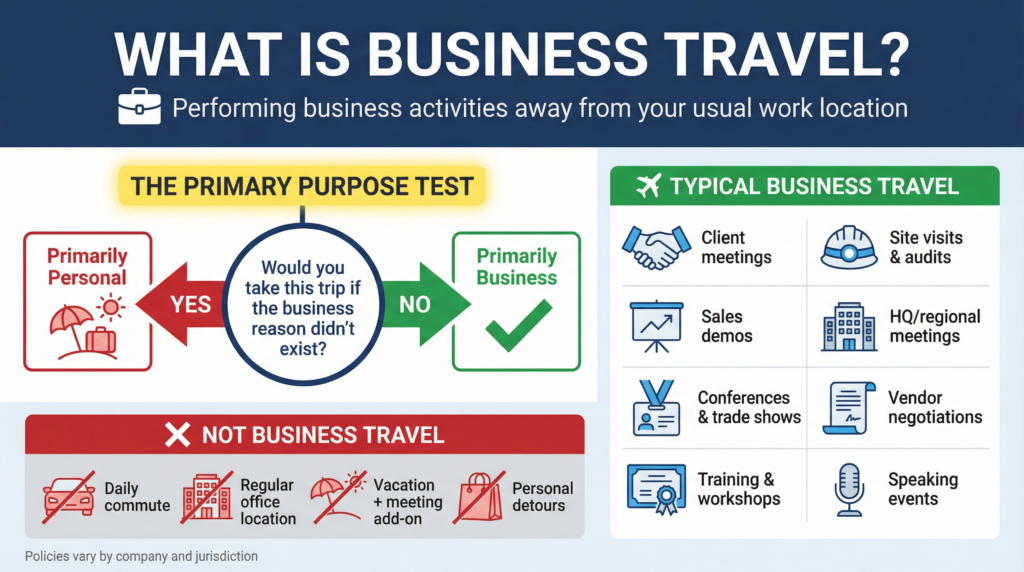
Travel is the primary purpose of performing business activities away from your usual work location.
What “primary purpose” really means
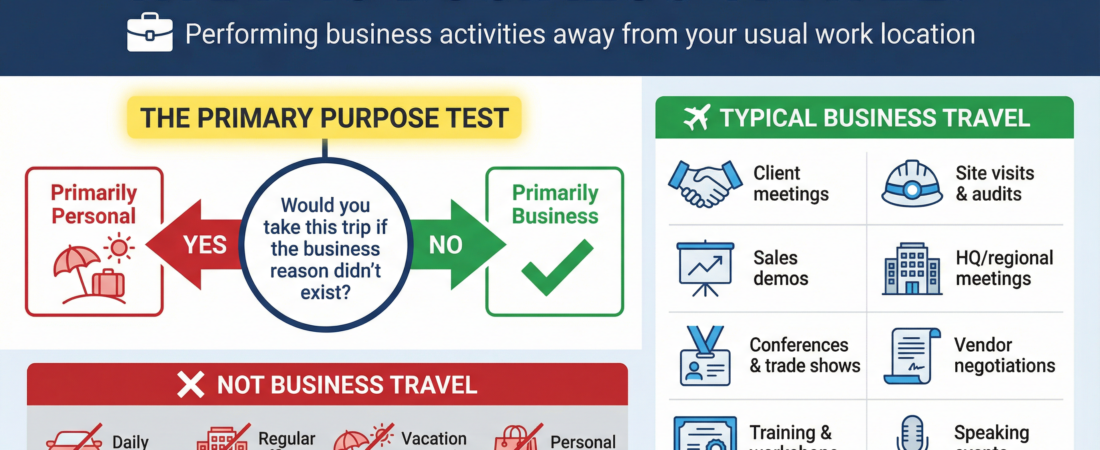
If a trip has both business and personal elements (common with “bleisure”), the key question is: Would you still take the journey if the business reason didn’t exist?
- If yes, it’s likely primarily personal.
- If no, it’s likely primarily business.
Typical business travel activities
Business travel often includes:
- Client meetings and presentations
- Sales demos and territory visits
- Conferences, trade shows, and industry events
- Trainings, certifications, and workshops
- Site visits (construction, IT deployments, audits)
- Internal meetings at HQ or regional offices
- Partner/vendor negotiations
- Speaking engagements and recruiting events
What business travel is not (in most cases)
These are commonly not considered business travel (definitions vary by company/country):
- Your normal daily commute
- Travel to a regular office location you report to
- Trips taken mainly for vacation with “a meeting added on”
- Personal detours and non-essential upgrades outside policy
(Quick note: policies and tax rules vary by jurisdiction and employer—use this as a practical guide, not legal/tax advice.)
4. Key Characteristics of Business Travel
1) A business objective you can state in one sentence
Examples:
- “Show the client in Chicago the results from Q1.”
- “Go to AWS re:Invent for training and meetings with partners.”
- “Go to three regional accounts to renew contracts.”
Reimbursements and write-offs are more difficult to process when you can’t clearly explain the purpose.
2) A schedule (even a simple one)
When you travel for business, you usually have:
- Dates, location(s), and planned activities
- Bookings that match the work schedule (flight times, hotel nights)
- Proof of attendance where relevant (conference badge, agenda, meeting notes)
3) Expenses that must be tracked
When you travel for business, you have to follow “T&E” (travel and expense) workflows:
- Flights, hotels, and ground transportation
- Meals and other costs (usually limited by policy)
- Wi-Fi, baggage fees, tips, and parking
- Conference fees and work-related supplies
If you’re self-funded (entrepreneur, contractor), expense tracking becomes even more critical.
4) A compliance framework
For employees, that’s the corporate travel policy:
- Approved booking channels
- Limits on fare classes and hotels
- Rules for per diem and receipt thresholds
- Preferred vendors and negotiated rates
- Duty of care requirements (where you can and can’t go, safety tools)
For non-employees, “policy” is often the client’s reimbursement terms plus your own documentation standards.
5) Productivity and performance expectations
Unlike leisure travel, business travel usually demands:
- Being “on” right after landing
- Delivering outcomes (meeting, pitch, site work)
- Staying responsive across time zones
- Managing energy, sleep, and routines
This is why frequent business travelers build repeatable systems.
5. Real-World Examples
Corporate road warrior (mid-to-senior management)
You fly from New York to Dallas for two days of stakeholder meetings, then return. The company pays for airfare and hotel; meals are within policy. This is business travel because the trip exists to deliver business outcomes.
Consultant or independent contractor
You travel to a client site for a two-week implementation. The client covers your hotel and flight costs, but you must submit weekly receipts that include project codes and categories. This is business travel with strict documentation.
Sales professional / field rep
You drive across a region to visit four accounts over three days, staying in one hotel and expensing mileage, parking, and meals. This is business travel (even without flying).
Small business owner/entrepreneur
You also get one extra day off after that. If the primary purpose for the trip is the event and meetings, and personal add-ons are clearly separated, it can still be business travel.
Mixed business + leisure (“bleisure”)
You go to London for a business conference and then stay the weekend for fun. To be clean, you should:
- Keep clear records of conference days.
- Separate the extra hotel nights and personal activities.
- Don’t mix the costs of personal companions with business costs.
6. Benefits and Advantages
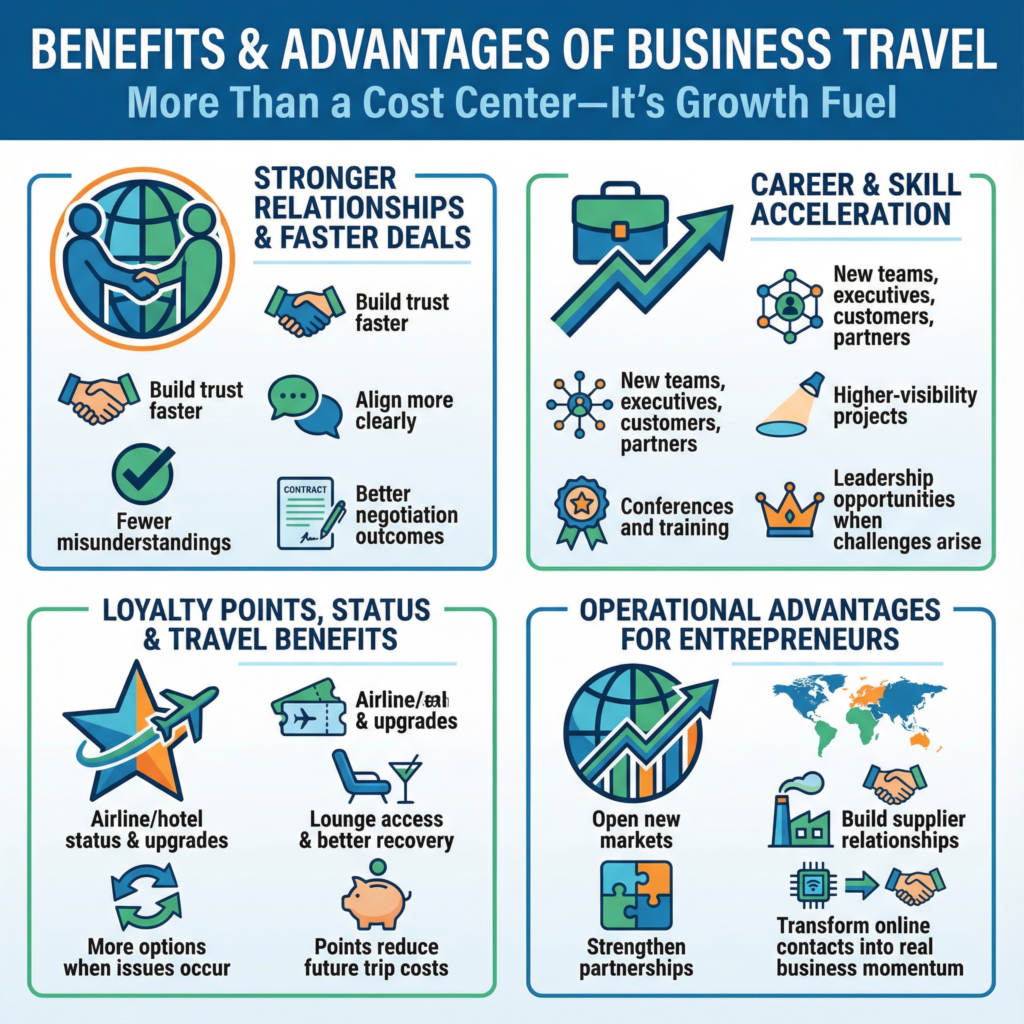
Business travel isn’t just a cost center. When done right, it’s a way to grow.
Stronger relationships and faster deals
Meetings in person can shorten timelines:
- Building trust faster
- Aligning more clearly
- Fewer misunderstandings
- Better negotiation outcomes
Career and skill acceleration
Travel gives you:
- New teams, executives, customers, and partners
- Higher-visibility projects
- Conferences and training
- Leadership opportunities (especially when things go wrong and you deal with it)
Loyalty points, status, and travel benefits
For frequent travelers, optimizing flights and hotels can give them:
- Airline and hotel status (upgrades, priority service)
- Access to lounges and better recovery between legs
- More flexibility when things go wrong
- Points that lower the cost of future trips
Operational advantages for entrepreneurs
If you’re self-funded, travel can:
- Open new markets
- Build relationships with suppliers
- Strengthen partnerships
- Turn “online-only” relationships into real business momentum
7. Related Concepts (That People Mix Up With Business Travel)
Corporate travel management
The systems that make business travel possible:
- Tools for booking (like online booking engines)
- Platforms for expenses
- Approvals and enforcement of policies
- Reporting and negotiating with vendors
Duty of care
Your boss is responsible for keeping you safe while you travel for work:
- Help in case of an emergency
- Tracking your location and checking in (sometimes)
- Risk guidance and restrictions
- Medical/security assistance
T&E (Travel & Expense)
The operational workflow:
- Approvals before the trip
- Rules for making reservations
- Capturing receipts
- Coding, submitting, reviewing, and getting reimbursed for expenses
Per day
A daily allowance for food and other expenses (this varies by organization). If you’re on per diem, you may not need itemized meal receipts, but you must still comply with the rules.
Bleisure travel
A trip that blends business and personal time. It’s common—and totally manageable—if you separate costs and keep the “primary purpose” clear.
Commuting vs. business travel
Commuting is routine travel to your usual workplace. Business travel is non-routine travel to perform work away from your regular base.
Practical Tips for the 3 Biggest Pain Points
A) Policy compliance + reimbursement delays
Make compliance automatic:
- Book inside the approved channel whenever possible
- Screenshot policy limits (hotel cap, meal cap, receipt thresholds)
- Save confirmations in one folder (email label or cloud folder)
- Track expenses daily—don’t “reconstruct” at the end
Speed up reimbursement:
- Submit expenses weekly on long trips
- Write clear memos: “Client dinner – Project X – 3 attendees”
- Attach agendas or event confirmations for conferences
- Keep receipts readable (photo in good light, flat, no blur)
B) Maximizing points/status across fragmented bookings
If you travel 10+ times/year, standardize:
- Pick one primary airline alliance and one primary hotel chain
- Use a dedicated travel card (if allowed) to centralize points
- Avoid scattering bookings across random sites unless savings are huge
C) Jet lag, productivity loss, and healthy routines
A sustainable “road warrior” routine:
- Hydration + electrolytes (especially on flight days)
- A simple mobility routine (10 minutes in the hotel)
- Light exposure strategy (sunlight on arrival)
- “Deep work blocks” scheduled around your energy, not the clock
Gear That Solves Real Business Travel Problems
These are optional but helpful for your readers who want a “plug-and-play” upgrade to their travel system:
A reliable carry-on that survives constant trips
A durable 4-wheel carry-on reduces stress, protects gear, and keeps you moving when connections are tight.
Check a top-rated business carry-on on Amazon
A travel backpack built for laptops + security lines
Look for a clamshell opening, a separate compartment for your laptop, and straps that are comfortable for long walks through the airport.
See business travel backpacks on Amazon
Noise-canceling headphones for flights and hotel work
Great for staying productive in airports, on planes, and in loud hotels, especially when you have to meet with clients the next day.
Browse noise-canceling headphones on AmazonA fast portable charger (power bank) for long travel days
Sometimes you miss your flight or don’t have enough outlets. Make sure your phone and laptop accessories are charged when you need them.
Shop high-capacity power banks on Amazon
Packing cubes to stay organized on multi-leg trips
They speed up unpacking, keep clothes separate, and reduce the “explosion” in hotel rooms.
Check packing cubes on Amazon
8. Conclusion
So, what is travel for business? Travel for business is mostly done to meet work goals away from your normal workplace. It usually has a clear itinerary, expenses that can be tracked, and rules that must be followed.
For corporate travelers, success is about repeatability: book smart, document fast, submit clean expenses, and protect your energy. For entrepreneurs and contractors, it’s about proof: a clear purpose, clean records, and a clear separation of personal add-ons.
When you treat business travel like a system—not a scramble—you get more than miles and receipts. You get better outcomes, less stress, and more control over your time on the road.
9. Frequently Asked Questions
1) What is travel for business exactly?
What is travel for business? Travel for business is mainly done to meet work goals away from your regular workplace. It usually has a clear itinerary, expenses that can be tracked, and rules that must be followed.
2) Does a day trip count as business travel?
Often yes. Many companies classify same-day travel as business travel if it’s outside your normal commute and for a work purpose (policy-specific).
3) Is commuting considered business travel?
Usually not. Typically, commuting to and from work is not considered business travel. Business trips are generally not routine and have a specific goal.
4) Can business travel include leisure days?
Yes, this is “bleisure.” The most important thing is that the primary goal remains business, and you keep personal costs separate (e.g., extra hotel nights, personal activities, and companion costs).
5) What expenses are typically reimbursable?
Airfare, hotel, ground transportation, baggage fees, meals for work (within limits), parking, tolls, and sometimes tips and Wi-Fi are reimbursable. Always do what your company or client says.
6) How can I avoid reimbursement delays?
Submit your expenses on time, include clear receipts, write specific memos, adhere to policy caps, and include supporting documents (such as event agendas and confirmations) for each event.
7) How do frequent travelers maximize loyalty points?
Book with a single airline alliance and hotel chain, use the same traveler profiles, and avoid spreading your reservations too widely.
8) Why does business travel feel so exhausting?
This is because it combines things that make it hard to sleep (time zones) with things that make you work harder (meetings, deadlines). The solution is to follow a set routine: drink plenty of water, move around a little, plan your day wisely, and get better gear.