

Affiliate Disclaimer: TravelForBusiness.org participates in affiliate programs, including Amazon Associates, and may earn a commission from qualifying purchases at no extra cost to you
Business travel isn’t just “showing up in person.” Done well, it’s a growth lever: it builds trust faster, shortens sales cycles, improves collaboration, and protects key accounts—often in ways video calls can’t honestly replicate. If you’re asking why travel is important for business, the honest answer is about outcomes: revenue, retention, speed, and relationships.
And because the reality of travel includes policies, receipts, jet lag, and productivity pressure, this guide also covers when travel is worth it, when it isn’t, and how to travel smarter with fewer headaches.
One quick gear note before we start: if you’re traveling even a few times a year, a reliable carry-on pays for itself in stress saved. A lightweight option that frequent flyers like is the Travelpro Maxlite 5 Carry-On Spinner—check price & availability on Amazon.
Quick Answer (TL;DR)
- In-person trust compounds. Face-to-face meetings accelerate decision-making, build rapport, and reduce misunderstandings.
- Travel wins for high-stakes moments. Sales closes, renewals, escalations, executive alignment, and complex projects often benefit from in-person collaboration.
- It’s also a talent advantage. Business travel supports leadership visibility, team cohesion, and career growth—if it’s managed sustainably.
- The downside is real—but manageable. Systems, the right gear, and smarter itineraries can reduce policy compliance, reimbursement friction, and health impacts.
- Best practice: travel with intent (clear objectives), track ROI (what changed because you went), and standardize your workflow (pack, plan, expense).
Decide whether to travel, go virtual, or choose a hybrid approach in under a minute—answer 6 quick questions and get a clear recommendation plus a prep checklist.
Understanding the Question
When people ask, “Why is business travel important?” they usually mean one of these:
- “Does in-person still matter in a remote-first world?”
- “Is travel worth the cost and time?”
- “How do I justify trips to leadership or finance?”
- “How do I travel without burning out?”
So, instead of romanticizing travel, we’ll compare business travel vs. virtual collaboration, and we’ll break down the situations where travel creates measurable value.
Detailed Explanation
Business travel vs. virtual meetings: what actually changes?
Virtual meetings are excellent for:
- routine check-ins
- quick alignment
- status updates
- low-stakes collaboration
But business travel tends to outperform virtual when the work requires:
- trust-building
- speed of resolution
- complex negotiation
- high-context collaboration
- executive influence
- relationship repair
Why? Because in-person time adds “bandwidth”: side conversations, subtle cues, shared experiences, and faster feedback loops. Those factors reduce friction and increase commitment.
Use this Business Travel ROI Calculator to instantly see if a trip is worth it based on expected value vs total cost (including your time).
Use the Business Travel ROI Calculator →The “value stack” of business travel
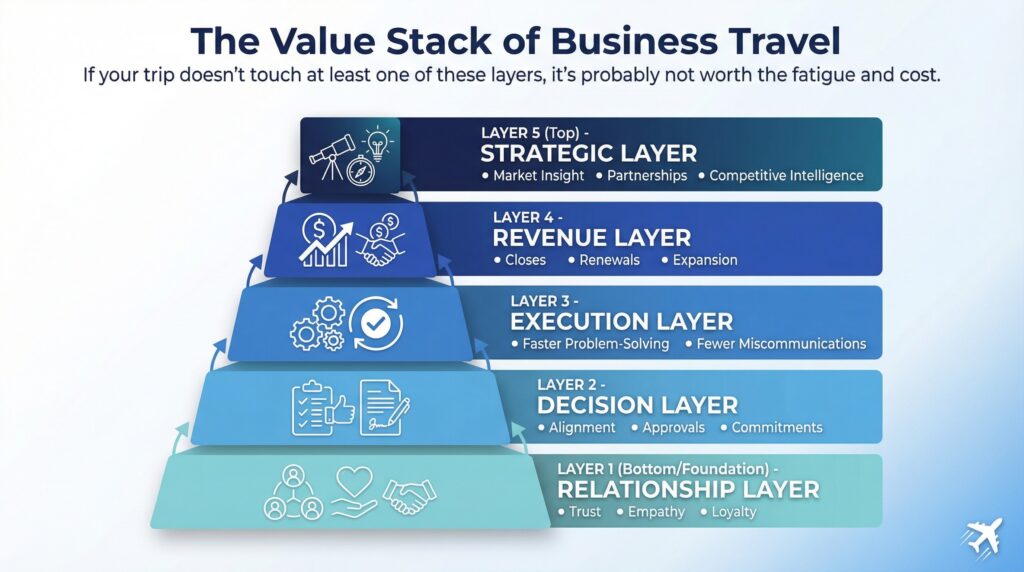
Think of business travel value in layers:
- Relationship layer: trust, empathy, loyalty
- Decision layer: alignment, approvals, commitments
- Execution layer: faster problem-solving, fewer miscommunications
- Revenue layer: closes, renewals, expansion
- Strategic layer: market insight, partnerships, competitive intelligence
If your trip doesn’t touch at least one of these layers, it’s probably not worth the fatigue and cost.
When travel is most important
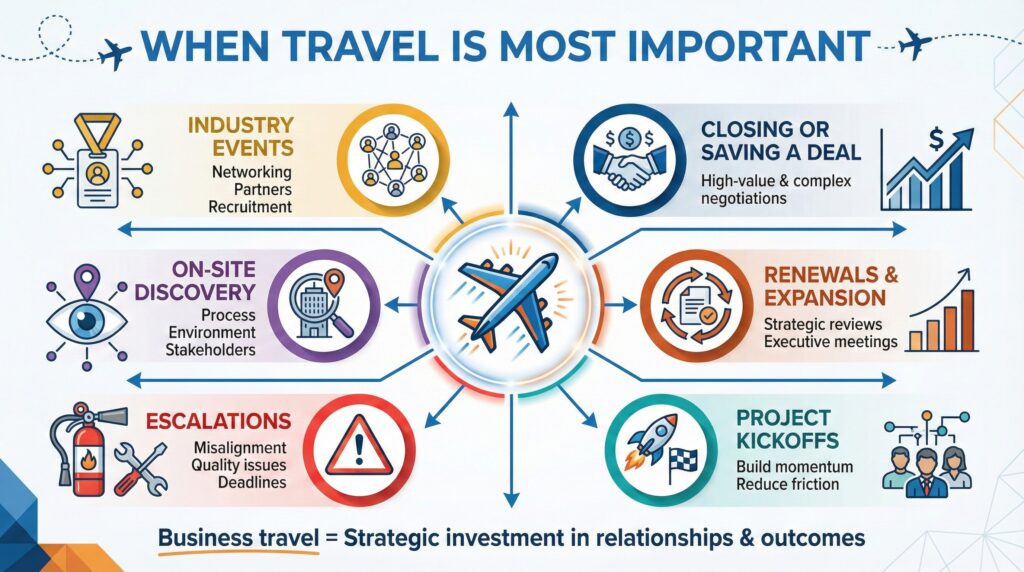
Business travel is often the highest ROI when you’re doing one of the following:
- Closing or saving a deal (especially complex or high-value)
- Renewals and account expansion (strategic reviews, executive sponsor meetings)
- Project kickoffs (reduces future friction; creates “one team” momentum)
- Escalations (misalignment, quality issues, missed deadlines)
- On-site discovery (process, environment, stakeholders—things you can’t fully see remotely)
- Industry events (network effects, partner meetings, recruitment)
When travel is not important (and what to do instead)
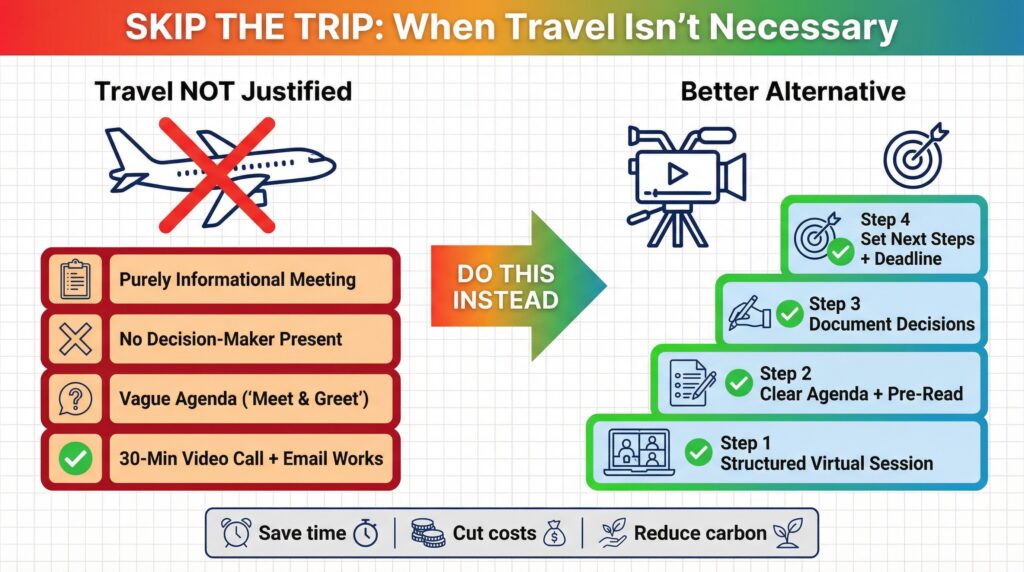
Travel is less justified when:
- The meeting is purely informational.
- No decision-maker is involved.
- The agenda is vague (“meet and greet” with no defined outcomes).
- A 30-minute video call and a written follow-up could help to resolve the issue.
Instead:
- Run a structured virtual session.
- Use a clear agenda and pre-read.
- Record decisions in writing.
- Set the next step and deadline before you end the call.
Key Points
1) Trust builds faster in person (and trust changes everything)
In business, trust reduces the “tax” on every interaction: fewer follow-ups, less second-guessing, faster decisions, and smoother renewals. In-person interactions often build trust faster because you’re sharing time and attention without the usual digital distractions.
Practical outcomes:
- clients respond quicker
- stakeholders give clearer feedback
- teams argue less and align more
- decisions stick because commitment is higher
2) Sales and negotiations move faster when you’re in the room
For sales professionals and consultants, travel is often about compressing time:
- fewer “maybe” answers
- more clarity on objections
- better stakeholder mapping
- a stronger sense of urgency
In-person also helps you read the room and adapt in real time—especially in multi-stakeholder deals.
3) Collaboration improves when complexity is high
Remote tools are great, but complex work has hidden context:
- competing priorities
- unspoken concerns
- internal politics
- unclear ownership
On-site workshops and working sessions often uncover blockers quickly and align the team around a shared plan.
4) Market intelligence is sharper on the ground
Being on site—at a client, a factory, a branch, or a trade show—gives you “texture”:
- What customers actually care about.
- What competitors are doing.
- What’s broken in real workflows.
- What frontline teams won’t say in a group call
5) Business travel supports leadership visibility and career growth
For corporate road warriors, travel can be part of leadership development:
- executive exposure
- cross-functional relationships
- reputation building through high-impact projects
- credibility from “being there when it matters.”
The key is sustainable travel: fewer pointless trips, better recovery, and tighter routines.
6) The costs are real—so treat travel like a system, not a sacrifice
The standard failure mode is treating every trip as a one-off. That creates:
- policy mistakes
- reimbursement delays
- forgotten items
- poor sleep
- low productivity
- burnout
A system fixes this: standardized packing, a repeatable booking strategy, and a clean expense workflow.
A small tool that helps many travelers is a portable receipt scanner—less lost paper, faster claims. If you want one, check price & availability on Amazon.
Examples and Case Studies
Case Study 1: The “renewal save” trip (Account Management)
Situation: A key client is unhappy—missed expectations, creeping frustration, slow email replies. Renewal is in 60 days.
Virtual reality: calls feel tense; stakeholders stay guarded; no one wholly owns the next step.
In-person outcome: a half-day on-site workshop aligns the stakeholders, resets expectations, and produces a clear remediation plan with owners and timelines.
Why travel mattered: escalation + trust repair + executive alignment.
How to measure ROI: renewal retained, expansion opportunities reopened, fewer time-wasting meetings later.
Case Study 2: The “kickoff that saves months” trip (Consulting/Projects)
Situation: A project has many dependencies and cross-functional teams.
Virtual risk: misunderstandings early create weeks of rework, unclear ownership, and slow approvals.
In-person outcome: the kickoff workshop makes roles, decision rights, and milestones clear; everyone leaves on the same page.
Why travel mattered: complicated teamwork and quick alignment.
How to measure ROI: fewer change requests, faster sign-offs, and fewer escalations.
Case Study 3: The “field rep route optimization” trip (Sales/Regional)
Situation: A rep has multiple prospects in a single region but struggles to convert.
Travel strategy: Have cluster meetings over two days and set aside time to meet with current customers to get referrals and proof points.
Outcome: Credibility goes up, objections are dealt with right away, and the next steps are set up right away.
Why travel mattered: relationship layer, momentum, and social proof.
How to measure ROI: meetings-to-proposal ratio, proposals-to-close ratio, pipeline velocity.
Expert Insights
Treat travel like an investment: decide with a simple framework
Before you book, answer these:
A) What is the specific outcome I need?
Examples include: signed renewal, stakeholder alignment, resolved escalations, and on-site discovery.
B) Who must be involved in person?
If the decision-maker isn’t available, reconsider.
C) What happens if I don’t go?
If the downside is slight, stay remote.
D) Can I bundle value?
Add a partner meeting, customer visit, or internal alignment while you’re there.
Track “Travel ROI” in plain language
You don’t need fancy metrics. Use three signals:
- Speed: Did we move faster?
- Clarity: Did decisions or ownership become clearer?
- Revenue/risk: Did we win/save money or reduce risk?
Write a short post-trip summary (5 lines). Over time, you’ll learn which trips pay off.
Reduce travel friction with a “default kit” approach
Frequent travelers benefit from standardizing gear and packing—less decision fatigue, fewer mistakes.
- If you want maximum lightness and easy handling, the Travelpro Maxlite 5 Carry-On Spinner is a solid frequent-trip option—Check price & availability on Amazon.
- If you want a more premium, polished softside carry-on that feels “executive-ready,” consider the Travelpro Platinum Elite Carry-On Spinner—Check price & availability on Amazon.
- If you want the “buy once, travel forever” category and you’re hard on luggage, many road warriors look at Briggs & Riley Baseline Essential Carry-On Spinner—Check price & availability on Amazon.
And one minor upgrade for every suitcase: packing cubes. They keep outfits organized, speed up security checks, and reduce hotel unpacking chaos—Check price & availability on Amazon.
Handle policy compliance and reimbursements like a pro
To reduce reimbursement delays:
- Book within policy (or document exceptions).
- Capture receipts immediately.
- Write the business purpose while it’s fresh.
- Submit weekly, not monthly.
- Keep a repeatable checklist for required fields.
This is where that receipt scanner earns its keep: fewer missing receipts and faster claims—Check price & availability on Amazon.
Protect your health and productivity on the road
Travel doesn’t have to wreck your routine. Use “minimum viable habits”:
- hydration + protein first
- 20–30 minutes daylight + walking
- consistent sleep window when possible
- caffeine cutoff
- short workout (even bodyweight in the hotel)
The goal isn’t perfection—it’s consistency.
Additional Resources
If you want to go deeper, build a small business-travel “operating system” around these topics:
- Travel policy mastery: what to pre-approve, how to document exceptions, and how to avoid reimbursement rejections
- Loyalty strategy: how to focus on one airline/hotel chain where possible, and when to prioritize convenience over points
- Trip templates: pre-built itineraries (same-day client visit, 2-day short trip, conference week)
- Packing checklist: one master list + role-specific add-ons (sales, consultant, executive)
- Expense workflow: capture → categorize → submit → follow-up
Conclusion
Business travel remains vital because it delivers outcomes that are difficult to replicate remotely: stronger relationships, faster decisions, better collaboration, and sharper insights. The smartest professionals don’t travel more—they travel with more apparent intent. Travel becomes a strategic advantage when the goal is to build trust, increase revenue, reduce risk, or accelerate the process. When it’s vague, it becomes a drain.
If you build a repeatable system—policy-aware booking, standardized packing, and a clean expense workflow—you get the upside of travel without the constant friction.
Frequently Asked Questions
Is business travel still necessary in 2026?
Often, yes—especially for high-stakes work: complex sales, renewals, escalations, onboarding major partners, and executive alignment. Routine updates usually don’t require travel.
What are the most significant benefits of business travel?
The most significant benefits are trust-building, faster decisions, more effective collaboration on complex work, and stronger client relationships that protect revenue over time.
How do I justify business travel to leadership or finance?
Tie the trip to outcomes: a renewal, a close, a project kickoff that reduces rework, or an escalation that protects revenue. Share a short post-trip summary of what changed because you went.
When should I not travel for business?
Don’t travel when the meeting has no decision-maker, no clear agenda, or no measurable outcome—especially if a structured virtual session can achieve the same result.
How can I avoid burnout as a frequent business traveler?
Limit trips to high-impact moments, cluster meetings to reduce total travel days, and protect “minimum viable habits” (sleep window, hydration, movement, and simple nutrition).
What’s the simplest way to reduce reimbursement delays?
Capture receipts immediately, document business purpose clearly, submit weekly, and keep a consistent format. A receipt scanner, for example, can help to reduce paperwork that goes missing.
Does business travel help career growth?
It can—when it’s strategic. Travel increases visibility, relationship depth, and leadership credibility when you’re attached to meaningful outcomes (not just being busy).