
Affiliate disclaimer: TravelForBusiness.org participates in affiliate programs, including Amazon Associates, and may earn a commission from qualifying purchases at no extra cost to you.
Quick Answer (TL;DR)
Business travel is a repeatable workflow: get approval → book within policy → travel and document expenses → submit an expense report → get reimbursed (or reconcile a corporate card).
Most friction happens in three places:
- Policy compliance: what you’re allowed to book, and how.
- Receipts + documentation: proving the business purpose and amounts.
- Time + energy management: staying productive while living out of a bag.
If you master those, business travel becomes predictable—and surprisingly low-stress.
Understanding the Question
When people ask, “how does business travel work?” they usually mean one (or more) of these:
- Who pays—the company or me?
- How do approvals and booking tools work?
- What counts as reimbursable—and what doesn’t?
- How do I avoid reimbursement delays?
- How do I travel often without burning out?
The answer depends on whether you’re traveling for:
- A corporate employer (with policies, booking tools, and finance rules)
- Your own business (you set the rules, but you carry the risk)
- A client contract (you may have to match the client’s policy + your own)
Detailed Explanation
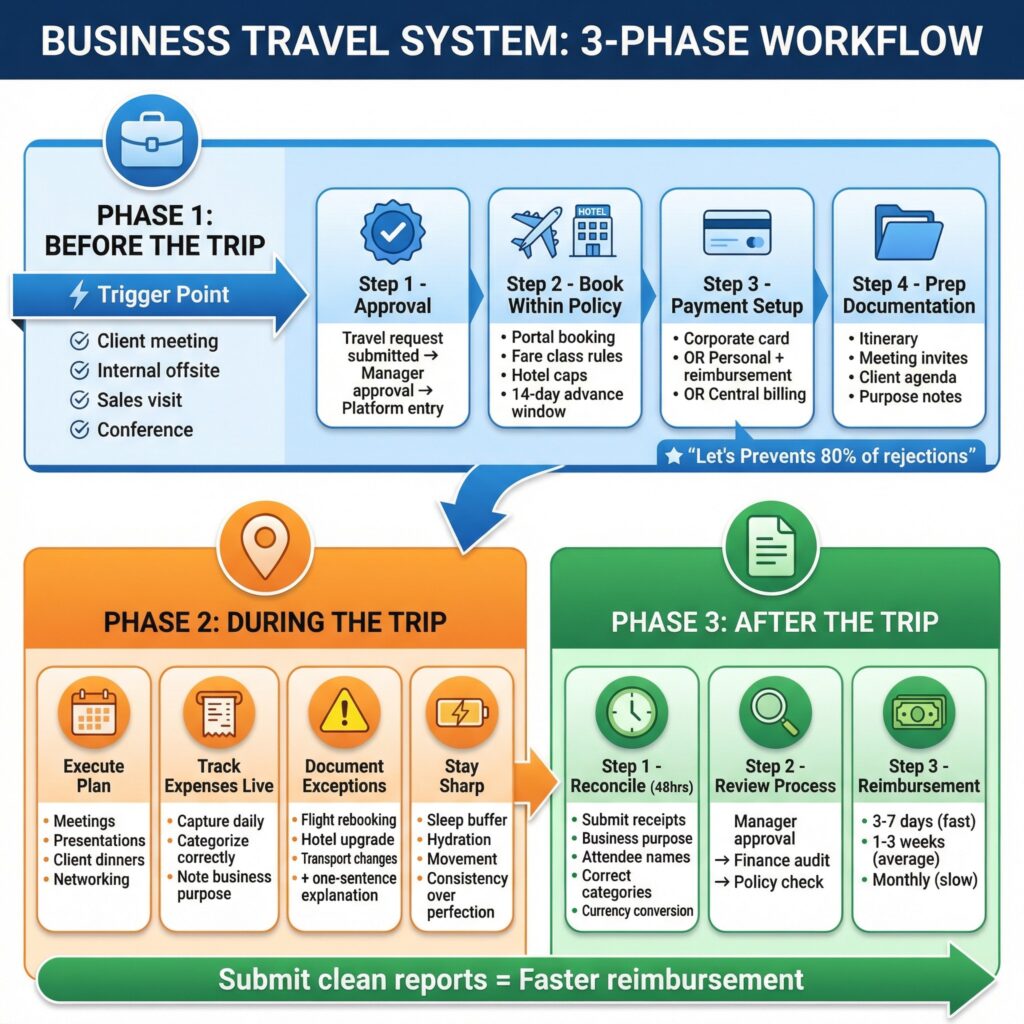
The Business Travel “System” in Plain English
Think of business travel as three phases:
- Before the trip: approval, booking, and setting yourself up to win.
- During the trip: execute, stay compliant, capture proof.
- After the trip: expense report, reimbursement, and cleanup.
Let’s break each phase down into what actually happens.
Want the whole process in a personalized checklist? Build your workflow in 30 seconds.
Build Your Business Travel Workflow →Phase 1: Before the Trip (Approval + Booking)
1) The trip gets triggered
A business trip usually starts with a “need”:
- Client meeting
- Internal offsite
- Sales visit
- Project kickoff
- Conference/training
Then the machine starts moving.
2) You get approval (formal or informal)
In many companies, you’ll do one of these:
- Submit a travel request (dates, destination, reason, estimated cost).
- Get a manager’s approval via email/Slack.
- Use a corporate travel platform (Concur Request, Egencia/Amex GBT, Navan, etc.).
Pro tip: The approval step is where most people lose time. A short, explicit request speeds everything up:
- Purpose: “Client quarterly review + onsite workshop.”
- Dates: include buffers if needed.
- Cost estimate: flight, hotel, and local transport.
- Any exceptions: “Need refundable fare due to schedule risk.”
3) You book within policy
Most corporate policies define:
- Where you must book (travel portal, approved travel agency, specific airlines/hotels)
- Fare class rules (economy vs. premium economy vs. business class).
- Hotel limits (nightly caps, preferred brands, location rules)
- Car vs rail vs rideshare guidelines
- Advance booking windows (e.g., “book 14 days out when possible”)
If you’re self-employed, you’re making the policy—but you still need a system:
- Choose a default airline alliance/hotel chain for loyalty.
- Use one consistent method to track receipts and the trip purpose.
- Decide what you’ll expense vs what you’ll treat as personal.
4) Payment method is decided
Common setups:
- Corporate card: the company pays the card issuer; you reconcile expenses.
- Personal card + reimbursement: you pay upfront; the company reimburses.
- Central billing: flights/hotels billed directly to the company.
- Client-billed travel: you invoice the client for travel (often with rules).
Watch out: If you’re paying with a personal card, reimbursement delays can become a cash flow issue. Plan for it.
5) You prep documentation (the “reimbursement insurance”)
This is where experienced travelers quietly win.
Before you leave, create a simple “proof folder”:
- Itinerary + confirmations
- Meeting invite/event registration
- Client agenda or purpose statement
- A note: “Who, what, why” for any unusual expenses
That one habit prevents 80% of the “finance rejected my report” pain.
Phase 2: During the Trip (Execution + Compliance)
1) You follow the trip plan (but stay flexible)
Business travel is never “just travel.” It’s travel plus performance:
- Meetings
- Deadlines
- Networking
- Presentations
- Client dinners
So your priorities shift from “fun” to “smooth.”
2) You track expenses in real time
This is the big one.
Most reimbursement delays are caused by:
- Missing receipts
- Unclear business purpose
- Wrong expense category
- Duplicates (especially with tips, split bills, or multiple travelers)
Best practice: capture receipts daily, not at the end.
If you want the most straightforward “zero-stress” setup, use a dedicated scanner so every receipt becomes a clean PDF in seconds:
Expense-proofing:
- Portable Receipt Scanner (great for road warriors who hate admin): Check price on Amazon
3) You stay inside policy (or document the exception)
Sometimes exceptions are valid:
- Flight canceled → rebooked last-minute at higher cost
- Hotel sold out near the site → higher rate elsewhere
- Client dinner runs long → rideshare instead of public transit
The trick is simple: write one sentence of context while it’s fresh.
Example: “Rebooked due to cancellation; next available flight was a higher fare.”
That sentence can save hours of back-and-forth later.
4) You protect productivity and health (this is the hidden game)
Business travel “works” when you can show up sharp, repeatedly.
A few non-negotiables:
- Sleep buffer: don’t land 20 minutes before a critical meeting
- Hydration + electrolytes: planes dry you out
- Simple routine: same morning flow every trip
- Movement: 20 minutes of walking beats a 0-minute gym plan
You’re not trying to be perfect. You’re trying to be consistent.
Phase 3: After the Trip (Expense Report + Reimbursement)
1) You reconcile expenses (ideally within 48 hours)
Most companies expect reports submitted within a time window (often 5–14 days). The sooner you do it, the fewer errors and the faster you get paid.
A clean expense report usually includes:
- Receipts (where required)
- Business purpose (per item or per day)
- Attendees for meals/entertainment (names + company)
- Correct categories (airfare, hotel, meals, local transport, etc.)
- Currency conversion handled correctly (if international)
2) The report gets reviewed
Depending on the organization, review may include:
- Manager approval
- Finance audit
- Policy checks (caps, preferred vendors, receipt rules)
If something is missing, it is returned, and reimbursement is paused.
3) Reimbursement happens (or card is settled)
Typical timelines:
- Fast organizations: 3–7 business days
- Average: 1–3 weeks
- Slow: monthly cycles
Pro move: keep a simple checklist so your reports pass the first time.
Avoid reimbursement delays—generate a receipts + report checklist you can copy/paste.
Use the Expense Report Generator →Key Points (What to Remember)
The 80/20 of business travel
- Approval + booking: do it once, do it right, stay within policy
- Receipts: capture them daily
- Purpose: always attach the “why” to the spend
- Consistency: your energy is the real travel budget
The “3-proof rule” for reimbursable expenses
For anything that might be questioned, make sure you have:
- Receipt or invoice
- Business purpose (one sentence)
- Who benefited (client/team names if needed)
The gear that quietly makes everything easier
You don’t need more stuff—you need fewer friction points.
One-bag sanity:
- Travelpro Platinum Elite Carry-On Spinner (built for frequent flyers): See it on Amazon
Stay organized fast:
- Packing Cubes (separate workwear, gym, cables, and “just in case”): Check options on Amazon
Hands-free airport flow:
- Nomatic 20L Travel Pack (expandable) (smart pockets + clean professional look): View on Amazon
Examples and Case Studies
Case Study 1: Corporate road warrior (10–20 trips/year)
Scenario: A mid- to senior-level manager visits regional offices monthly.
How travel works for them:
- Trips are usually pre-approved by role/budget
- Booking must happen through a corporate portal
- A corporate card is required
- Expense reports are audited randomly
What makes them successful:
- Always books preferred hotels (policy compliance)
- Uses a repeatable packing system (less mental load)
- Submits expenses within 48 hours (fewer missing receipts)
Case Study 2: Sales rep (budget-conscious, client-facing)
Scenario: 3-day regional loop with two client meetings per day.
How travel works:
- Must keep costs low (policy caps)
- Needs flexibility (clients reschedule)
- Meals/entertainment documentation is critical (attendees + purpose)
What makes them successful:
- Uses refundable fares only when justified
- Adds business notes immediately after client dinners
- Keeps a “meeting-ready” kit in carry-on (charger, backup shirt, grooming basics)
Case Study 3: Small business owner (self-funded travel)
Scenario: Founder travels to a conference and adds 1 leisure day.
How travel works:
- They pay upfront and track deductions/records themselves
- They must clearly separate business vs personal expenses
- They need clean documentation in case of questions later
What makes them successful:
- Keeps a separate folder per trip
- Saves invoices and agendas
- Uses one tool/system to store receipts consistently
Expert Insights (What Pros Do Differently)
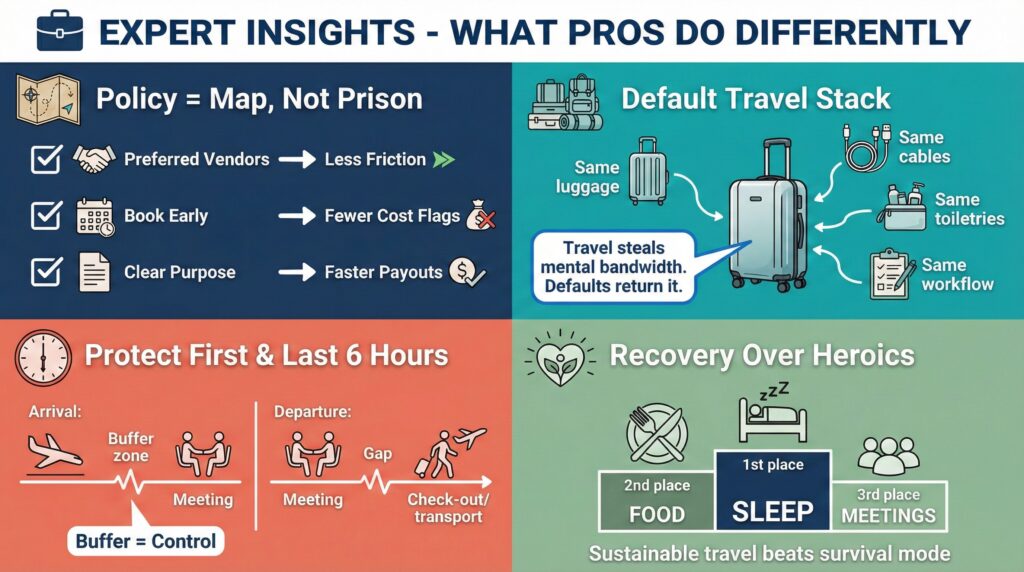
1) They treat policy like a map, not a prison
Pros don’t fight the system. They learn the rules and use them to move faster:
- Preferred vendors reduce approval friction
- Booking early reduces cost flags
- Clear business purpose prevents audits from stalling payouts
2) They build a “default travel stack”
Same luggage. Same cables. Same toiletries. Same workflow.
Why? Because travel already steals mental bandwidth. Defaults give it back.
3) They protect the first and last 6 hours
Those hours decide whether a trip feels smooth or chaotic:
- Arrive with a buffer.
- Avoid scheduling critical meetings immediately after landing.
- Leave space on departure day for check-out, transport, and delays
4) They optimize for recovery, not heroics
The goal isn’t to “survive” business travel. It’s to repeat it without burnout:
- Sleep first
- Food second
- Meetings third (yes, really)
Additional Resources
If you’re building a stronger business-travel system, create (or look for) resources like:
- Your company’s travel policy (PDF or intranet page)
- Expense category cheat sheet (what goes where)
- Packing checklist for your role (sales vs consultant vs leadership)
- Loyalty strategy (one airline alliance + one hotel brand to start)
- Personal “Go Bag” setup (always ready)
You can also build internal templates:
- “Trip purpose” one-liners you reuse
- Standard expense report notes
- A “client entertainment” log format (who/where/why)
Conclusion
Business travel works best when you stop treating it like a series of emergencies and start treating it like a repeatable system.
- Plan and book inside policy
- Capture proof daily
- Submit expenses fast
- Protect your energy like it’s part of your job (because it is)
Do that, and you’ll spend less time fighting reimbursement… and more time getting results on the road.
Frequently Asked Questions
How does business travel work for employees vs. contractors?
Employees typically adhere to company policies, use corporate booking tools, and receive reimbursement (or reconcile corporate cards). Depending on the contract terms, contractors may invoice clients or include travel expenses in project pricing.
Who pays for business travel?
It all depends. Some companies accept corporate cards or direct billing, while others require you to pay in advance and then submit for reimbursement. Always confirm your payment method before booking.
What expenses are usually reimbursable?
Common reimbursables include airfare, hotel, ground transportation, and meals (often with caps). Client entertainment may require attendee lists and business purpose.
Why do reimbursements get delayed?
The top reasons: missing receipts, unclear business purpose, incorrect categories, policy exceptions without explanation, or late submission.
What is a per diem, and how is it used?
A per diem is a daily allowance for meals and incidentals (sometimes lodging). If your company uses per diem, you may not need meal receipts—but rules vary widely.
Can I earn loyalty points on business travel?
Often, the answer is yes, particularly if you make your own reservations. However, some companies restrict specific booking methods or require corporate rates. If loyalty matters, choose one airline/hotel ecosystem and be consistent.
How do I avoid jet lag and stay productive?
Hydrate, protect sleep, build buffers, and keep a simple routine. The goal is consistent performance, not perfection.
What’s the simplest way to stay organized on the road?
Use a consistent luggage + packing system, and capture receipts daily. (This is where packing cubes and a receipt scanner pay for themselves fast.)
So… how does business travel work?
At its core: approval → booking → travel → documentation → expense report → reimbursement/reconciliation. Once you build a repeatable routine, it becomes straightforward.