
Affiliate Disclaimer: TravelForBusiness.org participates in affiliate programs, including Amazon Associates, and may earn a commission from qualifying purchases at no extra cost to you.
Your manager says the company pays “per diem” on your next trip. Sounds simple, until you land on a Monday afternoon, the client buys you lunch on Wednesday and you fly home Thursday night. How much do you actually get? Is it taxable? Do you need receipts?
This guide explains how a business travel per diem works in plain English: where the rates come from, how the 75% rule for travel days works, what happens when meals are provided, and when a per diem becomes taxable income. All rates are the new FY 2027 numbers that apply to travel from October 1, 2026 through September 30, 2027. Use the calculator below to work out your own trip.
The short version:
- Per diem is a fixed daily allowance for lodging, meals and incidental expenses on a business trip, paid instead of (or next to) itemized receipts.
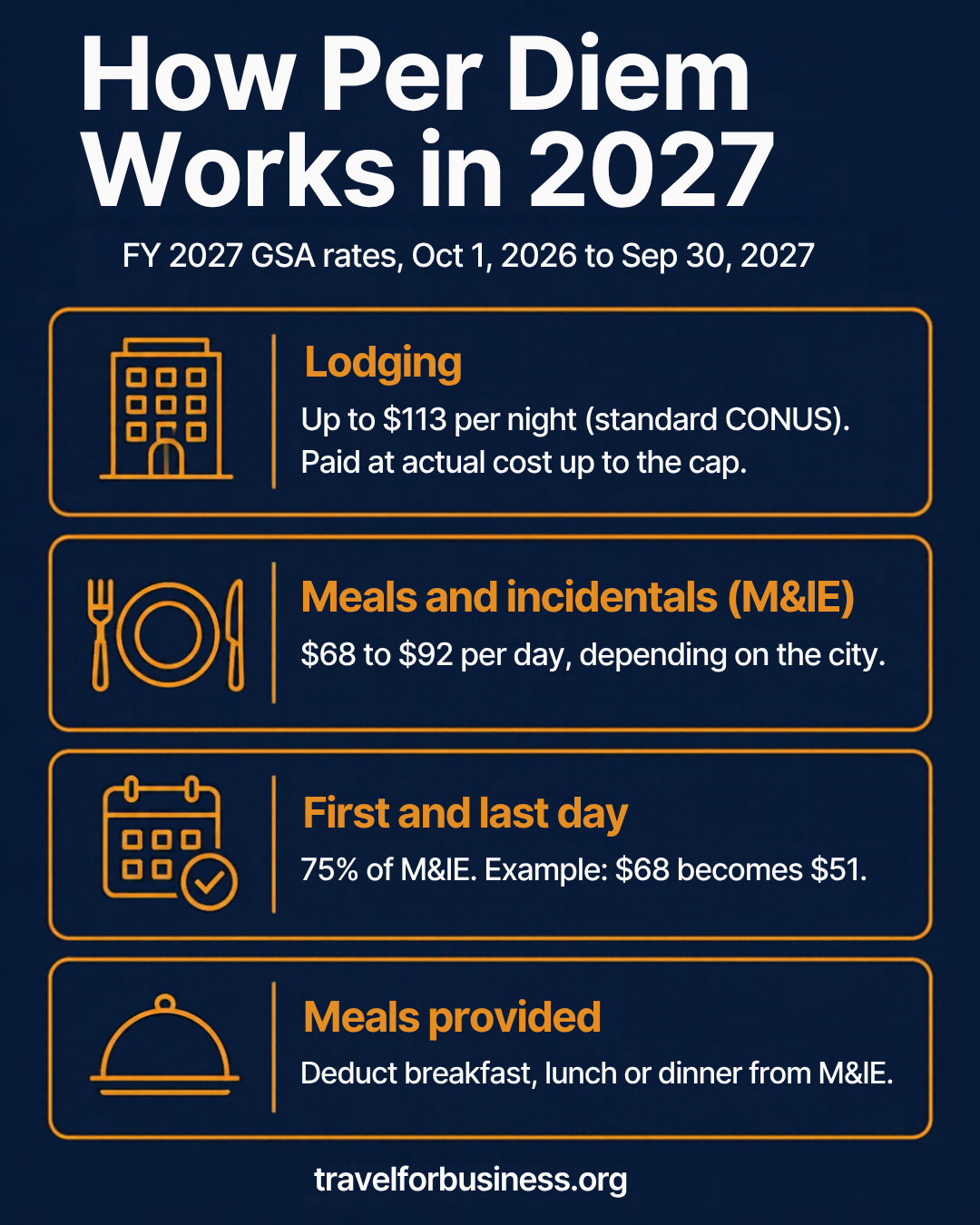
- Standard U.S. rate for FY 2027: up to $113 per night for lodging and $68 per day for meals and incidentals (M&IE). Expensive cities go up to $92 M&IE.
- First and last day: 75% of the M&IE rate.
- Tax: tax-free for employees under an accountable plan, as long as the allowance does not exceed the federal rate and you account for the trip.
- Best gear for it: a pocket Epson WorkForce ES-50 portable scanner to digitize hotel folios and receipts on the road.
What Is a Per Diem?
“Per diem” is Latin for “per day”. In business travel it means a fixed daily amount your employer pays to cover the cost of being away from home overnight. Instead of collecting every coffee and taxi receipt for meals, you get a set amount per day and spend it as you like.
A per diem normally covers three things:
- Lodging: the hotel room, excluding taxes in the federal system.
- Meals: breakfast, lunch and dinner.
- Incidental expenses: in IRS terms, tips and fees for porters, baggage carriers and hotel staff (IRS Publication 463). Laundry, phone calls and taxis to restaurants are not incidentals; they are reimbursed separately as ordinary travel expenses.
Some companies pay a full per diem (lodging plus meals). Most pay actual hotel cost from receipts and a per diem only for meals and incidentals. That second version is called an M&IE per diem, and it is what most employees mean when they say “per diem”.
Airfare, rental cars, mileage, baggage fees and conference registration are never part of the per diem. Those are reimbursed at actual cost. If you are new to the expense side of work trips, our guide on how business travel works explains the full process from booking to reimbursement.
Where Per Diem Rates Come From
Private companies can set any rate they want, but almost all U.S. employers anchor their policy to one of two federal sources, because those rates are what the IRS accepts as tax-free.
1. GSA rates (by city)
The General Services Administration publishes per diem rates for every county in the continental United States (CONUS) each fiscal year. For FY 2027 the standard lodging rate rose from $110 to $113 per night, while the M&IE tiers stayed the same at $68 to $92 per day. 295 locations have a higher, non-standard rate (GSA Per Diem Bulletin FTR 27-01).
Lodging rates in big cities change by season. Washington DC, for example, is $287 per night in October 2026, $203 from November through February and $295 from March through June 2027, with $92 for M&IE (GSA). Always look up the city and month you travel.
2. IRS high-low rates (two rates for the whole country)
Looking up hundreds of county rates is a lot of admin for a small company. The IRS therefore offers a simplified high-low method with just two rates. From October 1, 2026 these are (IRS Notice 2026-60):
- High-cost localities: $329 per day, of which $86 is for M&IE.
- All other CONUS locations: $230 per day, of which $74 is for M&IE.
- Incidental expenses only: $5 per day, for days when you pay no meals.
- Transportation industry: $80 per day M&IE in CONUS and $86 outside CONUS.
The notice lists which cities count as high-cost, some only in certain months. The rules for using these rates come from Revenue Procedure 2019-48.
3. Foreign travel
For trips outside the United States, the State Department publishes foreign per diem rates by city, and the Defense Department sets rates for Alaska, Hawaii and U.S. territories. The same logic applies: a lodging cap plus a daily M&IE amount.
How Per Diem Is Calculated
Three rules decide what you get for a trip.
The 75% rule for travel days
On the day you leave and the day you return, you get 75% of the M&IE rate. At the standard $68 rate that is $51 per travel day; at $92 it is $69. The IRS accepts this method, or any other method you apply consistently that follows reasonable business practice (IRS Publication 463).
Lodging per night, not per day
A four-day trip has three hotel nights. Under a GSA-based policy you are reimbursed your actual room rate up to the cap. If the hotel is cheaper, you get the lower amount. Lodging taxes are usually reimbursed on top.
Provided meals are deducted
If a conference, client or your employer pays for a meal, most policies deduct that meal from your M&IE using the GSA breakdown. A hotel breakfast included in the room rate counts too. The incidentals portion of $5 stays.
| M&IE rate | Breakfast | Lunch | Dinner | Incidentals | First and last day (75%) |
|---|---|---|---|---|---|
| $68 | $16 | $19 | $28 | $5 | $51.00 |
| $74 | $18 | $20 | $31 | $5 | $55.50 |
| $80 | $20 | $22 | $33 | $5 | $60.00 |
| $86 | $22 | $23 | $36 | $5 | $64.50 |
| $92 | $23 | $26 | $38 | $5 | $69.00 |
Worked example
A Monday to Thursday trip to a standard-rate city, with lunch provided at a client meeting on Wednesday:
- Lodging: 3 nights x $113 = $339
- M&IE full days (Tuesday, Wednesday): 2 x $68 = $136
- M&IE travel days (Monday, Thursday): 2 x $51 = $102
- Provided lunch: minus $19
- Total: $558, of which $219 is M&IE
Calculate Your Per Diem
Pick the rate your company uses, enter the number of travel days and any meals that were paid for you. The calculator handles the 75% days, the lodging cap and the meal deductions, and shows what a self-employed traveler can deduct.
Per Diem Calculator
Pick a rate, enter your travel days and any meals that were provided. The calculator applies the 75% rule for the first and last day and deducts provided meals the way federal-style policies do.
$0.00
Loading the checkerEstimate only. Meal deductions use the GSA M&IE breakdown (breakfast, lunch and dinner amounts per tier); custom rates use the same proportions as the $68 tier. Lodging taxes are usually reimbursed separately. Your employer’s travel policy decides what you are actually paid, and this is not tax advice.
Is Per Diem Taxable?
For employees, a per diem is tax-free when your employer pays it under an accountable plan. An accountable plan has three requirements (IRS Publication 463):
- Business connection: the expense was incurred while working away from home.
- Substantiation: you report the time, place and business purpose of the trip within a reasonable period (the IRS safe harbor is 60 days). With a per diem you do not need meal receipts, but you do need proof of the trip itself.
- Return of excess: any advance you did not use for the trip is paid back within a reasonable period (120 days under the safe harbor).
Two situations make a per diem (partly) taxable:
- The rate is higher than the federal rate. If your employer pays $100 M&IE in a $68 city, the $32 difference is wages and appears on your W-2.
- There is no overnight stay. Meal money on a day trip is taxable, because for tax purposes you are only “traveling away from home” when you need sleep or rest.
What if your employer pays nothing? Then you are out of luck at tax time. The One Big Beautiful Bill Act made the suspension of miscellaneous itemized deductions permanent, so employees can no longer deduct unreimbursed business expenses (University of Illinois Tax School). Ask for a per diem or reimbursement policy instead.
Not sure your trip qualifies at all? Read how to prove a trip is for business before you file the expense report.
Per Diem for the Self-Employed
Freelancers and business owners can use the federal M&IE rate as their meal deduction instead of keeping every receipt. This is called the standard meal allowance. Two limits apply (IRS Publication 463):
- Meals at 50%: you can deduct only half of the M&IE amount. Travelers subject to Department of Transportation hours-of-service rules, such as truck drivers, can deduct 80%.
- No lodging per diem: self-employed travelers always deduct lodging at actual cost, so keep the hotel folio.
The guide to writing off travel as a business expense covers the rest of the deductible costs, from airfare to dry cleaning.
Per Diem vs Actual Expense Reimbursement
| Per diem | Actual expenses | |
|---|---|---|
| Meal receipts needed | No | Yes, every meal |
| Admin for traveler | Low | High |
| Admin for finance team | Low, predictable budget | High, every line checked |
| Expensive client dinner | Not covered beyond the rate | Covered if approved |
| Cheap trip | Traveler keeps the difference | Only what you spent |
| Best for | Frequent, routine travel | Executives, client entertainment |
Many companies combine both: actual cost for hotels and flights, a per diem for meals. Booking and expense platforms can apply the rates automatically. Our Navan guide shows how that works in practice.
Tools That Make Per Diem Paperwork Easier
A per diem means fewer receipts, not zero. You still need the hotel folio, transport receipts and a record of the trip. These three items keep that under control.
1. Epson WorkForce ES-50: Scan Receipts in the Hotel Room
Phone apps work for a single receipt, but a long hotel folio or a stack of taxi slips is faster with a real scanner. The ES-50 weighs 0.59 lb, runs on USB power from your laptop and scans a page in about 5.5 seconds. The included software can create searchable PDFs (Epson). Scan everything on the last evening and your expense report is done before you board.
Trade-offs: it needs a cable to your laptop and scans one sheet at a time. If you want to scan without a laptop, look at the wireless ES-60W.
Check the Epson WorkForce ES-50 on Amazon
2. Maimis Accordion Receipt Organizer: One Pocket per Trip Day
A small 13-pocket accordion file in A6 size fits in a laptop bag and gives each day of the trip its own pocket. Paper receipts stay flat and in order, which makes scanning or handing them in much faster.
Check the Maimis Receipt Organizer on Amazon
3. Bellroy Travel Folio: Passport, Cards and Paperwork in One Place
A zip-around travel folio keeps your passport, cards, a pen and folded boarding passes or receipts together, so nothing ends up loose in a jacket pocket. Bellroy’s version is slim enough to carry all day (Bellroy).
Check the Bellroy Travel Folio on Amazon
How to Choose the Right Per Diem Policy
If you set the travel policy for your company, these questions decide the best setup:
- How many destinations? A few fixed cities: use the GSA rate per city. Travel all over the country: the IRS high-low method is far simpler.
- Lodging or meals only? A meals-only per diem with actual hotel cost avoids arguments about expensive conference hotels.
- Do you want to pay more than federal rates? You can, but the excess must run through payroll as taxable wages.
- One method per year. An employer that uses the high-low method for an employee generally has to keep using it for that employee’s travel for the rest of the calendar year (Rev. Proc. 2019-48).
Per Diem Tips for Business Travelers
- Look up the rate for the city where you work, not where you sleep. The GSA bases the rate on the work location.
- Check the month. Seasonal rates in cities like New York and Washington can differ by more than $100 per night.
- Report provided meals honestly. Auditors compare conference agendas with per diem claims.
- Keep a simple trip log: dates, city, client or event and purpose. That is your substantiation.
- Submit within 60 days. Late reports can turn a tax-free per diem into taxable income.
- Rates reset every October 1. Recheck them before the first trip of each fiscal year.
Final Verdict
A business travel per diem is the simplest way to cover meals and lodging on a work trip: a fixed daily amount, 75% on travel days, minus any meals someone else paid for. For FY 2027 the baseline is $113 for lodging and $68 for M&IE, up to $92 in expensive cities, or $329 and $230 under the IRS high-low method. Stay within the federal rate, document the trip within 60 days and the money is tax-free.
The paperwork that remains is the hotel folio and your trip log. A small portable scanner turns that into a five-minute job on the last night of the trip.
Related Articles
- Can I Write Off Travel as a Business Expense?
- How to Prove a Trip Is for Business
- How Does Business Travel Work?
- Complete Guide to Travel for Business
Frequently Asked Questions
Question: What is the standard per diem rate for 2027?
Answer: For federal fiscal year 2027 (October 1, 2026 to September 30, 2027) the standard CONUS rate is $113 per night for lodging and $68 per day for meals and incidental expenses. Higher-cost cities have M&IE rates of $74, $80, $86 or $92.
Question: Do I get a full per diem on the first and last day of travel?
Answer: No. Most policies pay 75% of the M&IE rate on the departure and return days, which is $51 at the standard $68 rate. Lodging is paid per night, so a four-day trip has three nights.
Question: Is a business travel per diem taxable?
Answer: Not for employees, as long as the employer pays it under an accountable plan, the rate does not exceed the federal rate and you substantiate the time, place and purpose of the trip. Any amount above the federal rate is taxable wages.
Question: Do I need receipts if I get a per diem?
Answer: Not for meals and incidentals. You still need proof of the trip itself, and under most policies you need the hotel folio for lodging, because lodging is usually paid at actual cost up to the cap.
Question: What happens to per diem when meals are provided?
Answer: The provided meal is deducted from your M&IE using the GSA breakdown. At the $68 rate that is $16 for breakfast, $19 for lunch and $28 for dinner. The $5 for incidentals is not deducted.
Question: Can self-employed people use per diem rates?
Answer: Yes, for meals. The self-employed can deduct the federal M&IE rate instead of actual meal costs, but only 50% of it (80% for DOT hours-of-service workers). Lodging must always be deducted at actual cost.