

Affiliate Disclaimer: TravelForBusiness.org participates in affiliate programs, including Amazon Associates, and may earn a commission from qualifying purchases at no extra cost to you.
You land at 7:00, walk into a 10:00 meeting feeling fine, and by 15:00 you have lost the thread. That night you are wide awake at 3:00. That is jet lag, and on a business trip it costs you exactly the hours you flew in for.
This guide explains how to beat jet lag on business trips with the methods sleep researchers and the CDC actually recommend: shifting your sleep before you leave, timing bright light, and handling caffeine, naps and alcohol the smart way. Use the free Jet Lag Planner below to get a day-by-day light and sleep schedule for your own route.
The short version:
- Shift early: move your bedtime 1 hour per day toward destination time for 2 to 3 days before you fly.
- Use light as your main tool: after flying east, get bright light in the morning and avoid it in the evening. After flying west, do the opposite.
- Live on local time from day one: meals, bedtime and caffeine all follow the destination clock.
- Nap short: 20 to 30 minutes at most, so you still sleep at night.
- Pack a sleep kit: a contoured sleep mask such as the Manta Sleep Mask, good earplugs and a supportive travel pillow.
What Jet Lag Is and Why It Hits Business Travelers Hard
Jet lag is a temporary sleep disorder. Your internal body clock stays on home time while the sun, meals and meetings at your destination run on another. The CDC lists sleep disturbances, reduced cognitive performance, daytime sleepiness, general malaise and stomach problems as the typical symptoms, and cites a survey in which 68% of international business travelers regularly experienced negative symptoms (CDC Yellow Book).
You need to cross at least two time zones before jet lag sets in, and the more zones you cross, the stronger it gets. Symptoms usually start within a day or two of arrival (Mayo Clinic Care Network). Frequent flyers, including business travelers, are listed as a risk group, and older travelers may need longer to recover.
For a business traveler the problem is timing: the important meeting is often on day one or two, exactly when your body clock is furthest out of sync.
Why Flying East Is Harder Than Flying West
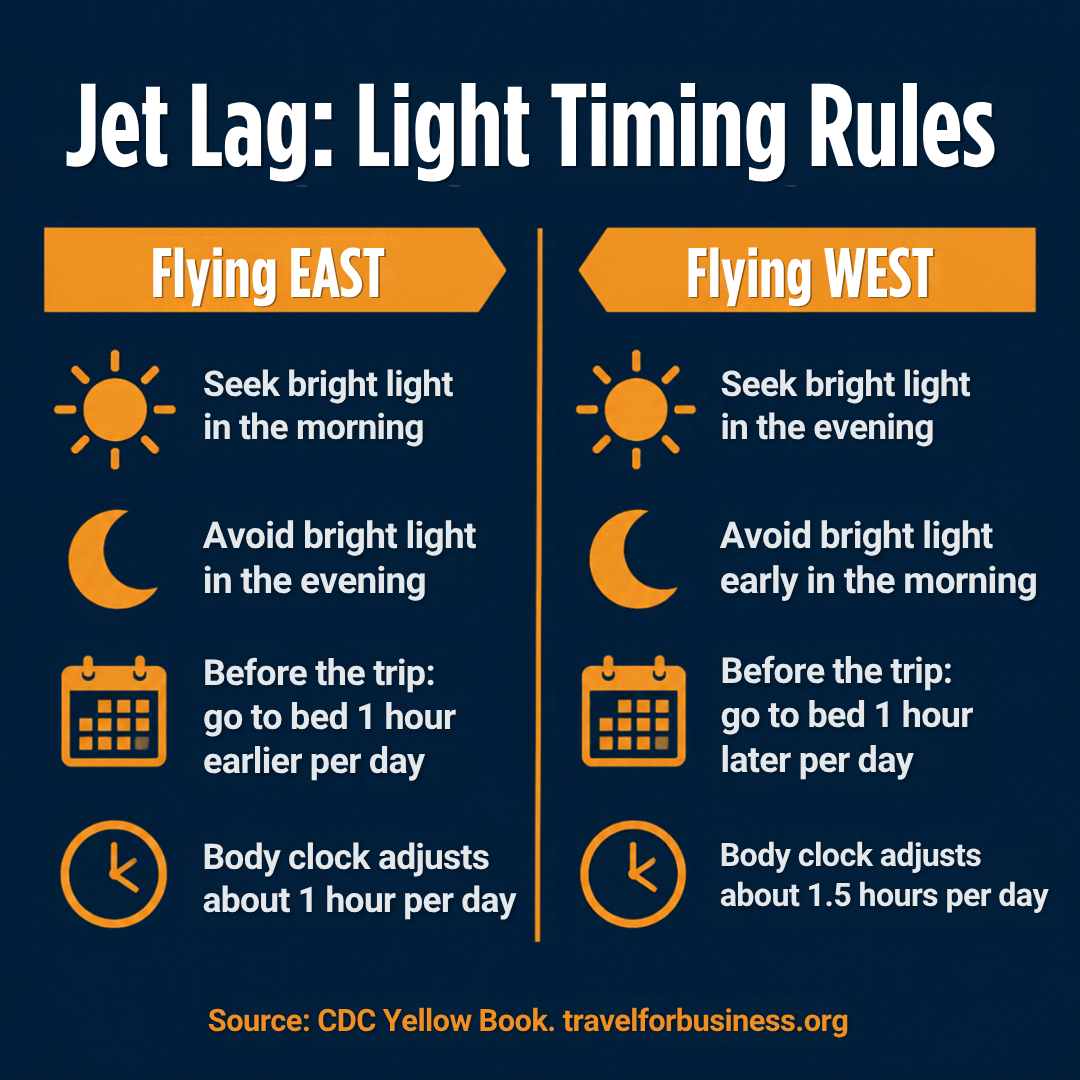
Your body clock naturally runs slightly longer than 24 hours, so it is easier to delay it (stay up later) than to advance it (go to bed earlier). On average, people adjust about 1.5 hours per day after flying west and only about 1 hour per day after flying east (CDC Yellow Book).
For a trip of eight or more time zones east, such as Europe to Japan or the US East Coast to India, there is an extra trap: your clock may shift the wrong way and drift later instead of earlier. Researchers call this antidromic re-entrainment and note it is common after eastward travel across eight or more time zones (Burgess and Eastman, Sleep Medicine Clinics). Correct light timing in the first days is what prevents it.
Jet Lag Planner: Your Light and Sleep Schedule
Enter your route, arrival date and normal sleep times. The planner calculates the time difference for that date, including daylight saving time, and gives you a pre-flight schedule plus the hours to seek and avoid bright light on each day after you land.
Jet Lag Planner
Pick where you fly from and to, your travel date and your normal sleep times. The planner shows how many time zones you cross, how to shift your sleep before you leave, and when to seek and avoid bright light each day after you land.
How it works: your body clock is lowest about 3 hours before your usual wake-up time. Bright light after that point moves your clock earlier, light before it moves your clock later. The planner assumes your clock adjusts about 1 hour per day after flying east and about 1.5 hours per day after flying west, the averages given by the CDC. Individual results vary. This is general information, not medical advice. Talk to a doctor before using melatonin or sleep medication.
The light windows come from a simple rule. Your body temperature, and with it your body clock, is at its lowest roughly 3 hours before your usual wake-up time. Bright light after that low point moves your clock earlier, while light before it moves your clock later (Burgess and Eastman). The planner tracks where that low point falls in local time and moves it each day as you adjust.
Before You Fly: Start Adjusting at Home
The most effective jet lag tactic happens before you board. The CDC recommends shifting your sleep 1 hour per day for 2 to 3 days before the trip: 1 hour earlier per day before flying east, 1 hour later per day before flying west (CDC Yellow Book).
- Flying east: go to bed and get up 1 hour earlier each day. Get bright light right after waking and keep the evening dim, with screens on night mode.
- Flying west: go to bed and get up 1 hour later each day. Get bright light in the evening and avoid bright light early in the morning.
- Shift meals too: eating on the new schedule reinforces the change.
- Do not arrive exhausted: a late night of packing before an early flight adds sleep debt on top of jet lag. Pack the evening before; our 5-day business trip packing list helps.
If the meeting really matters, arrive a day or two early. Mayo Clinic advice is the same: build in time to adjust before an important event (Mayo Clinic Care Network). If your travel policy does not allow that, try to book a morning or midday meeting slot after eastward flights and avoid early morning slots after westward flights, when your body still thinks it is the middle of the night.
On the Plane: Sleep or Stay Awake on Destination Time
Set your watch and phone to destination time as soon as you board, then behave accordingly.
- If it is night at your destination, sleep. A contoured eye mask, earplugs or noise-cancelling headphones and a travel pillow make the difference between dozing and real sleep.
- If it is daytime at your destination, stay awake. Keep the window shade open, walk the aisle and save your sleep for local night.
- Go easy on alcohol. It helps you fall asleep but makes sleep more fragmented, and alcohol and caffeine both dehydrate, which can worsen symptoms (CDC Yellow Book).
- Drink water throughout the flight. Cabin air is dry.
For long flights, see our best noise-cancelling headphones for business travel.
After You Land: Use Light, Caffeine and Naps Strategically
Get the right light at the right time
Daylight is the strongest signal your body clock knows. After flying east, seek bright morning light and avoid evening light. After flying west, avoid bright early-morning light (close the curtains, wear dark sunglasses) and get light later in the day (CDC Yellow Book). A walk outside to your meeting counts.
After eight or more time zones east, the first days are different: your body clock low point still falls in the local morning. Bright light before it pushes your clock the wrong way, so wear sunglasses on the way from the airport and save your daylight for late morning and midday. The planner above shows those windows for your route.
Time your caffeine
Caffeine helps you stay alert during the local day, but its half-life is about 5 hours. The CDC example plan stops caffeine 6 hours before bedtime (CDC Yellow Book). If you plan to sleep at 23:00, your last coffee is at 17:00.
Nap short, not long
A nap of 20 to 30 minutes can rescue an afternoon. Longer daytime naps cut into your night and keep you on home time. Set an alarm, and nap before mid-afternoon if you can.
Go to bed on local time
Even if you are not tired, go to bed at your normal bedtime in local time from the first night, keep the room dark and cool, and get up at your normal local wake-up time. A sleep mask and earplugs help with hotel corridor noise and blackout curtains that leave a gap.
What About Melatonin and Sleep Aids?
Melatonin is widely used for jet lag, but timing matters more than most travelers realize. According to the CDC, melatonin taken when your body clock reads early evening shifts it earlier (useful after flying east), and melatonin taken when your body clock reads morning shifts it later. Taken at the wrong time, it can make the misalignment worse. In the United States, melatonin is sold as a supplement that the FDA does not regulate, so product contents may differ from the label (CDC Yellow Book).
Prescription sleep aids have side effects, and long-acting ones can leave you groggy in a meeting. This article gives no dosing advice: talk to your doctor or a travel medicine clinic before using melatonin or any sleep medication.
The Business Traveler Sleep Kit
Light timing and schedule shifts do the heavy lifting. The gear below makes them easier to follow.
1. Manta Sleep Mask: Best Sleep Mask for Total Darkness
The Manta uses two separate, hollow eye cups that you slide along the strap to fit your face, so nothing presses on your eyelids or lashes. Manta claims 100% blackout, and because the cups sit around your eyes rather than on them, you can blink freely. The cups are Modal fabric, the strap is adjustable, and the whole mask is machine washable in a laundry bag (Manta Sleep).
Trade-offs: bulkier than a flat mask; side sleepers may feel the cups.
Check the Manta Sleep Mask on Amazon
2. MZOO Sleep Eye Mask: Best Budget Contoured Mask
The MZOO uses molded 3D memory foam cups that arch away from your eyes, with an adjustable strap. It is one of the best-selling sleep masks on Amazon and costs a fraction of the Manta. Reviewers rate its light blocking highly, with some reporting a little light at the nose.
Trade-offs: warmer material, and the strap can loosen over time.
Check the MZOO Sleep Eye Mask on Amazon
3. Loop Quiet 2: Best Reusable Earplugs
Loop Quiet 2 earplugs are soft-touch silicone, reusable and come with four sizes of ear tips (XS to L) for a proper seal. Loop rates them at up to 24 dB (SNR) of noise reduction and markets them for travel, focus and sleep (Loop). They are low profile, so they work for side sleepers.
Trade-offs: less noise reduction than good foam earplugs. Loop makes a sleep-specific model (Loop Dream) if you mainly use them in bed.
Check the Loop Quiet 2 earplugs on Amazon
4. Mack’s Ultra Soft Foam Earplugs: Maximum Noise Reduction
For the loudest cabins and thin hotel walls, classic foam still wins. Mack’s Ultra Soft foam earplugs carry a 33 dB noise reduction rating (NRR) and come in multi-pair packs, so you can leave a few pairs in every bag (Mack’s product listing).
Trade-offs: single use for hygiene, and foam takes some practice to insert correctly. Roll, insert, hold for a few seconds while it expands.
Check Mack’s Ultra Soft Foam Earplugs on Amazon
5. Trtl Travel Pillow: Most Compact Neck Support
The Trtl is not a classic U-shaped pillow. It is a soft fleece wrap with a removable internal support that holds your head upright, worn like a scarf. It weighs 4.7 oz (133 g), is machine washable once you remove the support, and comes with a carry bag with a carabiner (Trtl). The height-adjustable Trtl Pillow Plus is the upgrade.
Trade-offs: supports one side at a time, and the fit takes a few tries.
Check the Trtl Travel Pillow on Amazon
6. Cabeau Evolution S3: Best Support for Long-Haul Flights
The Evolution S3 is a memory foam neck pillow with raised sides and a strap system that attaches it to the seat headrest, so your head does not drop forward when you fall asleep. The included bag compresses it to about a third of its size and clips to your luggage, and the cover is machine washable (Cabeau).
Trade-offs: bulkier than the Trtl, even compressed.
Check the Cabeau Evolution S3 on Amazon
Comparison at a Glance
| Product | Type | Key feature | Best for |
|---|---|---|---|
| Manta Sleep Mask | Sleep mask | Adjustable hollow eye cups, blackout claim | Darkening hotel rooms, morning arrivals |
| MZOO Sleep Eye Mask | Sleep mask | 3D contoured memory foam cups | Budget, a mask in every bag |
| Loop Quiet 2 | Earplugs | Reusable silicone, up to 24 dB SNR | Side sleepers, frequent use |
| Mack’s Ultra Soft Foam | Earplugs | Foam, 33 dB NRR | Loud cabins and hotels |
| Trtl Travel Pillow | Travel pillow | 4.7 oz wrap with internal support | Carry-on only trips |
| Cabeau Evolution S3 | Travel pillow | Memory foam, seat strap, compresses | Long-haul overnight flights |
How to Build Your Jet Lag Plan
Count the time zones and the direction
Two time zones or fewer: keep your normal schedule on local time and you will barely notice. Three to seven zones: shift before you leave and follow the light rules. Eight or more zones east: plan carefully, because the first days need light avoidance in the morning. The planner does this calculation for your exact date.
For more on staying productive on the road, read our guide on how to travel for work like a pro.
Staying connected abroad
Mobile data from the moment you land
When you land at 6 a.m. and need a ride and your meeting details, you want mobile data right away. A travel eSIM installs on your phone at home and starts working when you land, while your own number stays active for calls and SMS codes. We recommend Simsima: plans for 190+ destinations, one Europe plan that covers 41 countries, and hotspot for your laptop on the plans we checked.
Affiliate link. Plans and prices are set by Simsima and may change.
Final Verdict
You cannot avoid jet lag completely, but you can cut it down from days of fog to a manageable dip. Shift your sleep 1 hour per day for 2 to 3 days before you leave, live on local time from the moment you board, and use light as your main tool: morning light after flying east, evening light after flying west, with extra care in the first days after eight or more time zones east. Keep naps short, stop caffeine 6 hours before bed and go easy on alcohol.
For gear, the Manta Sleep Mask is the single most useful item, paired with Loop Quiet 2 or Mack’s foam earplugs and, on long-haul flights, the Cabeau Evolution S3 or the compact Trtl. Run your next route through the Jet Lag Planner above before you book.
Related Articles
- How to Travel for Work Like a Pro
- Best Noise-Cancelling Headphones for Business Travel
- 5-Day Business Trip Packing List: A Full Work Week in a Carry-On
- Top 10 Must-Have Accessories for Efficient Business Travel
- Best Power Banks for Business Travel: Airline-Approved Picks
Frequently Asked Questions
Question: How long does jet lag last after a business trip?
Answer: Count on roughly one day per time zone crossed if you do nothing. The CDC gives average adjustment rates of about 1 hour per day after flying east and about 1.5 hours per day after flying west. Shifting your sleep for 2 to 3 days before you leave shortens that.
Question: Does melatonin help with jet lag?
Answer: It can, but only when timed correctly, and wrong timing can make jet lag worse. Melatonin products in the US are not regulated by the FDA. Ask your doctor or a travel clinic before using it, and do not rely on it instead of light and schedule changes.
Question: What is the best way to beat jet lag on a short business trip?
Answer: On a one- or two-night trip, do not try to fully adjust. Sleep well on local nights with a mask and earplugs, put important meetings at times when you feel alert, and protect your sleep when you get home. For trips of three nights or more, use the pre-flight shift and the light schedule from our Jet Lag Planner.