
Affiliate Disclaimer: TravelForBusiness.org participates in affiliate programs, including Amazon Associates, and may earn a commission from qualifying purchases at no extra cost to you.
Engine drone is the background noise of every business trip. On a six-hour flight it wears you down, and it makes the difference between landing ready for a client meeting or landing drained. Good noise-cancelling headphones are the one piece of travel tech that pays off on every single flight, on the train and in a noisy hotel room.
This guide picks the best noise cancelling headphones for business travel in 2026. We checked the current model generations from Sony, Bose, Apple and Soundcore against the manufacturers’ own specs, and we looked at what matters on the road rather than in a studio: noise cancelling on a plane, battery life on a long-haul day, call quality from a busy gate, and how small the whole kit packs. Not sure which type suits you? The quiz further down matches a pick to how you travel.
Short on time? These are our picks:
- Best overall: Sony WH-1000XM6
- Most comfortable for long-haul: Bose QuietComfort Ultra Headphones (2nd Gen)
- Best earbuds for iPhone users: Apple AirPods Pro 3
- Best earbuds for Android: Sony WF-1000XM6
- Best value: Soundcore Space One Pro
What Business Travelers Need from Noise-Cancelling Headphones
Most headphone reviews focus on sound quality. For work trips, four other things decide whether you reach for a pair on every flight:
- Low-frequency noise cancelling. Cabin noise is mostly a steady low rumble. That is exactly what active noise cancelling (ANC) handles best, and where the gap between a flagship and a cheap pair is biggest.
- Battery life that outlasts the trip. A long-haul day easily runs 15 hours door to door. Over-ear models now last 30 hours or more with ANC on, which covers a full outbound and return trip on one charge.
- Microphones that work in noisy places. If you take calls from the gate, the lounge or a taxi, the microphone array matters as much as the speakers.
- Multipoint and easy switching. Being connected to your laptop and phone at the same time means a Teams call on the laptop does not stop your phone from ringing through.
Over-ear headphones still block more noise and run longer. Earbuds win on packing space and are easier to sleep in on your side. Many frequent flyers carry both: earbuds for short hops and calls, over-ears for long-haul.
Find Your Match
Answer five quick questions about your flights, phone and calls. The quiz scores all five picks and shows your best match plus a runner-up.
Headphone Match Quiz
Answer five quick questions about how you travel. The quiz scores our five picks and shows the best match plus a runner-up.
Scores are based on manufacturer specs and published reviews as of October 2026. Battery figures are the maker’s claims with noise cancelling on.
The Best Noise-Cancelling Headphones for Business Travel
1. Sony WH-1000XM6: Best Overall
The WH-1000XM6 is the pair we would hand to most business travelers. Sony moved to a new HD Noise Canceling Processor QN3 and a 12-microphone array, which improves both noise cancelling and the ambient sound mode (SoundGuys). In practice that means the steady drone of a cabin is close to silent, and voices around you are pushed far into the background.
For travel the most welcome change is practical: unlike the XM5, the XM6 folds again, and it ships with a hard case that closes with a magnetic clip instead of a zipper. Battery life is rated at up to 30 hours with noise cancelling on and 40 hours with it off (Sony), and a 3-minute charge gives about 3 hours of playback (GSMArena), handy when you realize at the gate that they are flat.
- Type: over-ear, foldable, hard case
- Battery: up to 30 hours with ANC, 40 hours without
- Microphones: 12-mic array
- Connectivity: multipoint, SBC, AAC, LDAC and LC3
- Weight: about 254 g (9 oz)
Trade-offs: they do not play audio over USB-C, so for seatback screens you use the included 3.5 mm cable. The folding mechanism is a little fiddly, and the case is still larger than the Bose case.
Check the Sony WH-1000XM6 on Amazon
2. Bose QuietComfort Ultra Headphones (2nd Gen): Most Comfortable for Long-Haul
Bose has always been the comfort pick, and the second generation of the QuietComfort Ultra keeps that reputation. The headphones weigh 0.58 lb (about 264 g) and press lightly on your head, which you notice in hour nine of an overnight flight (Bose). Noise cancelling is in the same top tier as Sony, and reviewers found the plastic build mercifully light for long wear (SoundGuys).
The 2nd Gen fixed the two weak points of the original. Battery life went up to 30 hours (23 with Immersive Audio on), and the headphones now play lossless audio over USB-C and can be used while charging (Bose press release). A low-power standby mode kicks in when you fold them or lay them flat, and Bluetooth 5.4 with multipoint connects your phone and laptop at once.
- Type: over-ear, folding, soft-shell carry case
- Battery: up to 30 hours with ANC, 15-minute charge for 3 hours
- Wired: USB-C audio plus a 2.5 mm to 3.5 mm cable for seatback screens
- Connectivity: multipoint, SBC, AAC and aptX Adaptive
- Weight: 0.58 lb (about 264 g)
Trade-offs: no LDAC support, no water resistance rating, and the companion app offers fewer settings than Sony’s.
Check the Bose QuietComfort Ultra Headphones (2nd Gen) on Amazon
3. Apple AirPods Pro 3: Best Earbuds for iPhone Users
If your work life runs on an iPhone and a Mac, the AirPods Pro 3 are the easiest travel audio you can own. They switch automatically between your Apple devices, pair in a second, and the case is small enough for a jacket pocket. Apple rates them at up to 8 hours of listening with noise cancelling on and up to 24 hours with the case, and 5 minutes in the case gives about an hour (Apple).
Two features are useful on the road. Live Translation helps with short conversations abroad, and the FDA-authorized hearing aid feature can boost conversation in loud environments. The earbuds are rated IP57 against dust, sweat and water, and the case charges over MagSafe or USB-C.
- Type: in-ear earbuds with charging case
- Battery: up to 8 hours with ANC, 24 hours with the case
- Extras: Live Translation, heart rate sensing, hearing aid feature
- Durability: IP57 rated
- Weight: 5.55 g per earbud
Trade-offs: they cannot plug into a seatback screen, so for in-flight entertainment you need a Bluetooth transmitter or a plane with Bluetooth pairing. On Android you lose most of the smart features. And 8 hours is fine for most flights but not for a full long-haul day without a top-up in the case.
Check the Apple AirPods Pro 3 on Amazon
4. Sony WF-1000XM6: Best Earbuds for Android
Announced in February 2026, the WF-1000XM6 are Sony’s newest flagship earbuds and the best choice for Android users who want something smaller than over-ears. Each earbud now has four microphones, two more than the XM5, and they run on Sony’s Integrated Processor V2 together with a QN3e noise-cancelling chip (GSMArena).
In testing they lasted a little over 8 hours with noise cancelling on, with two extra full charges in the case for about 24 hours in total. Multipoint lets you stay connected to a phone and a laptop, switching is instant, and LDAC gives Android users higher-quality Bluetooth audio. The case also charges wirelessly.
- Type: in-ear earbuds with charging case
- Battery: about 8 hours with ANC, 24 hours with the case
- Microphones: four per earbud
- Connectivity: multipoint, SBC, AAC, LC3 and LDAC
- Durability: IPX4
Trade-offs: they are bigger than the AirPods Pro 3, which some people notice when sleeping on their side. Wireless charging is about twice as slow as charging over the cable.
Check the Sony WF-1000XM6 on Amazon
5. Soundcore Space One Pro: Best Value
Not every traveler needs a flagship. The Soundcore Space One Pro from Anker delivers most of what matters for a fraction of the price: adaptive noise cancelling driven by six microphones, multipoint, LDAC on Android and the longest battery life in this guide at up to 40 hours with ANC on. A 5-minute charge gives about 8 hours of playback (Soundcore).
The other standout for travel is the folding design. A five-segment headband with three rotating joints lets the headphones fold to roughly half their size, so they take less bag space than many premium models.
- Type: over-ear, folds to about half size, comes with a case
- Battery: up to 40 hours with ANC, 60 hours without
- Microphones: 6 for noise cancelling, 4 optimized for calls
- Connectivity: multipoint, LDAC on Android
- Weight: 286 g (10.1 oz)
Trade-offs: noise cancelling is very good but a step below Sony and Bose on deep cabin rumble, and at 286 g they are the heaviest pick here.
Check the Soundcore Space One Pro on Amazon
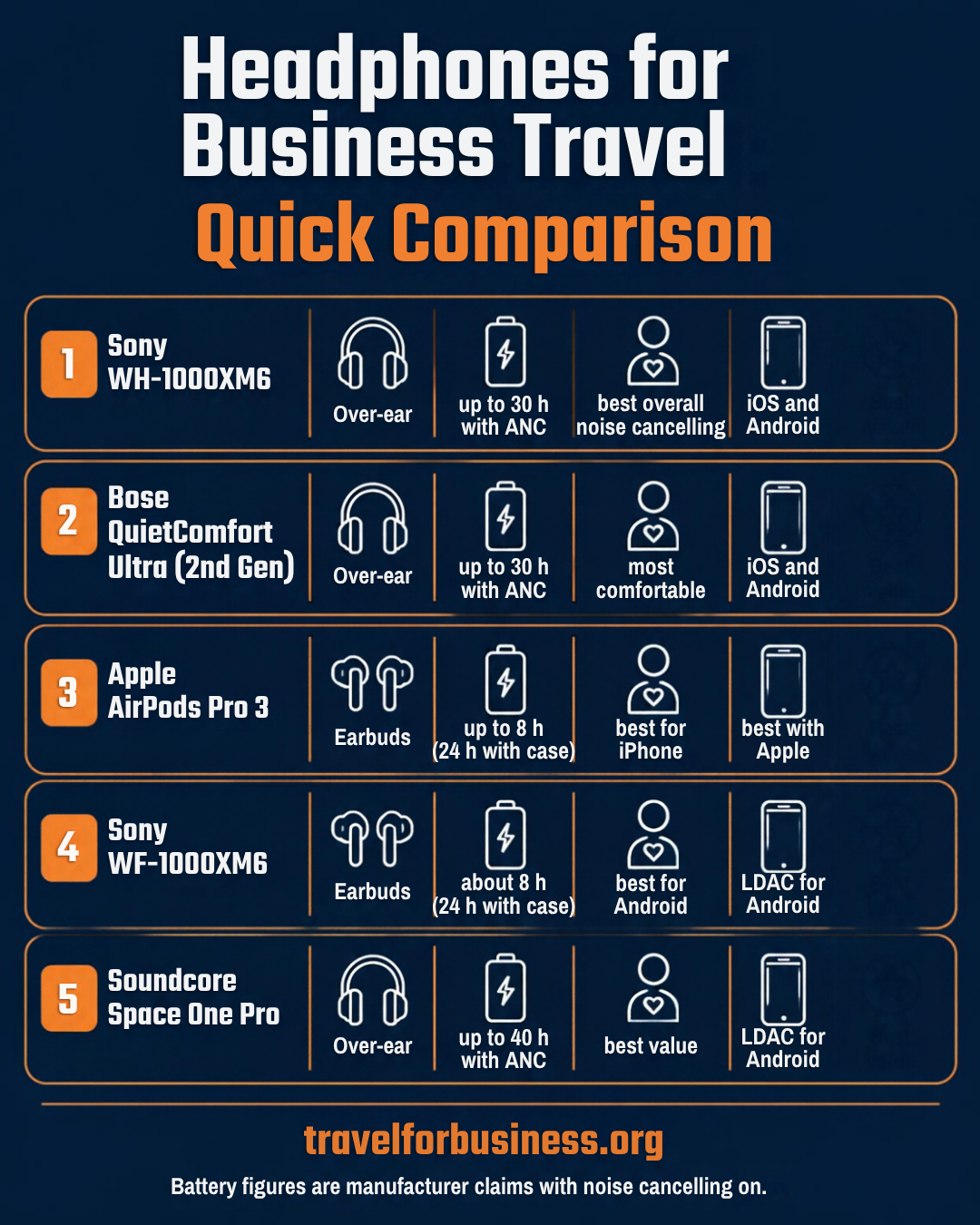
Comparison at a Glance
| Model | Type | Battery with ANC | Key feature | Best for |
|---|---|---|---|---|
| Sony WH-1000XM6 | Over-ear | Up to 30 h | 12-mic array | Best all-round noise cancelling |
| Bose QC Ultra (2nd Gen) | Over-ear | Up to 30 h | Multipoint, USB-C audio | Long-haul comfort |
| Apple AirPods Pro 3 | Earbuds | Up to 8 h (24 h with case) | Auto-switching on Apple devices | iPhone and Mac users |
| Sony WF-1000XM6 | Earbuds | About 8 h (24 h with case) | 4 mics per earbud, LDAC | Android users |
| Soundcore Space One Pro | Over-ear | Up to 40 h | 6 mics, LDAC | Best value |
How to Choose Noise-Cancelling Headphones for Work Trips
Over-ear or earbuds?
Choose over-ear if you fly long-haul, want the strongest noise cancelling, or use seatback entertainment a lot. Choose earbuds if you mostly fly short domestic routes, travel with only a backpack, or want something you can sleep in on your side. If you fly both, a pair of each is not overkill.
Match the ecosystem
AirPods make sense if all your devices are Apple. With Android or a Windows laptop, Sony and Bose give you multipoint and the full feature set on any platform. LDAC only matters if you stream high-quality audio from an Android phone.
Check how you will connect to the seatback screen
Most seatback screens still use a 3.5 mm jack, sometimes with an older two-prong airline socket. Over-ear headphones with a cable handle this out of the box. Some airlines are adding Bluetooth: United offers it on about 300 aircraft (Points Path), and Delta is rolling it out on new A350-1000, A321neo and 737 MAX 10 deliveries from mid-2026 (The Points Guy). For everything else, earbud users need a small transmitter such as the Twelve South AirFly Pro 2.
Calls matter more than you think
If you take calls from airports and hotel lobbies, give microphone quality more weight than sound quality. Larger microphone arrays, like the 12 mics on the Sony WH-1000XM6, filter out background noise better. Earbuds put the microphones further from your mouth, so test them on a call before a big trip.
Comfort over hours, not minutes
A pair that feels fine in the store can hurt after four hours. Weight, clamping force and ear cup depth decide comfort on a long flight. Glasses wearers in particular tend to prefer lighter, softer headphones like the Bose.
Tips for Flying with Noise-Cancelling Headphones
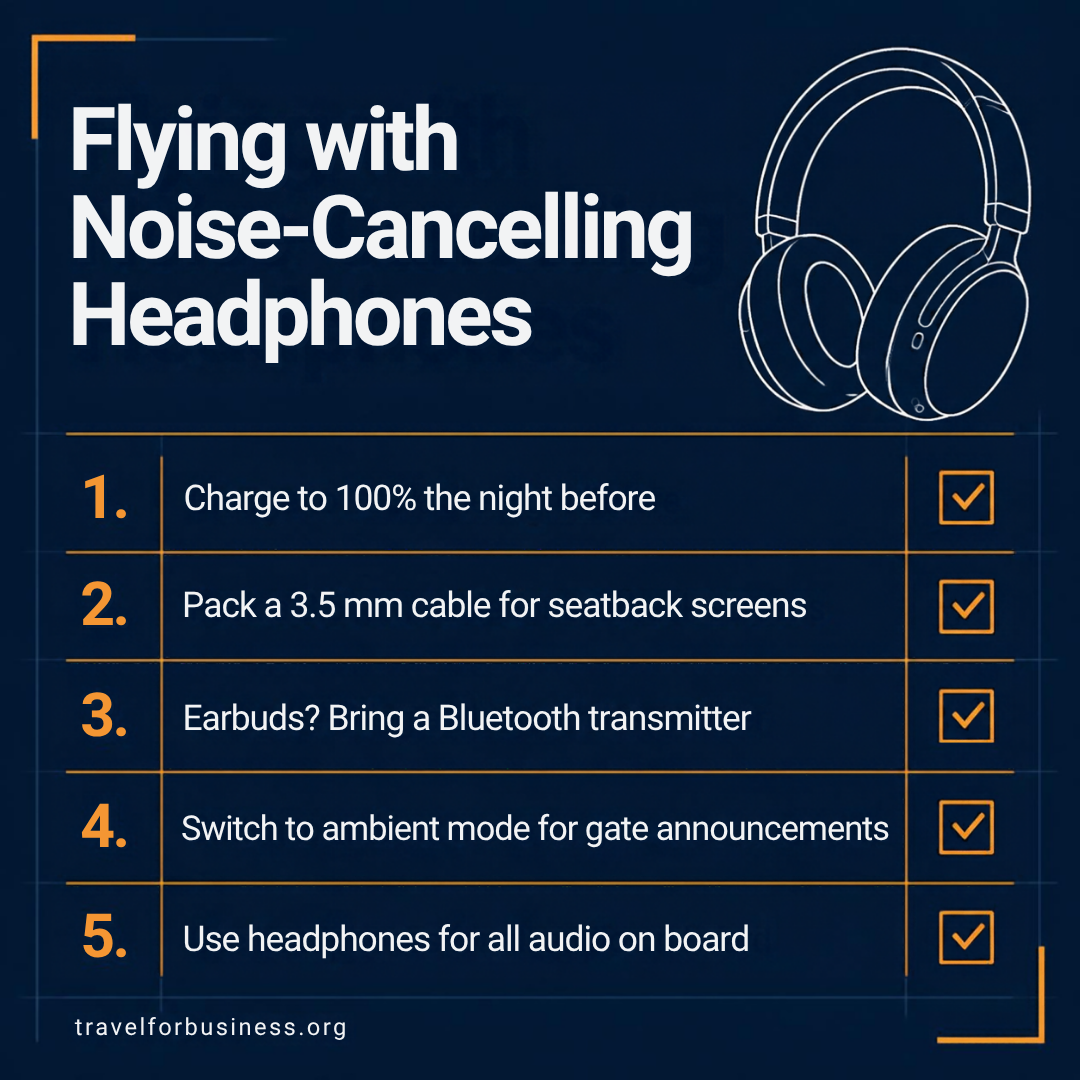
- Charge fully the night before. Even 30-hour headphones are no use if they were left on in your bag.
- Pack the 3.5 mm cable in the case, plus a two-prong airline adapter if you fly older aircraft.
- Switch to ambient or transparency mode at the gate and during boarding so you hear announcements.
- Keep the volume low. With noise cancelling on you need far less volume, which protects your hearing on long flights.
- Use headphones for all audio on board. United added this to its contract of carriage in February 2026 and can remove passengers who play audio out loud (ABC News).
- Store earbuds in their case, not loose in a seat pocket. It is the easiest way to leave them behind.
Headphones are only one part of a good travel tech kit. Our list of must-have accessories for efficient business travel covers the rest, and our laptop backpack guide helps you find a bag with a spot for the headphone case.
Final Verdict
For most business travelers the Sony WH-1000XM6 is the best noise-cancelling headphone for business travel in 2026: top-tier noise cancelling, a 12-mic array for calls, 30 hours of battery and, finally, a folding design again. If comfort on overnight flights is your priority, the Bose QuietComfort Ultra (2nd Gen) is the one to get. iPhone users who want to travel light should pick the AirPods Pro 3, Android users the Sony WF-1000XM6, and if you want strong noise cancelling without the flagship price, the Soundcore Space One Pro is excellent value.
Related Articles
- Top 10 Must-Have Accessories for Efficient Business Travel
- The Best Laptop Backpacks for Business Travel: Tumi, Nomatic & More
- Essential Packing Tips for a 3-Day Business Trip
- How to Travel for Work Like a Pro
Frequently Asked Questions
Question: What are the best noise cancelling headphones for business travel?
Answer: For most travelers the Sony WH-1000XM6, thanks to its strong noise cancelling, 12-mic array for calls and 30-hour battery. The Bose QuietComfort Ultra (2nd Gen) is the most comfortable for long-haul flights, and the AirPods Pro 3 are the best earbuds for iPhone users.
Question: Are over-ear headphones or earbuds better for flying?
Answer: Over-ear headphones block more low-frequency engine noise and last much longer on a charge, so they are better for long flights. Earbuds are smaller, easier to sleep in and better for short trips or when bag space is tight.
Question: Can I use Bluetooth headphones with the seatback screen?
Answer: Only on aircraft that support Bluetooth pairing, such as about 300 United planes and Delta’s newest deliveries. Otherwise use a wired 3.5 mm cable with over-ear headphones, or a Bluetooth transmitter like the AirFly Pro 2 with earbuds.
Question: Can I wear noise cancelling headphones during takeoff and landing?
Answer: Most airlines allow it, but crew may ask you to remove them during the safety briefing. Switching to ambient or transparency mode lets you hear announcements without taking them off.
Question: Do noise cancelling headphones help with jet lag?
Answer: They do not change your body clock, but by cutting constant cabin noise they make it easier to sleep and reduce fatigue on long flights, which helps you arrive in better shape.