

Introduction
Business travel looks simple from the outside: book a flight, pick a hotel, show up, and do the work. In reality, business travel involves navigating a complex web of policies, approvals, rates, safety concerns, traveler preferences, and the ubiquitous expense reports.
If you’re responsible for company travel (or you’re the one booking your own trips), a strong travel program can reduce costs, cut admin time, and make trips less exhausting. That’s where travel management companies come in: they combine technology, negotiated content, and human support to help organizations plan, book, track, and control travel—without turning every trip into a spreadsheet marathon.
If expense reporting is your biggest pain point, a small tool can save hours per month—like this portable receipt scanner. Grab it here
Understanding the Basics
What a TMC actually does (beyond booking)
At the basic level, a TMC supports corporate travel bookings (air, hotel, rail, car) and wraps that with policy controls, reporting, and traveler support. But the best value usually comes from the layers around booking:
- Policy enforcement (preferred suppliers, cabin rules, budgets, approval flows)
- Reporting & visibility (spend by team, supplier, route, reason code, out-of-policy leakage)
- Traveler support (changes, disruptions, VIP handling, 24/7 help)
- Duty of care (traveler tracking, risk alerts, emergency help—depending on provider setup)
- Program strategy (negotiation support, supplier programs, policy optimization)
This “service + tech” model is the hallmark of modern TMC offerings.
TMC vs. “travel platform” vs. traditional agency
The market now has three common models (often blended):
- Traditional TMCs (service-led + tools):
Strong agent support, global servicing, meetings/events capability, and mature reporting. - Modern travel + expense platforms (software-led):
App-first booking, tighter integration with cards/expense workflows, fast adoption for SMB/mid-market. (Example: TripActions rebranded to Navan and positions itself as a unified travel + expense approach.) - Local/industry specialists:
Regional strength or niche expertise (marine/energy/government), sometimes with better on-the-ground help.
Why this matters in 2026: consolidation and vendor stability
Vendor landscapes change. A recent example: Amex GBT completed its acquisition of CWT on September 2, 2025, illustrating how consolidation can affect service models, tech roadmaps, and contract terms over time.
For buyers, that means evaluating not just today’s features but also how your provider handles change—migrations, new tooling, service transitions, and reporting continuity.
Key Considerations
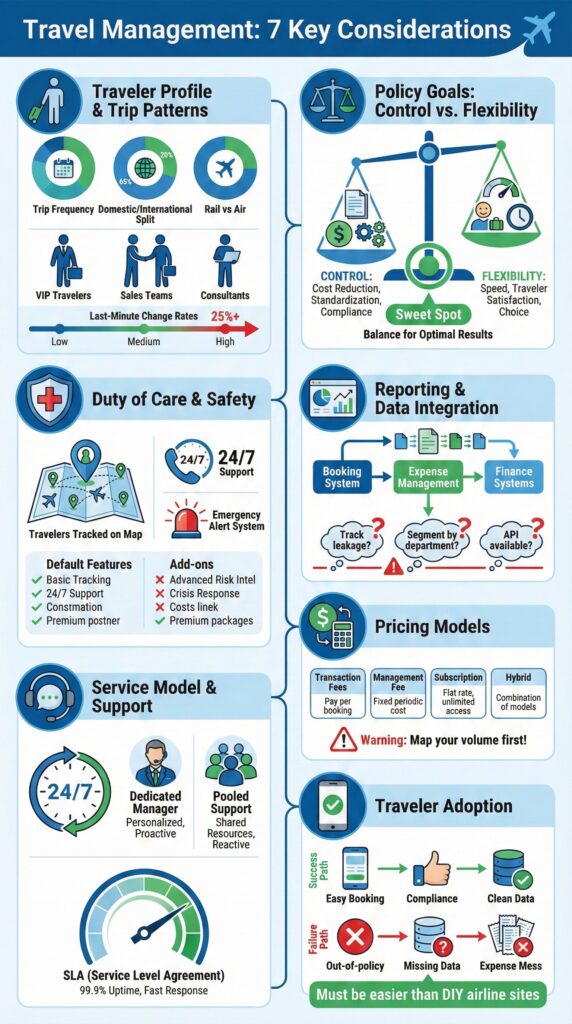
1) Your traveler profile and trip patterns
Start with reality, not ideal policy:
- Average trip length and frequency
- Domestic vs. international mix
- Rail-heavy regions (common in Europe)
- Last-minute change rate (sales teams often change constantly)
- VIP travelers (executives, client-facing leads)
A program that works for consultants doing weekly city hops won’t look the same as a team doing quarterly international off-sites.
2) Policy goals: control vs. flexibility
Every travel program balances two forces:
- Control: reduce costs, standardize suppliers, enforce compliance
- Flexibility: improve traveler experience, speed bookings, keep teams productive
The best programs define where control matters most (e.g., airfare cabin rules, hotel caps) and give flexibility where it reduces friction (e.g., preferred areas, rail vs. air choice).
3) Duty of care and traveler safety
Duty of care isn’t only a crisis feature. It’s also about:
- Knowing who is where when disruptions happen
- Having a reliable support channel for changes and rebooking
- Clear processes for emergencies and after-hours issues
Ask what’s included by default vs. add-ons (risk intelligence tools, tracking, response workflows).
4) Reporting, data ownership, and integrations
This is where many programs succeed or fail.
Checklist:
- Can you track out-of-policy bookings and leakage?
- Can you segment reporting by department, project, client, or cost center?
- Does it integrate cleanly with your expense process and card program?
- What’s the export format and cadence (API, scheduled reports, BI connector)?
If your biggest pain point is reimbursement, your travel solution must reduce expense friction—not add steps.
5) Service model and support quality
Ask for clarity on:
- 24/7 coverage (true 24/7 or “after-hours partner”?)
- Dedicated account manager vs. pooled support
- VIP desk availability
- Average speed to answer (SLA), escalation, and disruption handling
6) Pricing: understand how you’ll really pay
Common pricing approaches:
- Transaction fees (per air/hotel/rail booking)
- Management fee (monthly/annual)
- Subscription per traveler
- Hybrid (lower transaction fee + base fee)
Don’t compare proposals without mapping your expected volume. A “cheap” transaction fee can become expensive if you have high change rates.
7) Traveler adoption (the hidden ROI lever)
A perfect policy that nobody follows creates:
- out-of-policy bookings
- missing itinerary data (hurts duty of care)
- messy expense reports
Your solution has to be easier than “do it myself on the airline site.”
Tip for smoother packing and less stress on frequent trips: add lightweight packing cubes to standardize packing and reduce wrinkles. Here’s a solid option.
Step-by-Step Guide
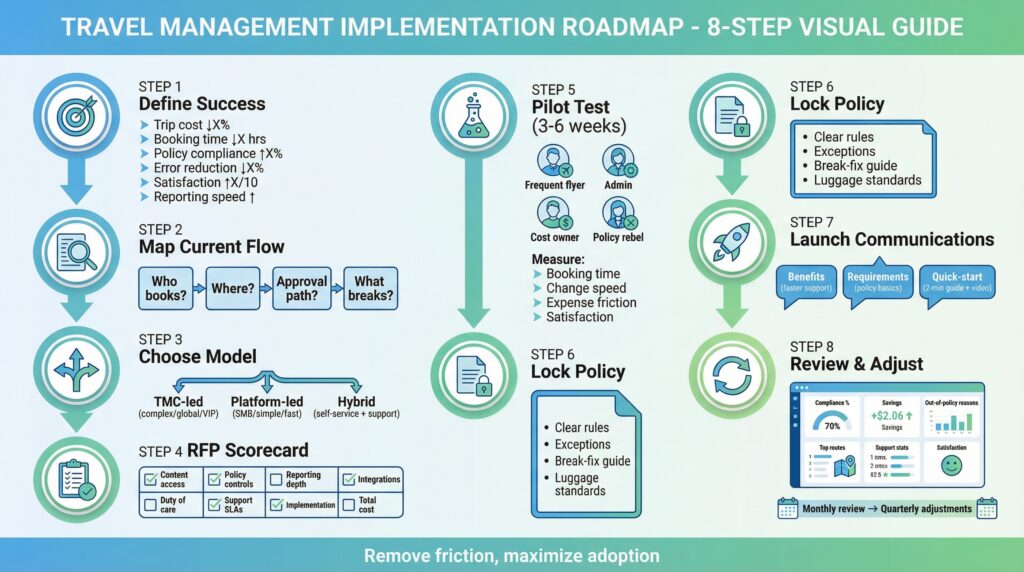
Step 1: Define success (before you shop)
Pick 6–10 measurable outcomes. Examples:
- Reduce average trip cost by X%
- Cut booking-to-approval time by X hours
- Improve in-policy booking rate to X%
- Reduce expense report errors/rejects by X%
- Improve traveler satisfaction score to X/10
- Improve reporting timeliness (monthly close)
Step 2: Map your current travel flow
Document the real process:
- Who books (traveler, admin, manager)?
- Where do bookings happen today?
- How are approvals handled?
- What breaks the most (changes, cancellations, receipts, missing invoices)?
This becomes your baseline for ROI.
Step 3: Choose your program model (TMC-led, platform-led, or hybrid)
- If you have complex global travel and VIP needs, you’ll likely prefer stronger agent support.
- If you’re a growing SMB with simple patterns and want speed, a software-led model can work well.
- Many organizations adopt a hybrid approach: self-service for most trips and high-touch support for exceptions.
Step 4: Build an RFP scorecard (make it hard to “hand wave”)
Score each vendor on:
- Content access (air, hotel, rail, car; corporate rates; NDC capabilities where relevant)
- Policy controls (rules, caps, approval flows)
- Reporting depth and exportability
- Integrations (expense, HR, SSO)
- Duty of care options
- Support SLAs and service coverage
- Implementation plan (time, resources, training)
- Total cost (fees + change costs + add-ons)
Step 5: Validate with a pilot group
Pick a pilot mix:
- frequent travelers
- one admin/booker
- one cost-center owner
- one “difficult” traveler (the person who always books outside policy)
Run the pilot for 3–6 weeks and measure:
- booking time
- change handling speed
- expense friction
- satisfaction and compliance
Step 6: Lock policy and payments (then simplify)
A common mistake is writing a 12-page policy nobody reads.
Aim for:
- one-page summary
- clear rules + exceptions
- “what to do when something breaks”
If you can, standardize luggage requirements as well—frequent flyers lose time when their bags fail. A reliable business-friendly carry-on helps. This is a strong option.
Step 7: Roll out with “why” messaging and shortcuts
Adoption happens when travelers understand:
- What’s in it for them (faster support, fewer expense headaches)
- What’s required (policy essentials)
- How to do it in 2 minutes (quick start guide + short video)
Step 8: Review monthly, adjust quarterly
Track:
- compliance rate
- savings vs. baseline
- top out-of-policy reasons
- top routes and suppliers
- support response stats
- traveler satisfaction
Then adjust policy to remove unnecessary friction.
Expert Tips (from programs that actually work)
Use “guardrails,” not handcuffs
Instead of banning everything, set smart defaults:
- Preferred hotel list per city + price cap.
- Rail-first rule under X hours (where practical).
- Approval only for exceptions (premium cabin, last-minute, over cap).
Reduce expense pain by standardizing receipts and documentation
Small habits eliminate big headaches:
- Require itemized receipts where needed.
- Use a consistent naming convention (Client_Project_Date).
- Capture receipts immediately.
If receipts are your bottleneck, upgrading your process beats nagging people. The earlier portable receipt scanner link is one of the simplest upgrades.
Make disruption support a headline requirement
Travelers judge the program most during chaos:
- flight cancellations
- weather disruptions
- missed connections
- last-minute client changes
Ask vendors to walk through a real disruption scenario and show the escalation path.
Plan for market change
Consolidation and rebrands happen. Build contract language around:
- reporting continuity
- migration support
- service-level protections
- exit clauses and data export
Common Mistakes (and how to avoid them)
Mistake 1: Choosing based on headline price only
A low transaction fee doesn’t help if:
- Reporting is weak.
- Travelers avoid the tool.
- Changes are painful and expensive.
Always model total cost using your actual volumes and exchange rates.
Mistake 2: Ignoring integrations until after signing
If expense reporting is your pain point, integration is not optional.
Validate:
- SSO and user provisioning
- expense and invoice handoff
- card and payment workflow compatibility
- data exports for finance
Mistake 3: Overcomplicating policy
A strict policy that causes constant exceptions will be ignored.
Keep it short, focus on the essentials, and address the real cost drivers.
Mistake 4: Rolling out without traveler training
Even a great tool fails if people don’t know:
- How to book in policy.
- How to change/cancel.
- How to get help fast.
Mistake 5: Not measuring leakage and compliance
If you can’t see unmanaged spend, you can’t fix it.
Make leakage reporting a core KPI from month one.
Conclusion
The right partner and process can turn business travel from a constant fire drill into a predictable system: clear policy, clean data, faster support, and fewer expense-report battles. Whether you’re optimizing for cost, traveler experience, safety, or finance visibility, the key is to define success upfront, pilot with real travelers, and measure outcomes monthly—so your program improves instead of stagnating.
If you want one more practical upgrade for frequent flyers: a durable, lightweight carry-on reduces stress and avoids downtime when luggage fails. This Travelpro option is a reliable pick.
Affiliate disclaimer: TravelForBusiness.org participates in affiliate programs, including Amazon Associates, and may earn a commission from qualifying purchases at no extra cost to you.