

If your company has more than a handful of trips a month, travel can quietly become a major cost center—and a major risk center. A travel manager is the person (or team) who turns business travel from “everyone books however they want” into a controlled, safe, trackable program that still works for travelers.
Many teams ask, “What does a travel manager do?” when travel starts scaling—because the role sits at the intersection of cost control, traveler support, compliance, and risk.
And because business travel generates a constant stream of invoices, receipts, and policy exceptions, one simple “quick win” many travel managers recommend is tightening receipt capture and expense documentation—tools like a portable receipt scanner can reduce missing receipts and speed up reimbursement workflows for frequent travelers. If your organization is experiencing difficulties with this issue, consider implementing a Portable Receipt Scanner.
Affiliate Disclaimer: TravelForBusiness.org participates in affiliate programs, including Amazon Associates, and may earn a commission from qualifying purchases at no extra cost to you.
1. Quick Answer (TL;DR)
A travel manager designs, runs, and improves a company’s business travel program so employees can travel efficiently while the business controls cost, stays compliant, and fulfills its duty of care.
In practice, that means they:
- Set and enforce travel policy (what’s allowed, what’s reimbursable, approval rules).
- Control spend via negotiated rates, preferred suppliers, and booking compliance.
- Choose and manage tools (online booking, expense, traveler tracking, reporting).
- Support travelers with clear processes, help resources, and issue escalation paths.
- Manage duty of care (risk monitoring, emergency response plans, and traveler communication).
- Report performance (savings, compliance, traveler experience, and supplier performance).
- Coordinate stakeholders (Finance, HR, Security, Procurement, and Executive leadership).
Want to see what a travel manager could realistically save your company each year?
Estimate Travel Program ROIUse this 2-minute calculator to estimate annual savings from better compliance, centralized booking, and faster expense processing.
2. Understanding the Question
Travel manager vs. travel agent vs. travel coordinator
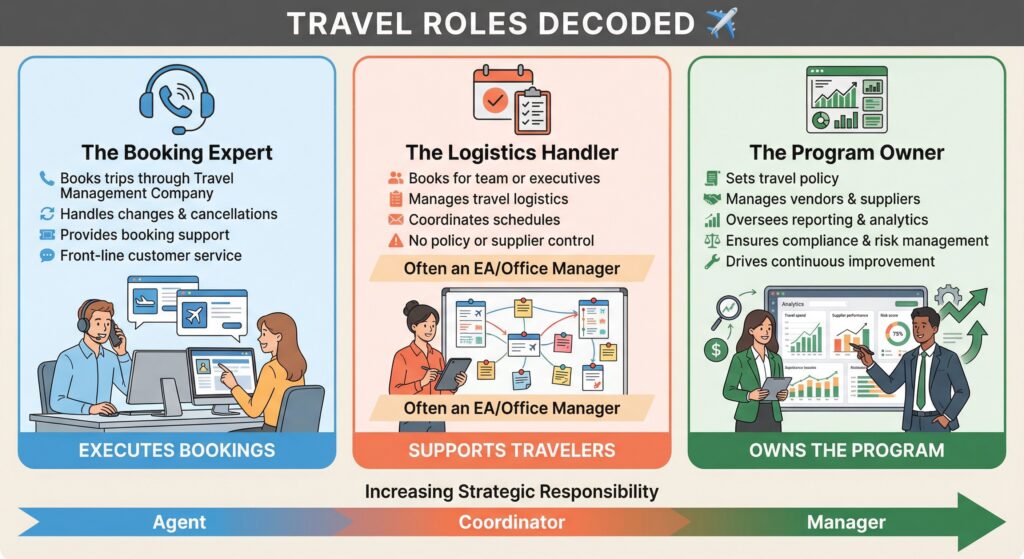
These roles get mixed up a lot:
- Travel agent/TMC counselor: Books trips (often through a Travel Management Company), handles changes, and provides booking support.
- Travel coordinator (often an EA/office manager): Executes bookings for a team or executive group; may handle logistics but usually doesn’t set policy or manage suppliers.
- Travel manager: Owns the program—policy, vendors, tools, reporting, compliance, risk, and continuous improvement.
Why the role matters now
Business travel is one of the messiest categories: many suppliers, many price points, constant exceptions, and a direct impact on productivity. Without a travel manager (even a “part-time” one), companies often face:
- Duplicated bookings and inconsistent rates
- Missed policy savings (people booking outside approved channels)
- Weak visibility into where travelers are
- Slow expense reimbursement and frustrated employees
- Risk exposure when disruptions happen (weather, strikes, security incidents)
3. Detailed Explanation
3.1 Building the travel program foundation (policy + governance)
A travel manager typically starts by making the rules clear and enforceable:
- Booking rules: approved booking channels, lead times, cabin class guidelines
- Hotel standards: rate caps, preferred brands, location guidelines
- Ground transport: rental vs. rideshare vs. rail policy
- Expense rules: per diems, receipt thresholds, reimbursable vs. non-reimbursable items
- Approval workflows: who approves what, and when exceptions are allowed
- Traveler profiles: required info (passport, emergency contacts, loyalty numbers)
The key isn’t “strict rules.” The key is simple rules people will actually follow—with clear exception paths.
3.2 Supplier sourcing and negotiation
Even small businesses can benefit from preferred suppliers. Travel managers commonly negotiate or set preferred options for:
- Airlines (or at least preferred alliances/routes)
- Hotel programs (preferred properties in key cities, negotiated corporate rates)
- Car rental/ground transport providers
- Rail providers (for regions where rail dominates)
- Meeting & events travel (if applicable)
They also monitor supplier performance, including on-time service metrics, traveler feedback, rate availability, and problem-resolution speed.
3.3 Travel technology stack ownership
A travel manager often becomes the “product owner” for travel tools. The typical stack includes:
- Online booking tool (OBT) or booking platform
- Travel management company (TMC) support layer (optional, but common)
- Expense management (receipts, categorization, approvals, reimbursements)
- Traveler tracking/risk intelligence (duty of care, alerts, check-ins)
- Reporting/BI (dashboards for spend, compliance, savings, carbon footprint)
They ensure integrations work (HR → travel profile, travel → expense, card feeds → expense, etc.) so travel isn’t retyped across systems.
3.4 Compliance and cost control (without wrecking traveler experience)
Travel managers drive savings through behavior and system design, like:
- Keeping bookings inside approved channels
- Encouraging booking windows
- Rate caps and “logical” upgrades (e.g., long-haul rules)
- Preferred hotel lists that match where teams actually work
- Automated policy checks and pre-trip approvals
- Smart prompts: “This flight is $220 cheaper within policy—switch?”
The true challenge lies in balancing cost and productivity. A travel manager knows when a cheaper option creates hidden costs (missed meetings, late arrivals, burnout, extra nights).
3.5 Duty of care: safety, risk, and disruption response
Duty of care is often the most critical (and least understood) part of the job.
A travel manager helps the company:
- Know who is traveling, where, and when
- Push timely alerts (weather, civil unrest, strikes, health risks)
- Provide traveler guidance (safe transport options, neighborhoods to avoid, check-in protocols)
- Coordinate emergency response with Security/HR/TMC
- Document processes for compliance and insurance requirements
When faced with disruption scenarios such as mass cancellations, airport closures, or political instability, the travel manager establishes escalation pathways to prevent travelers from becoming stranded without support.
3.6 Expense and reconciliation: making the back office less painful
A travel manager works closely with finance to reduce friction:
- Standardizing expense categories for travel
- Encouraging timely receipt capture
- Reducing manual reimbursement exceptions
- Aligning corporate card usage and rules
- Creating “traveler-friendly” guides (“How to expense a trip in 5 minutes”)
This is also where practical gear can quietly improve compliance. For example, travelers who keep documentation organized tend to file faster and get reimbursed with fewer issues—simple tools like packing cubes can keep trip items and paperwork separated (dirty laundry, receipt envelope, charging kit, etc.). One reliable option: Packing Cubes.
4. Key Points
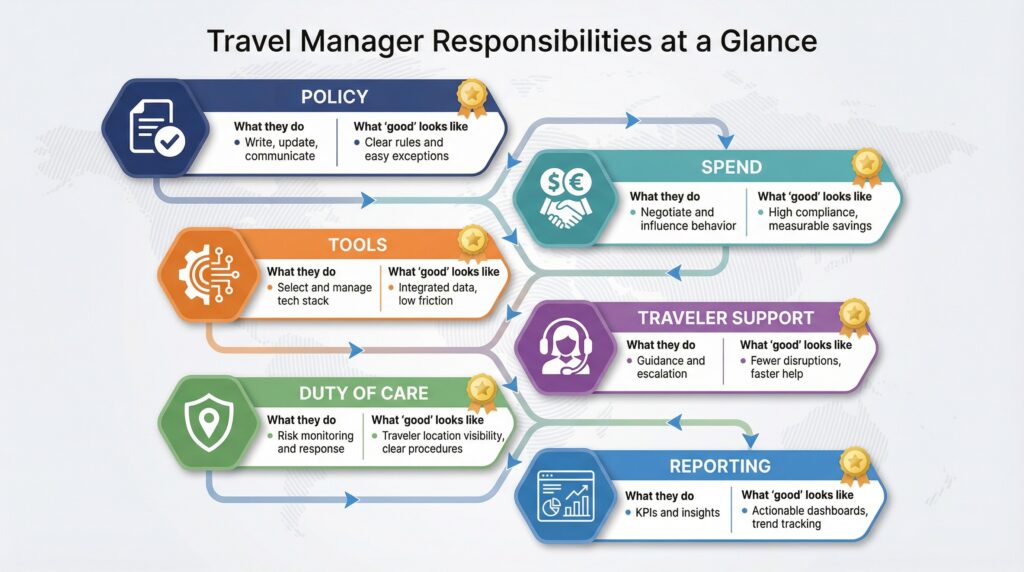
What a travel manager is responsible for (at a glance)
| Area | What they do | What “good” looks like |
| Policy | Write, update, communicate | Clear rules and easy exceptions |
| Spend | Negotiate and influence behavior | High compliance, measurable savings |
| Tools | Select and manage tech stack | Integrated data, low friction |
| Traveler support | Guidance and escalation | Fewer disruptions, faster help |
| Duty of care | Risk monitoring and response | Traveler location visibility, clear procedures |
| Reporting | KPIs and insights | Actionable dashboards, trend tracking |
KPIs that travel managers commonly track
- Booking channel compliance (% in-tool vs. out-of-tool)
- Average ticket price vs. benchmarks / advance purchase days
- Hotel attachment rate and average daily rate (ADR)
- Policy exception rate and top reasons
- Traveler satisfaction (NPS-style surveys)
- Disruption metrics (rebook time, support response time)
- Expense submission time and exception volume
5. Examples and Case Studies
Case 1: Small business scaling from chaos to control (10–50 employees)
Problem: Everyone books differently, finance can’t forecast, and reimbursements drag.
Travel manager move:
- Create a simple policy (rate caps, approval thresholds)
- Establish preferred hotels in the top 3 cities
- Require booking through one channel for visibility
- Standardize receipts and expense timelines
Result: - Fewer surprise expenses
- Faster reimbursements
- Better negotiating leverage over time
Case 2: Consulting team with constant multi-city travel
Problem: Frequent changes, missed connections, and high traveler fatigue.
Travel manager move:
- Tight partnership with a TMC for after-hours changes
- “Productivity-first” rules for long travel days
- Preferred airlines/hubs to reduce missed connections
- Stronger traveler profiles and emergency contacts
Result: - Less downtime and fewer preventable disruptions
Case 3: Field service teams (project-based, time-sensitive)
Problem: Travel must happen quickly, often to secondary markets; safety risk varies.
Travel manager move:
- Build location playbooks (safe hotels, transport guidance)
- Pre-approved booking options for urgent dispatch
- Strong traveler tracking and check-in procedures
Result: - Faster dispatch with less risk exposure and cleaner documentation
6. Expert Insights (What Great Travel Managers Do Differently)
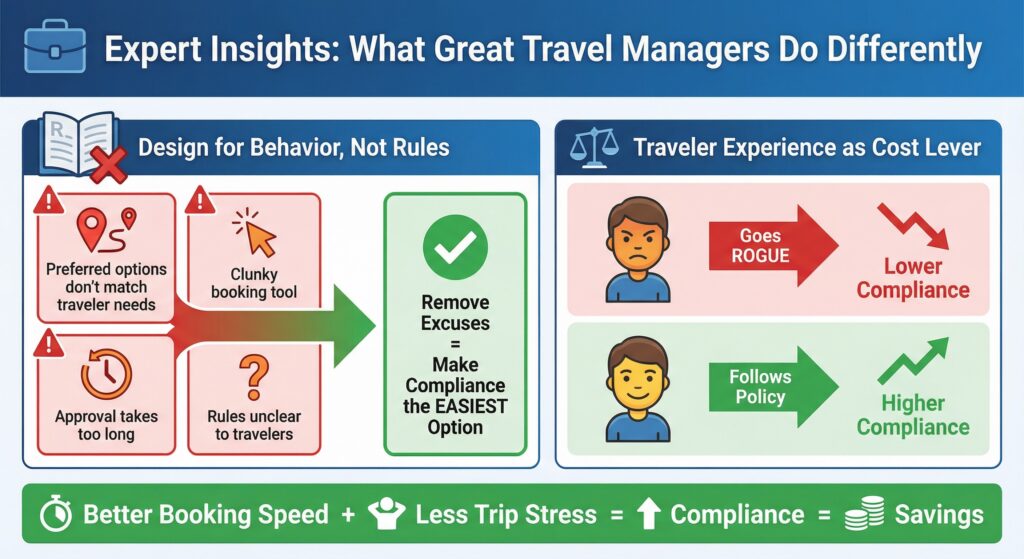
They design for behavior, not rules
If travelers constantly break policy, it’s often a system problem:
- The preferred options don’t match where people need to be
- The booking tool is clunky
- Approval takes too long
- Travelers don’t understand why the rule exists
Great travel managers “remove excuses” by making the compliant option the easiest option.
They treat traveler experience as a cost lever
Happy travelers follow the policy. Frustrated travelers go rogue.
A travel manager who improves booking speed and reduces trip stress often sees compliance rise—and compliance is where savings live.
They built a “business traveler kit” standard
Many programs recommend (or even reimburse) core travel gear because it reduces friction and lost time. For example:
- A reliable carry-on reduces checked bag delays (and missed meetings). A popular lightweight choice: Travelpro Maxlite 5 Carry-On Spinner
- A consistent, professional backpack keeps laptops, chargers, and documents organized. If your travelers need a clean “one-bag” setup, the Thule Aion Travel Backpack 28L is a solid option
(Those purchases may sound small, but across frequent travelers they can reduce productivity loss and trip-day chaos.)
7. Additional Resources
If you’re building or improving a travel program, these resources can help:
- Complete Guide to Travel Management Companies (how TMCs work, when you need one, what to ask vendors)
- Navan Review 2026 (example of a modern travel + expense platform)
- Create a simple internal “Travel Hub” page: policy, booking link, emergency numbers, expense steps, FAQs
8. Conclusion
So, what does a travel manager do? They build and run the systems, policies, vendor relationships, and reporting that make business travel efficient, compliant, and safe.
A travel manager’s job is to make business travel predictable: predictable costs, predictable processes, predictable support, and predictable safety outcomes—even when the travel itself is unpredictable.
Whether you’re a corporate travel manager formalizing a program, a small business owner trying to stop travel from eating your budget, or an EA tasked with constant bookings, the “best next step” is the same: centralize visibility (where people book, what they spend, where they are) and then improve one friction point at a time.
9. Frequently Asked Questions
Is a travel manager only for large companies?
No. Many small businesses effectively have a part-time travel manager (often in finance, ops, or an EA function). If travel spending is meaningful—or disruptions are painful—the role pays off quickly.
What’s the difference between a travel manager and a travel coordinator?
A coordinator typically books and schedules. A travel manager owns the program: policy, tools, suppliers, reporting, duty of care, and strategy.
Do travel managers book trips?
Sometimes, but in mature programs, they usually don’t book individual trips day to day. They design the system and support framework that makes booking efficient for everyone else.
What departments does a travel manager work with most?
Common partners include:
- Finance (budgeting, reimbursement, cards)
- Procurement (vendor negotiations)
- HR (traveler policies, employee support)
- Security/Risk (duty of care, incident response)
- IT (tool integrations, access, data)
What tools does a travel manager typically manage?
Usually, an online booking platform, expense system, risk/traveler tracking solution, reporting dashboards, and vendor relationships (TMC, airlines, hotels, etc.).
What skills make a travel manager successful?
- Stakeholder management (obtaining buy-in across teams)
- Negotiation and Supplier Management
- Data Analysis and Reporting
- Process Design and Change Management
- Crisis/Disruption Management
- Empathy for the traveler experience (which drives compliance).
How does a travel manager demonstrate ROI?
They associate improvements with measurable outcomes such as:
- Increased booking compliance.
- Lower average ticket/hotel rates vs. baseline.
- Reduction in expense exceptions and faster reimbursement cycles
- Fewer disruptions (shorter rebooking times, less downtime)
- Better traveler satisfaction scores
Who does a travel manager report to?
It varies: Procurement, Finance, Operations, or sometimes HR—depending on whether the company prioritizes savings, process control, or employee experience.