

Affiliate Disclaimer: TravelForBusiness.org participates in affiliate programs, including Amazon Associates, and may earn a commission from qualifying purchases at no extra cost to you.
Quick Answer (TL;DR)
If you’re asking how do you become a travel manager?, the practical path is usually this: start in travel coordination, executive support, procurement, finance, operations, or office management; learn how business travel policy, booking, supplier management, expense workflows, and traveler support work; then move from “booking trips” into “running the system.” A modern travel manager is typically responsible for policy, approvals, suppliers, reporting, duty of care, and traveler experience, not just reservations. In many organizations, the role also overlaps with sourcing meetings and events.
The fastest route is to build three things at once: operational experience, commercial judgment, and program ownership. That means learning to control spend without making travel painful, improving compliance without endless chasing, and helping travelers stay productive and safe.
For hands-on practice, it helps to travel as the people you’ll eventually support do. A reliable business carry-on makes it easier to test packing, airport flow, and trip friction points yourself.
Understanding the Question
Many people assume a travel manager is a senior travel booker. That is too narrow.
In smaller businesses, one person may handle approvals, bookings, expense questions, traveler issues, and vendor communication. In larger organizations, the role becomes more strategic: defining policy, managing a Travel Management Company (TMC) or booking platform, negotiating with suppliers, improving reporting, and working with finance, human resources (HR), procurement, and security teams. Corporate travel management includes policy development, approval processes, booking control, expense and reimbursement systems, risk management, vendor relationships, technology, reporting, and traveler support. (cvent.com)
That matters because the path into the role depends on which side of the job you are coming from:
Common entry points
1. Administrative and executive support
Executive assistants and office managers often already handle travel calendars, VIP preferences, last-minute changes, and approval friction. That is real travel-operations experience.
2. Procurement and finance
People from procurement or finance often understand budgets, supplier negotiations, card programs, contracts, and reporting. That is a strong base for the commercial side of travel management. The closest broader U.S. career category, purchasing managers, buyers, and purchasing agents, is projected to grow 5% from 2024 to 2034, with about 58,700 openings per year on average. (Bureau of Labor Statistics)
3. Travel agency, TMC, or hospitality roles
If you have worked in a TMC, hotel sales, airline support, or travel operations, you may already understand inventory, fare logic, service levels, disruptions, and traveler behavior.
Detailed Explanation
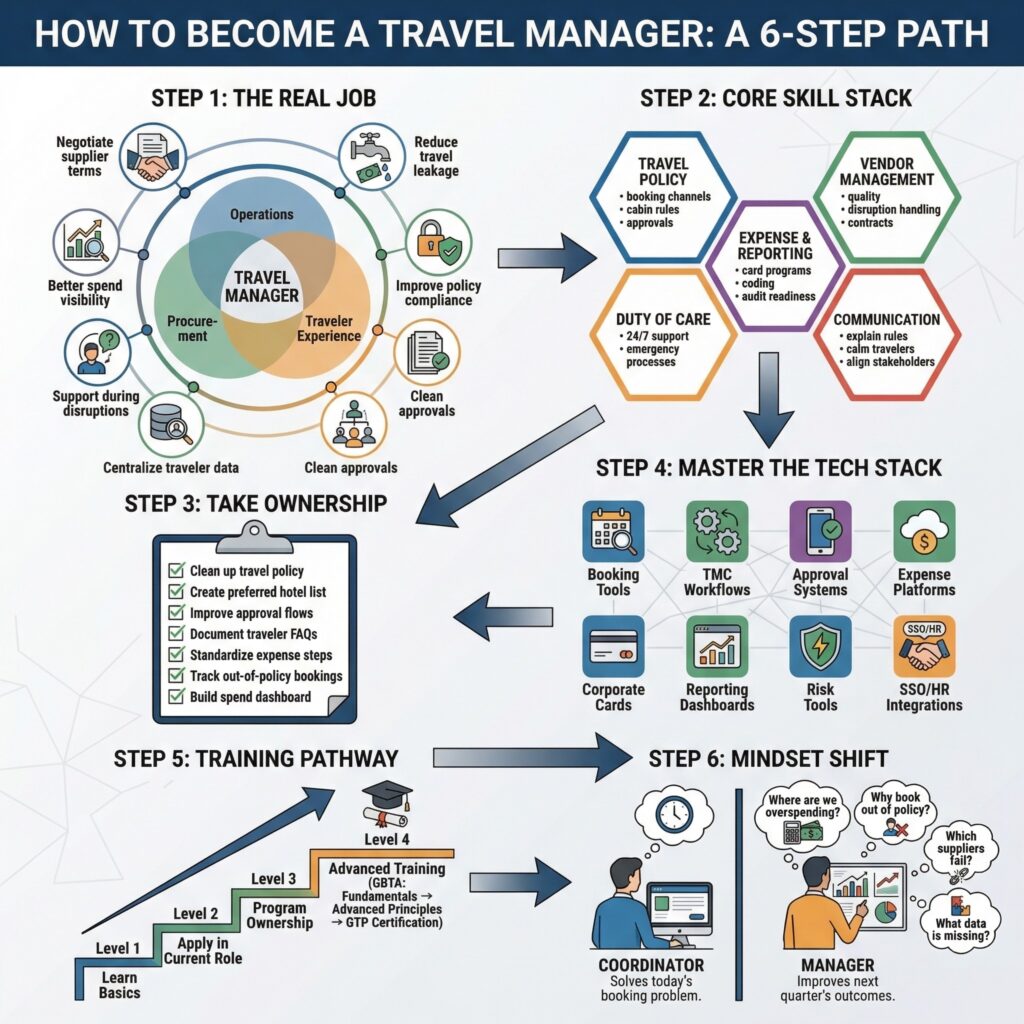
Step 1: Learn the real job, not just the title
Before you chase the title, understand what employers actually need fixed.
They usually need someone who can:
- reduce travel leakage
- improve policy compliance
- make approvals cleaner
- centralize traveler data
- support travelers during disruptions
- produce better spend visibility
- help negotiate stronger supplier terms
That is why the job sits at the intersection of operations, procurement, and traveler experience.
A beneficial first move is to map your current work against those responsibilities. If you already manage bookings, expense issues, policy questions, or vendor escalations, you are closer than you think.
Step 2: Build the core skill stack
You do not need to master everything on day one, but you do need a useful working level across the core areas.
Travel policy
Learn how a company’s travel policy is structured: booking channels, cabin rules, hotel limits, approvals, preferred suppliers, reimbursement rules, exceptions, and duty-of-care processes. If you can help write, clean up, or enforce policy without making it unreadable, you become valuable fast. Cvent’s overview of corporate travel management highlights policy development and compliance, approvals, bookings, expense systems, duty of care, data analysis, vendor management, and technology as core elements. (cvent.com)
Supplier and vendor management
A travel manager has to evaluate more than price. You need to think about support quality, disruption handling, reporting, integrations, rate loading, traveler satisfaction, and contract terms.
Expense and reporting
If you cannot tie travel decisions back to spending, savings, and compliance, you are stuck at the admin layer. Learn the basics of card programs, expense coding, reimbursement errors, audit readiness, and monthly reporting.
A simple way to get sharper here is to standardize your receipts and trip records. A portable receipt scanner is a small but genuinely useful tool for understanding how messy expense workflows can be in real life.
Traveler support and duty of care
The best policy in the world fails if nobody can get help when flights are canceled or plans change. Learn how traveler support works before, during, and after a trip. Travelers can easily access assistance and information when unexpected situations arise thanks to strong programs built around visibility, support channels, and clear emergency processes. (Travel for Business)
Communication
You will spend a surprising amount of time explaining rules, calming frustrated travelers, aligning with finance, and pushing suppliers for better performance. The role rewards calm, clear communication more than jargon.
Step 3: Get practical ownership before you get the title
One of the best ways to become a travel manager is to start owning a piece of the process where you already work.
That could be:
- cleaning up a travel policy
- creating a preferred hotel list
- improving approval flows
- documenting traveler FAQs
- standardizing expense submission steps
- tracking out-of-policy bookings
- building a monthly spend dashboard
This is where many people make the leap. They stop being the person who reacts to travel problems and become the person who improves the travel system.
Step 4: Learn the tools and workflows companies actually use
You do not have to become a software expert, but you should understand the stack around managed travel:
- booking tools
- TMC workflows
- approval systems
- expense platforms
- virtual cards or corporate cards
- reporting dashboards
- traveler tracking or risk tools
- SSO and HR integrations
Service plus technology forms the foundation of modern TMC models, which strongly prioritize policy enforcement, reporting, traveler support, duty of care, and program optimization. (Travel for Business)
This is also why reading the wider ecosystem matters. These related guides on your site are strong internal next steps for readers:
- What Does a Travel Manager Do?
- What Is the Meaning of Travel Management?
- Complete Guide to Travel Management Companies
- What are the 5 basic functions of a travel management agency? (Travel for Business)
Step 5: Add formal training when you are ready
You do not always need a certification to land the role. Still, structured training can help you move faster and look more credible, especially if you are coming from admin, finance, or hospitality rather than a dedicated travel program, as it provides essential knowledge and skills that are highly valued in the travel industry.
GBTA’s professional development path includes The Fundamentals of Business Travel Management, Advanced Principles of Business Travel Management, Sustainable Travel Management, and the Global Travel Professional (GTP) certification. GBTA says its Fundamentals course is designed to help professionals understand and own the travel management function, develop policy, and oversee vendors and technology procurement. The Advanced Principles course is aimed at professionals who want to become more strategic and also prepares them for the GTP exam. (gbta.org)
That is a strong progression:
- Learn the basics.
- Apply them in your current role.
- Move into program ownership.
- Use advanced training when managing policy and strategy, not just transactions, to ensure you make informed decisions that align with organizational goals and improve overall travel efficiency.
Step 6: Think like a buyer, not just a coordinator
This is the mindset shift that separates a travel coordinator from a travel manager.
A coordinator solves today’s booking problem.
A manager improves next quarter’s travel outcomes.
That means asking:
- Where are we overspending?
- Why are travelers booking out of policy?
- Which suppliers are causing service issues?
- Where is approval time slowing the business down?
- What data is missing?
- What traveler complaints repeat every month?
When you start answering those questions, you are already operating like a manager.
The Fundamentals course from GBTA aims to assist professionals in comprehending and controlling the travel management function, formulating policies, and managing vendor and technology procurement. A practical way to sharpen traveler empathy is to do a few short work trips with a one-bag setup. A dependable Thule Aion Travel Backpack 28L is a solid option if you want to test airport movement, laptop access, and day-trip usability yourself.
Key Points
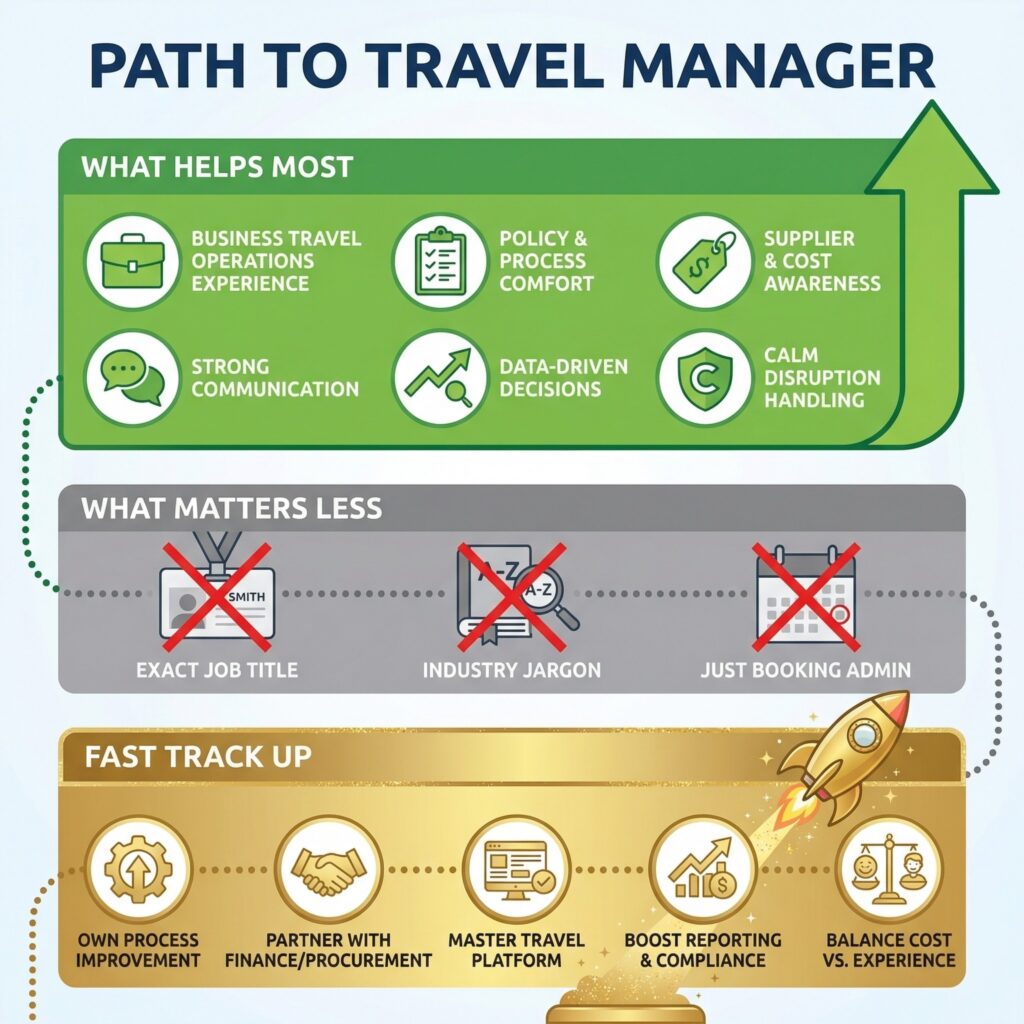
What helps most
- experience with business travel operations
- comfort with policy and process
- supplier and cost awareness
- strong communication
- ability to use data to improve decisions
- calm handling of disruption
What matters less than people think
- having the exact job title already
- memorizing industry jargon
- treating the role like pure booking admin
What moves you up faster
- owning a process improvement project
- working closely with finance or procurement
- learning one managed-travel platform well
- improving reporting and policy compliance
- showing that you can balance cost control with traveler experience
Examples and Case Studies
Example 1: Executive assistant to the travel manager
An EA at a 200-person company starts by handling leadership travel. Over time, she notices duplicate bookings, vague approval rules, and constant exceptions at the hotel. She builds a simple travel FAQ, standardizes preferred hotels across the top five cities, and creates a single approval form. Six months later, finance asks her to formalize the company travel policy. That is the bridge in travel management.
Example 2: Office manager to travel program owner
An office manager coordinates team offsites and regular sales travel. He begins tracking spending by trip type, flags where last-minute bookings are costing the most, and helps evaluate a booking tool. He may not have “travel manager” in his title yet, but he is already doing the work that leads to it.
Example 3: Procurement analyst moving into travel
A procurement analyst already understands contracts and supplier reviews. She partners with HR and operations to review travel categories, compares TMC support models, and negotiates improved hotel terms. Because she can connect travel decisions to savings and governance, she becomes the natural owner of the program.
For frequent trips, small process upgrades matter. Standardized packing cubes can reduce packing friction and help travelers stay organized, especially when they need faster hotel unpacking and cleaner expense documentation around trip essentials.
Expert Insights
The role is getting broader, not narrower.
GBTA and Cvent describe the corporate travel manager role as transforming, and recent Cvent reporting shows that many travel managers also handle meetings and events sourcing responsibilities. In one Cvent report snippet for 2025, 91% of travel managers said they were also responsible for sourcing hotels and venues for meetings and events. Even earlier Cvent research in Europe found 88% of surveyed corporate travel managers were responsible for sourcing hotels for meetings and events in addition to employee travel. (cvent.com)
That means aspiring travel managers should not think too narrowly. The strongest candidates increasingly understand:
- travel policy
- supplier strategy
- meetings and event overlap
- sustainability expectations
- traveler experience
- finance and reporting discipline
It also means soft skills matter more than many people expect. A travel manager often works in the tension between traveler happiness, budget pressure, policy control, and supplier leverage. That is not a software problem. It is an operating judgment problem.
If you want to experience the traveler side directly, a durable Travelpro Maxlite 5 Carry-On Spinner is a practical benchmark for testing airport flow, overhead fit, and real-world durability.
Additional Resources
If you want to go deeper after this article, these are the best next reads on your site:
- What Does a Travel Manager Do?
- What Is the Meaning of Travel Management?
- Complete Guide to Travel Management Companies
- How to Pack a Suit in a Carry-On Without Wrinkles (Travel for Business)
Conclusion
Becoming a travel manager is less about “breaking into travel” and more about proving you can make business travel controlled, efficient, and easier to live with.
Start where you are. Learn about policy, suppliers, expense logic, and traveler support, as well as how these elements interact to create a seamless travel experience for employees. Take ownership of one piece of the process. Improve it. Document the results. Then grow from trip coordination into program leadership.
That is the path.
Frequently Asked Questions
Do you need a degree to become a travel manager?
Not always. A degree in business, hospitality, tourism, operations, or finance can help, but practical experience often matters more. Employers usually care most about whether you can manage policy, suppliers, spending, reporting, and traveler issues effectively.
Is a certification worth it?
It can be, especially if you want to move faster or strengthen your credibility, as certifications like the GTP can enhance your qualifications and demonstrate your expertise to potential employers. GBTA’s Fundamentals and Advanced Principles courses, plus the GTP (Global Travel Professional) certification path, are among the clearest formal development routes in the travel management space. (gbta.org)
What jobs can lead into travel management?
Executive assistant, office manager, travel coordinator, operations coordinator, procurement analyst, finance analyst, TMC consultant, hotel sales manager, and event operations roles can all lead into travel management.
What is the most important skill for a travel manager?
Judgment. You need to balance cost control, traveler experience, policy compliance, and supplier performance without creating a system people hate using.
Do small businesses need a travel manager too?
Yes. The title may not exist yet, but the function still does. In a smaller company, the role may sit with an office manager, finance lead, or operations person until travel volume justifies a dedicated owner.