
Affiliate Disclaimer: TravelForBusiness.org participates in affiliate programs, including Amazon Associates, and may earn a commission from qualifying purchases at no extra cost to you.
Your client meeting in Lisbon ends on Thursday. The flight home is booked for Friday. Why not stay until Sunday, see the city and fly back rested? That is bleisure: a business trip with a few leisure days attached. It is one of the easiest perks of business travel, as long as you know which costs stay with the company, which ones are yours and what the IRS lets you deduct.
This guide explains bleisure travel from start to finish: the tax rules for trips inside the United States and abroad, how to count business days, what happens when your partner joins you, what your travel policy probably says and how to pack one bag for both halves of the trip. Use our free Business vs Personal Days Allocation Calculator to split your own trip day by day.
The short version:
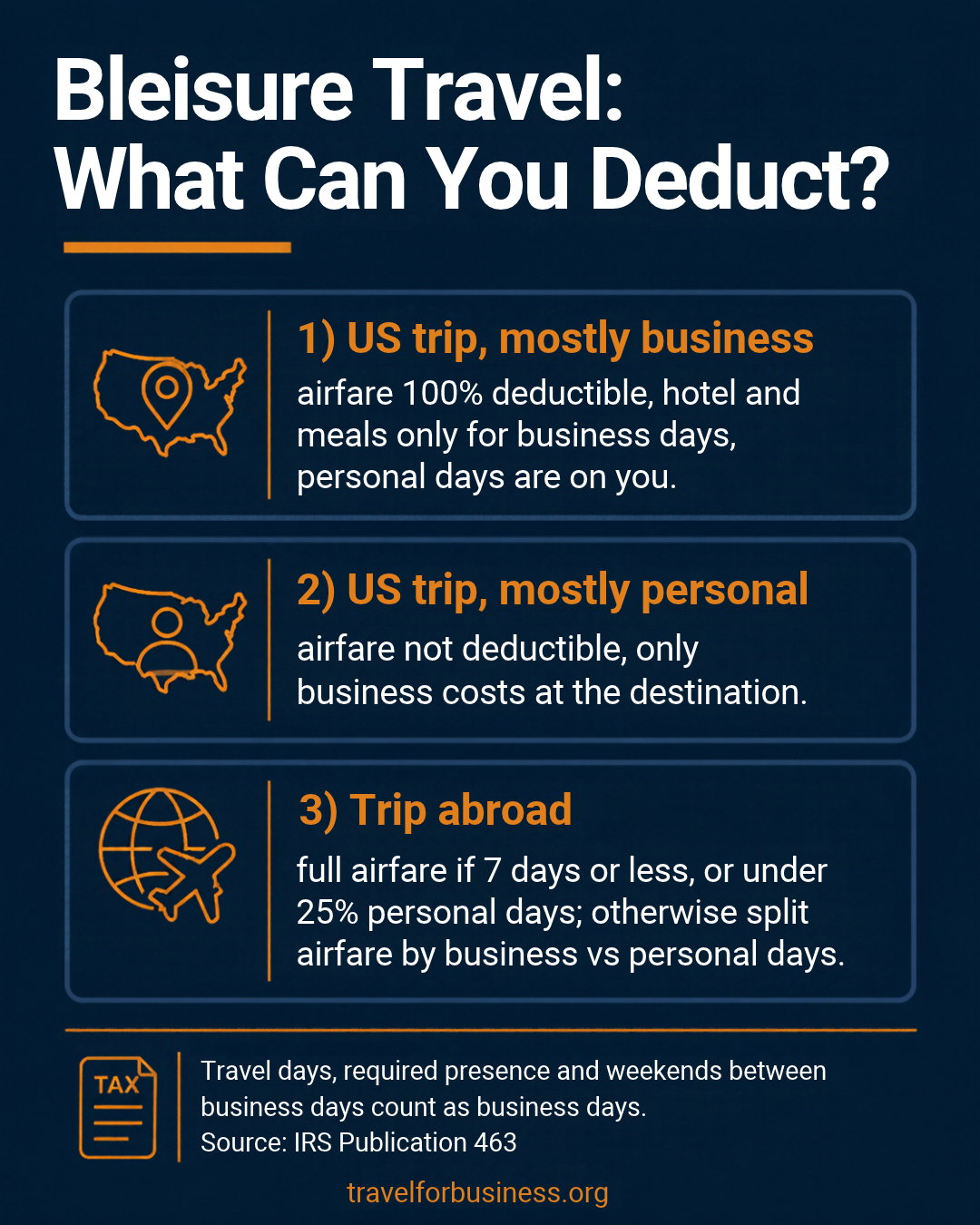
- Primarily business trip in the US: the round-trip airfare is deductible in full. Hotel and meals only for business days. The leisure days are on you.
- Primarily personal trip: the airfare is not deductible at all, only the business costs at the destination.
- Trip abroad: the airfare is fully deductible if you were away a week or less, or if less than 25% of the days were personal. Otherwise you split it by business and personal days.
- Business days include travel days, days your presence is required and weekends that fall between business days.
- Partner or family: their costs are personal, unless they are an employee with a real business purpose.
- One bag for both: an expandable carry-on such as the Travelpro Platinum Elite handles a suit for the meetings and casual clothes for the weekend.
What Is Bleisure Travel?
Bleisure combines business and leisure. You travel for work and add personal time before or after the business part, usually a weekend or a few vacation days. The company pays for the trip it needed anyway; you pay for the extra days. Sometimes a partner or the family flies out to join you.
It has become normal. In a 2025 survey of 1,000 UK small and medium businesses by Travel Counsellors for Business, 76% of respondents said they usually add leisure time to overseas work trips, up from 48% a year earlier. Of those, 57% add one or two days and 32% add three or four, according to The Business Travel Magazine.
The Key Question: Is the Trip Primarily for Business?
For a trip inside the United States, everything depends on one test from IRS Publication 463: was the trip primarily for business or primarily personal? The scope and duration of the business activities compared to the personal activities is the main factor, and in practice that comes down to counting days.
| Primarily business | Primarily personal | |
|---|---|---|
| Airfare or mileage to and from the destination | Deductible in full | Not deductible |
| Hotel on business days | Deductible | Deductible |
| Hotel on leisure days | Not deductible | Not deductible |
| Meals on business days | 50% deductible (self-employed) | 50% deductible (self-employed) |
| Business costs at the destination (taxis to meetings, conference fee) | Deductible | Deductible |
That is why bleisure works so well: as long as the business days dominate, the flight stays a business cost and you only pay for the extra nights and your days off.
Worked example: a domestic bleisure trip
You fly from Chicago to San Diego on Monday. Meetings run until Thursday afternoon, and you could fly home that evening. Instead you stay for the weekend and fly home on Sunday.
- Business days: Monday (travel and meetings) to Thursday = 4 days
- Personal days: Friday and Saturday = 2 days
- Result: even if you count the Sunday flight home as personal too, that is 4 business days against 3 personal days, so the trip is primarily business.
- Deductible or reimbursable: the round-trip airfare, the hotel for Monday, Tuesday and Wednesday night, meals and local transport on the 4 business days.
- Your own cost: the hotel for Thursday, Friday and Saturday night, and everything you spend on the weekend.
Flip the ratio and the outcome flips too. Three days of meetings attached to a ten-day family vacation is a personal trip with some business in it: the airfare becomes a personal expense, and only the costs of the business days at the destination remain deductible.
The Saturday night stay rule
Sometimes staying over a Saturday makes the flight cheaper. Tax advisers point to an IRS position for this case: if the airfare with the Saturday night stay plus the extra hotel night and meals costs less than the cheapest airfare without the stay, those extra costs are deductible as well, according to GRF CPAs and Advisors. Save a screenshot of both fares at the moment of booking, because that comparison is your proof.
How to Count Business Days
The counting rules come from the foreign travel section of Publication 463, and they are the standard way to split any mixed trip. A day counts as a business day when:
- You travel to or from a business destination. A full day on a plane to a meeting is a business day, as long as you take a reasonably direct route.
- Your presence is required at a particular place for a specific business purpose, even if you spend most of that day on other things.
- Business is your principal activity during working hours that day.
- It is a weekend, holiday or necessary standby day between two business days. A Saturday between a Friday meeting and a Monday meeting counts as business.
The weekend rule only works when the weekend sits between business days. A weekend after your last meeting, when you stay for personal reasons, is personal time.
Our Business vs Personal Days Allocation Calculator does this counting for you: enter the dates, mark each day as business, personal or travel and it produces a day-by-day allocation statement for your expense report or tax file.
Bleisure Trips Abroad: The 7-Day and 25% Rules
International trips have stricter rules. If the trip is primarily business but includes personal days, you normally have to allocate the airfare between business and personal days. There are exceptions where the trip counts as entirely business and you do not have to split the airfare (IRS Publication 463):
- A week or less abroad. If you were outside the United States for a week or less, the transportation counts as fully business. For this count, do not count the day you leave the United States, but do count the day you return.
- Less than 25% personal. If you were away longer than a week but spent less than 25% of the total days on non-business activities, no allocation is needed.
- No substantial control. An employee who was sent on the trip by the employer and had no real say over it. This exception generally does not apply to business owners, executives and the self-employed.
- Vacation was not a major consideration in deciding to make the trip.
Worked example: a trip to Europe
You fly to Munich for a trade show and stay 10 days: 7 business days (including both travel days) and 3 personal days. The trip is longer than a week and 30% of the days are personal, so neither of the first two exceptions applies. You allocate: 3 of 10 days are personal, so 30% of the airfare is a personal expense and 70% is business.
Shorten the extension to 2 personal days on a 9-day trip and the personal share drops to 22%. Under 25%, the full airfare is business again.
When Your Partner or Family Comes Along
Bringing a partner is one of the most popular forms of bleisure. The tax rule is simple: the costs of a spouse, dependent or other companion are not deductible, unless that person is an employee of the company, travels for a bona fide business purpose and the costs would otherwise be deductible. Helping out with notes or entertaining customers is not enough (IRS Publication 463).
You can still claim what it would have cost you to travel alone:
- Hotel: the single room rate, not half of the double room. If a single room costs almost the same as the double, almost the whole room is still a business cost.
- Rental car: fully deductible on business days, because the car costs the same with or without a passenger.
- Flights and meals for your partner: always personal.
What Your Employer and Travel Policy Expect
The tax rules decide what is deductible. Your company’s travel policy decides what is allowed. Most policies that permit bleisure use the same principles:
- Approval first. Ask your manager before you book. Many policies require approval for extensions longer than a weekend.
- No extra cost to the company. The company pays the airfare it would have paid for the business trip alone. If the return flight on Sunday costs more than the Thursday flight, you pay the difference.
- Leisure days on your own card. Hotel nights, meals and activities after the business part go on your personal card, not the corporate card.
- Book through the company tool. It keeps you visible to the travel team, which matters for duty of care. See our comparison of Navan, Perk and SAP Concur.
- Check the insurance. Ask whether the company travel insurance also covers the leisure days. If it covers only the business part, buy your own cover for the extension.
For employees, the leisure part matters at tax time too. When the company only reimburses the business costs under an accountable plan, the reimbursement stays tax-free. If the company pays for your personal days, that part is a taxable benefit. And employees cannot deduct the leisure costs themselves: the deduction for unreimbursed employee expenses is gone at the federal level. Self-employed travelers deduct the business part on their own return. Our guide to writing off travel as a business expense covers the full list of deductible travel costs.
How to Prove the Business Part of the Trip
A mixed trip draws more attention in an audit than a short business trip. Keep the agenda or invitations for every business day, your day-by-day split, business receipts separate from personal ones and the fare comparison if you stayed over a Saturday.
Our article on how to prove a trip is for business explains what the IRS looks for, and the Business Trip Proof Packet Builder helps you collect it in one place.
Packing for Business and Leisure in One Bag
The practical challenge of bleisure is luggage. You need a suit or a blazer for the meetings, and shorts, sneakers or a jacket for the weekend, preferably without checking a bag. Two things help: an expandable carry-on and a packing system that separates the two halves of the trip.
1. Travelpro Platinum Elite Expandable Carry-On Spinner: Best Overall
The Platinum Elite adds up to 2 inches of packing capacity with a tapered expansion, so the bag stays stable when it is full. It has a drop-in, fold-out suiter that keeps a blazer or dress shirts flat, and the suiter comes out as a separate garment bag. The case body measures 21 x 14 x 9 inches and the bag weighs 7.8 lbs, according to Travelpro. Pack it unexpanded for the flight out and use the extra space for the weekend clothes and anything you buy.
Trade-offs: fully expanded, it may be too deep for strict airlines. Keep it compressed when you fly a carrier with tight carry-on rules.
Check the Travelpro Platinum Elite Carry-On on Amazon
2. Briggs and Riley Baseline Essential Carry-On: Best for Frequent Flyers
Briggs and Riley’s patented CX system expands the bag to give you more space, then compresses it back to its original size once you zip it closed, according to Briggs and Riley. That is exactly what a bleisure trip needs: compact on the way out, more room for the leisure part, compact again for the flight home. The brand backs its luggage with its Simple as that lifetime guarantee.
Trade-offs: heavier than minimalist carry-ons, because the structure that makes it durable adds weight.
Check the Briggs and Riley Baseline Essential Carry-On on Amazon
3. CHAMPS Luggage: Carry-Ons and Sets from a Canadian Brand
Want a separate weekend bag or a full set? CHAMPS Luggage sells carry-ons, luggage sets, laptop bags and backpacks.
Browse carry-ons at CHAMPS Luggage
For more choice, see our full guide to the best expandable luggage for business travel that doubles for leisure. To keep the work clothes and weekend clothes apart, use one set of packing cubes per half of the trip, and start from our 5-day business trip packing list plus two casual outfits.
Final Verdict
Bleisure travel is one of the best ways to get more out of a business trip, and the rules are clearer than most people think. Keep the business days in the majority and the airfare stays a business cost. Pay for the leisure nights and meals yourself. Abroad, stay within a week or keep personal days under 25%, or split the airfare. Leave your partner’s costs out, and document the business part of every trip.
Count your own days with the free Business vs Personal Days Allocation Calculator, get the extension approved and pack one expandable carry-on for both halves of the trip.
Related Articles
- Can I Write Off Travel as a Business Expense?
- Best Expandable Luggage for Business Travel That Doubles for Leisure
- How to Prove a Trip Is for Business
- Per Diem Explained: How Business Travel Per Diems Work
- Corporate Housing vs Hotel on Long Business Trips
- 5-Day Business Trip Packing List
Frequently Asked Questions
Question: What is bleisure travel?
Answer: Bleisure travel is a business trip with personal leisure time added before or after the business part, such as a weekend in the destination city. The company usually pays for the business part and the traveler pays for the extra days.
Question: Can I deduct my flight if I add vacation days to a business trip?
Answer: For a trip inside the United States, yes, as long as the trip is primarily for business, which mostly means more business days than personal days. If the trip is primarily personal, the airfare is not deductible. Abroad, the full airfare is deductible if you were away a week or less or spent less than 25% of the days on personal activities; otherwise you split it.
Question: Do weekends count as business days?
Answer: A weekend counts as business days when it falls between two business days, for example between a Friday meeting and a Monday meeting. A weekend after your last meeting that you stay for personal reasons is personal time.
Question: Does my employer have to pay for the extra days?
Answer: No. Most travel policies allow bleisure only if it costs the company nothing extra, so you pay for the leisure nights, meals and any difference in airfare. If the company does pay for personal days, that amount is a taxable benefit.
Question: Are my spouse’s travel costs deductible on a business trip?
Answer: Generally not. A companion’s costs are only deductible if that person is an employee with a bona fide business purpose for the trip. You can still deduct your own costs, such as the single room rate for the hotel.