
Affiliate Disclaimer: TravelForBusiness.org participates in affiliate programs, including Corporate Housing by Owner via Awin, and may earn a commission from qualifying purchases and bookings at no extra cost to you.
A three-month project in Houston, a relocation that starts before the house sale closes, a six-week audit in Denver: at some point a hotel stops making sense. The room is small, you eat out every night, and the bill keeps growing. This guide to corporate housing vs hotel stays shows when a furnished monthly rental is the better choice for a long business assignment, when a hotel still wins, and how taxes and travel policies treat long stays. The free comparator below calculates your own break-even point.
Quick answer
- Under about 3 weeks: a hotel or extended-stay hotel is usually simpler and often cheaper, because many furnished rentals have a minimum stay of 30 nights.
- One month or longer: a furnished monthly rental often wins on cost per night, and you get a kitchen, more space and a real place to work.
- Dates uncertain or the trip may end early: stay in a hotel, or negotiate a lease that can be shortened.
- Where to look: Corporate Housing by Owner (CHBO) is a U.S. marketplace for furnished mid-term rentals, with a free housing request service if you do not have time to search.
What Corporate Housing Is
Corporate housing is a fully furnished apartment, condo or house rented for weeks or months, usually to people on a work assignment, a relocation or a training program. You move in with a suitcase: furniture, kitchenware, linens and internet are already there. Rent is paid per month instead of per night, and you sign a short lease or rental agreement instead of checking in at a front desk.
CHBO describes its own model like this: it connects property owners and managers with travelers who need turn-key furnished properties, so you do not have to rent furniture, buy housewares, set up internet or find a washer and dryer yourself. Its inventory ranges from studios to six-bedroom homes, and tenants book directly with the property manager with no fees from CHBO (CHBO, How it works).
Corporate Housing vs Hotel vs Extended-Stay Hotel
Extended-stay hotels sit between the two: a hotel room with a kitchenette, often with lower weekly rates. This is how the three options compare on a long work assignment:
| Hotel | Extended-stay hotel | Furnished monthly rental | |
|---|---|---|---|
| Typical minimum stay | One night | One night, lower rates for longer stays | Often 30 nights |
| Space | One room | Studio or suite | Full apartment or house |
| Kitchen | No | Kitchenette | Full kitchen |
| Laundry | Paid service | Shared guest laundry | Often in the unit |
| Housekeeping | Daily | Weekly or on request | Usually none, sometimes optional |
| Flexibility | Cancel or extend easily | Cancel or extend easily | Lease terms, notice periods |
| Loyalty points | Yes | Often yes | No |
| Billing | Per night plus hotel tax | Per night plus hotel tax | Per month, deposit and fees |
The trade-off is simple: hotels sell flexibility and service, furnished rentals sell space and a lower cost per night. The longer you stay at one location, the more the second option counts.
When a Furnished Rental Beats a Hotel
- You stay 30 nights or longer at one location. Monthly rent spread over 30 nights is often lower than a nightly hotel rate in the same area, especially in cities with high hotel taxes.
- You want to cook. Eating out three times a day for two months is expensive and tiring. A full kitchen cuts food costs and keeps you healthier.
- You work from where you sleep. A separate desk or dining table beats a hotel bed for long days of calls and reports.
- Your family joins you. On a relocation or a long project, a two-bedroom rental often costs less than two hotel rooms.
- A team travels together. A house shared by three colleagues can replace three hotel rooms, if your policy allows shared lodging.
When a Hotel Is Still the Better Choice
- Short or uncertain stays. If the project could end after two weeks, a lease with a 30-night minimum is a risk.
- Your travel policy requires it. Some companies only reimburse hotels booked through their travel management company. Check before you sign anything.
- You value elite status. Night credits and upgrades are worth real money to frequent travelers, and rentals do not earn them.
- You need service. Daily housekeeping, a 24-hour front desk and a gym downstairs make a hotel easier after long days.
Calculate Your Break-Even Point
Enter your number of nights, the hotel rate you were quoted and the monthly rent of a furnished rental. The comparator adds hotel taxes, one-time fees and extras, subtracts what you save by cooking, and shows the total cost of both options and the night from which the rental becomes cheaper.
Hotel vs Furnished Rental Cost Comparator
Enter your assignment length and the rates you were quoted. The comparator shows the total cost of each option, the cost per night and the break-even point.
Your stay
Hotel or extended-stay hotel
Furnished monthly rental
Fill in the fields above.
Estimate only, based on the numbers you enter. The rental is charged at least one month (30 nights); full-month billing charges every started 30-night period. With “Tax stops after 30 nights” the first 30 nights are taxed, as under the Texas permanent resident rule when you do not give the hotel written notice in advance; rules differ by state and city. Food savings assume you cook some meals in the rental kitchen. Not tax advice.
Two inputs make the biggest difference: whether the rental bills full months only (so a 45-night stay costs two months of rent), and whether hotel taxes stop on long stays in your state or city. Ask both questions before you compare quotes.
Taxes, Per Diem and Travel Policy on Long Stays
The IRS one-year rule
For U.S. taxes, a long assignment only counts as business travel while it is temporary. The IRS treats a work assignment that lasts, or is expected to last, more than one year as indefinite, and travel expenses for an indefinite assignment are not deductible (IRS Topic 511). The same logic decides whether employer reimbursements stay tax-free. If a project might run past a year, talk to your employer and a tax adviser early. For the basics of reimbursement, see our guide to business travel per diems.
Hotel tax can stop after 30 nights
Some states and cities stop charging hotel occupancy tax on long stays. In Texas, a guest who stays 30 or more consecutive days is treated as a permanent resident and is exempt from hotel tax. If you tell the hotel in writing that you will stay at least 30 consecutive days, and you do, the exemption applies from the date of the notice; without notice you pay tax for the first 30 days (Texas Comptroller). Rules differ by state and city, so ask the hotel when you book.
Long-stay per diem rules
Some employers lower the daily allowance on long assignments, on the idea that weekly or monthly lodging is cheaper. Federal travel is the best-known example: since November 2014, Defense Department travelers on a long assignment at one location receive a flat rate of 75 percent of the locality per diem for 31 to 180 days and 55 percent beyond 180 days (GAO report on the flat rate policy). The Army explained at the time that the change was meant to push long-term travelers toward cheaper extended-stay lodging (U.S. Army). Private companies set their own rules, so read your policy for anything about stays longer than 30 days.
How to Find Corporate Housing with CHBO
Corporate Housing by Owner has been around since 2005 and focuses on furnished mid-term rentals for corporate travelers, relocations and insurance housing in the United States and Canada. There are three ways to use it:
- Search by city. Enter your destination and dates. Each listing shows the location, a description, photos and sometimes videos. CHBO has pages for major business cities such as Houston, Dallas, Denver, Atlanta, Chicago and Washington, DC.
- Send a housing request. No time to search? With the free, no-obligation housing request you describe what you need, CHBO sends a list of options, and owners whose property fits contact you.
- Book a CHBO Rental Program property. For these properties CHBO handles the transaction: guest communication, the rental agreement, background and credit checks, and collection of the deposit and rent (CHBO Rental Program). For a business traveler that means one standard process instead of a different landlord setup every time.
Look for the CHBO Complete seal on listings: CHBO uses it to mark properties that meet the minimum standards a corporate housing resident expects.
Checklist Before You Sign a Furnished Rental
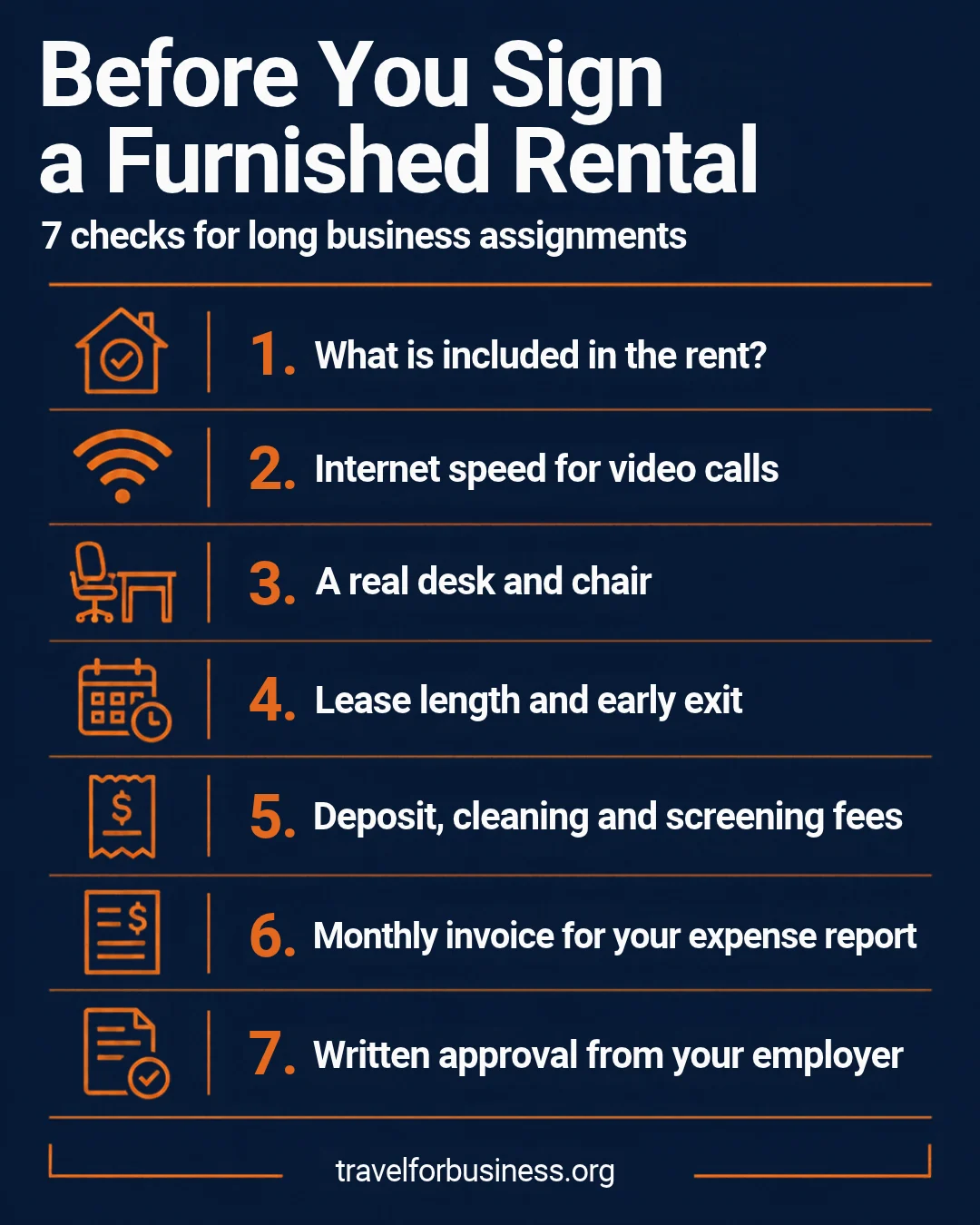
- What is included in the rent? Internet, utilities, parking, weekly cleaning and in-unit laundry. Anything extra goes into the comparator above.
- Internet speed. Ask for a speed test screenshot if you work remotely or join video calls from the rental.
- A real workspace. A desk and a proper chair matter more on a two-month stay than a nice view.
- Lease length and early exit. What happens if the project ends early? Is the last month prorated?
- Deposit and fees. Cleaning fee, application or screening fee, security deposit and when it is returned.
- Billing for your expense report. A monthly invoice with the property address and the dates of stay makes reimbursement easier.
- Policy approval. Get written approval from your manager or travel team before you pay a deposit.
Own a Furnished Rental?
The other side of the market is landlords. If you own a furnished apartment or house in a city with hospitals, military bases, large employers or frequent relocations, mid-term tenants can be a steady alternative to nightly vacation rentals. You can list a property on CHBO and reach corporate travelers, relocation specialists and insurance housing coordinators.
Final Verdict
For assignments of a month or longer at one location, a furnished monthly rental is often cheaper than a hotel and much more comfortable: a kitchen, space to work and room for family. For shorter or uncertain stays, the flexibility of a hotel or extended-stay hotel is worth the higher nightly cost. Run your own numbers in the comparator, check your travel policy and the tax rules for long stays, and if the rental wins, start your search on Corporate Housing by Owner.
Related Articles
- Per Diem Explained: How Business Travel Per Diems Work
- Can I Write Off Travel as a Business Expense?
- How to Prove a Trip Is for Business
- 5-Day Business Trip Packing List: A Full Work Week in a Carry-On
- Travel Routers and Hotel Wi-Fi Security: A Business Traveler’s Guide
- How to Travel for Work Like a Pro
Frequently Asked Questions
Question: Is corporate housing cheaper than a hotel?
Answer: Often, for stays of a month or longer at one location. Monthly rent spread over 30 nights is frequently lower than a nightly hotel rate plus tax, and a kitchen cuts food costs. For stays under about three weeks, a hotel is usually cheaper because many furnished rentals have a 30-night minimum. Use the comparator in this article to check your own numbers.
Question: What is the minimum stay for corporate housing?
Answer: Many furnished rentals have a minimum stay of 30 nights, but some owners accept shorter stays, so check each listing.
Question: Does my company reimburse a furnished monthly rental?
Answer: That depends on your travel policy. Some employers treat a monthly rental like hotel lodging, others only reimburse hotels booked through their travel agency. Get written approval before you pay a deposit, and keep the lease and monthly invoices for your expense report.
Question: Do I pay hotel tax on a long stay?
Answer: In some states and cities hotel occupancy tax stops after a long stay. In Texas, for example, a guest who stays 30 or more consecutive days is exempt as a permanent resident; with a written notice to the hotel, the exemption starts on the date of that notice. In Texas, apartments and houses leased for more than 30 consecutive days are not subject to hotel tax either. Rules differ by location.
Question: How long can a business trip last before it is no longer temporary?
Answer: Under IRS rules, an assignment that lasts, or is realistically expected to last, more than one year is indefinite, and travel expenses for it are no longer deductible. Assignments expected to last one year or less are generally temporary.
Question: Does CHBO charge tenants a booking fee?
Answer: According to CHBO, tenants book directly with the property manager or owner with no fees from CHBO. Owners may charge their own cleaning fees, deposits or screening costs, so check each listing.