
Affiliate Disclaimer: TravelForBusiness.org participates in affiliate programs, including Amazon Associates, and may earn a commission from qualifying purchases at no extra cost to you.
Hotel Wi-Fi is where business travelers do their most sensitive work: the contract review the night before the meeting, the finance dashboard, the client call. It is also a network you share with every other guest in the building, behind a login page anyone can imitate.
Hotel Wi-Fi is far less dangerous than it was ten years ago, but the risks that remain are exactly the ones a business traveler cares about. A travel router for business travel is the simplest way to close that gap: one small box that gives every device you carry its own private, encrypted network, wherever you check in. This guide explains what actually goes wrong on hotel Wi-Fi, what a travel router does and does not fix, which models to buy in 2026, and how to set one up in a hotel room in five minutes.
Short on time? These are our picks:
- Best overall: GL.iNet Beryl 7 (GL-MT3600BE)
- Best value: GL.iNet Beryl AX (GL-MT3000)
- Best with a touchscreen: GL.iNet Slate 7 (GL-BE3600)
- Must-have extra: 3M Privacy Filter for 14 inch laptops
What Actually Goes Wrong on Hotel Wi-Fi
Start with the honest part. The US Federal Trade Commission now says that public Wi-Fi is usually safe to use, because most websites and apps encrypt your traffic with HTTPS (FTC). Someone sniffing the hotel network cannot read your email or your banking session the way they could in 2010.
What HTTPS does not protect against is a different list, and it is the list that matters for business travel:
- Fake networks (evil twins). An attacker sets up a hotspot called “Hotel-Guest” or “Free_Hotel_WiFi” next to the real one. Your devices connect, and the attacker controls DNS and the login page. HTTPS still protects most sessions, but a convincing fake login page can harvest the password itself. As the FTC puts it, encryption protects data in transit, not from the people running the site you send it to.
- Exposure on the shared network. On most hotel networks your laptop sits on the same network segment as hundreds of strangers. Open file shares or an unpatched service on your laptop are visible to all of them unless the hotel enabled client isolation, which you cannot check from your room.
- Metadata. Even with HTTPS, the network operator can see which domains you visit and when. For a lawyer or dealmaker, that alone can be sensitive.
- Shoulder surfing. The lowest-tech attack is still the most common in lobbies and lounges.
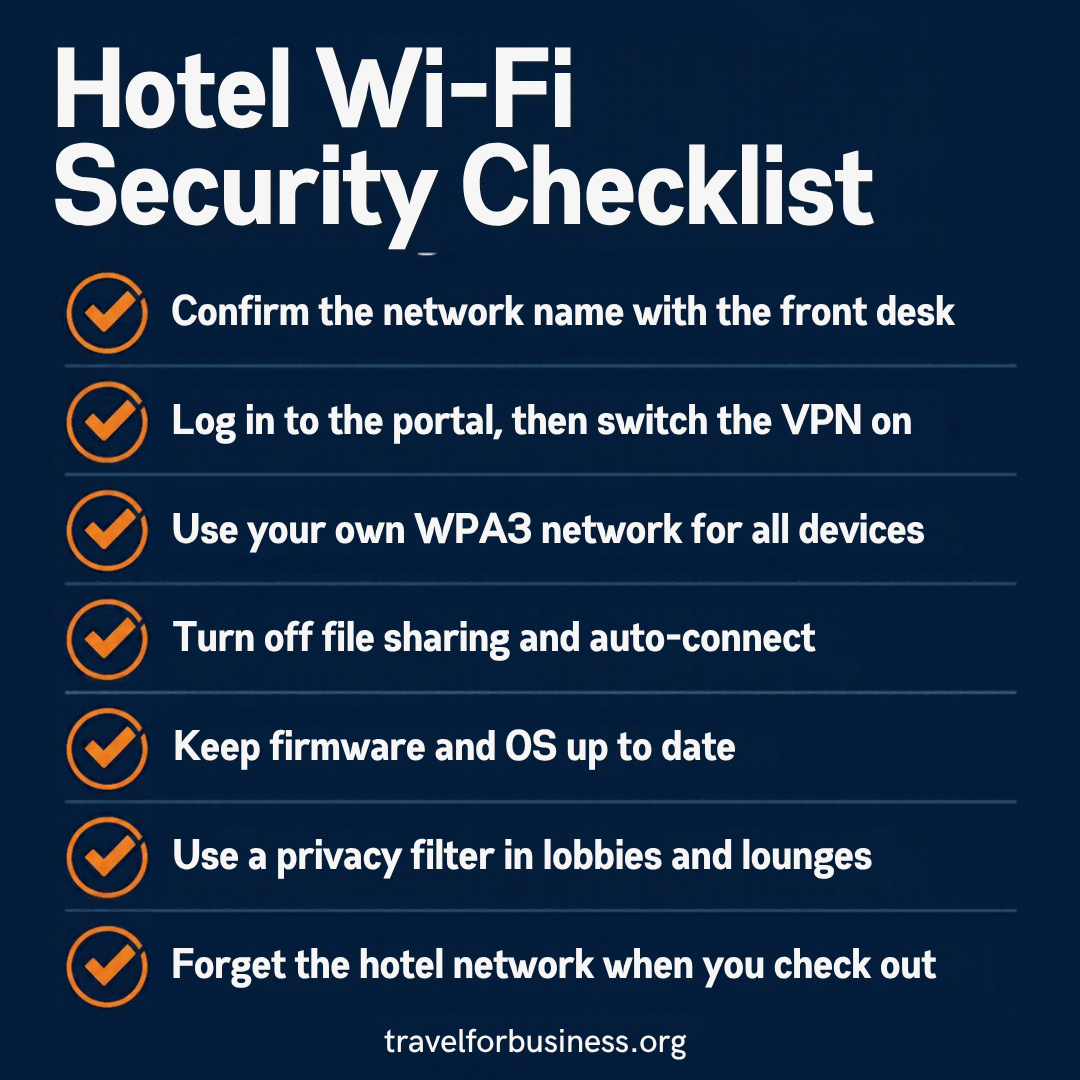
The NSA reaches a similar conclusion in its guidance on wireless devices in public settings: treat hotel and conference Wi-Fi as untrusted, use a VPN, prefer HTTPS, switch off auto-connect and file sharing, and forget the network when you leave (NSA). A travel router makes most of those habits automatic.
How a Travel Router Protects You
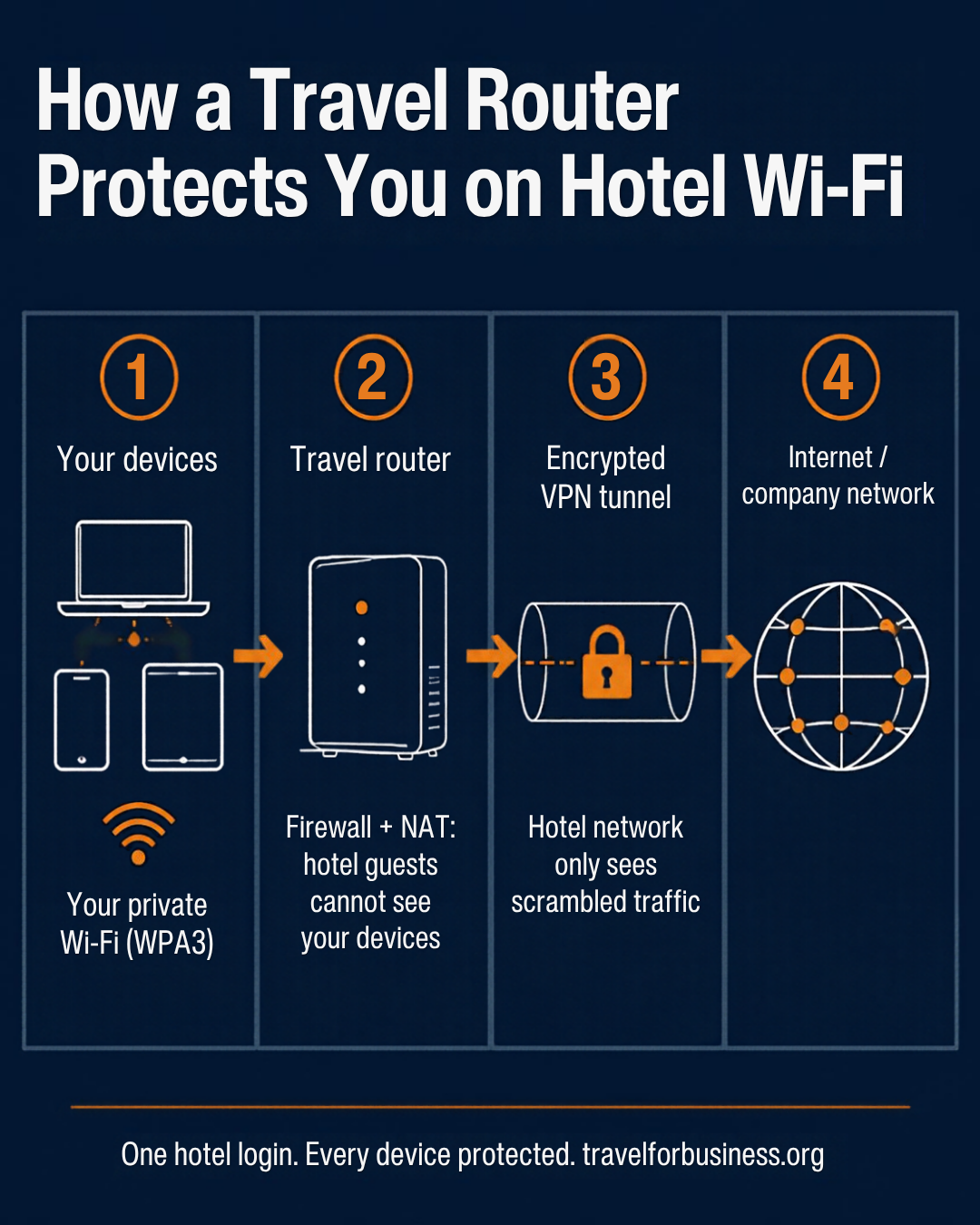
A travel router is a pocket-sized router that connects to the hotel network on one side and creates your own private Wi-Fi network on the other. Your laptop, phone and tablet only ever see your network. That one change has several effects:
- Your devices leave the shared network. The router does network address translation (NAT) and runs a firewall. Other guests see one device, the router, and nothing behind it. Your laptop’s file shares and services are no longer reachable from the hotel network.
- One VPN for everything. Run WireGuard or OpenVPN on the router and every device behind it is tunneled, including the phone and tablet that have no VPN app, and smart devices that cannot run one at all.
- Your devices always join the same network. Because your laptop connects to your own network name with your own password, it never auto-joins a look-alike hotspot. You only connect the router to a new network, deliberately, once per stay.
- One login for all devices. Hotels that limit the number of devices per room count the router as one. You log in once on the portal and every device is online.
- Ethernet turns into Wi-Fi. Plug the router into the wired port at the desk for a faster, more stable connection, still behind your own firewall.
What a travel router does not do: make a phishing page safe, patch your laptop or hide your screen. It is one layer next to HTTPS, two-factor authentication, updates and a privacy filter.
Hotel Wi-Fi Risk Check
How exposed are you right now? Pick the kind of network you are on, how you protect your traffic and how sensitive your work is. The checker scores the risk, lists what to fix first and suggests the gear that closes the biggest gap.
Hotel Wi-Fi Risk Check
Describe the network you are on, how you protect your traffic and what kind of work you do. The checker scores the risk and lists what to fix first.
What to fix first
A rule-of-thumb score based on the NSA guidance on public Wi-Fi and the FTC advice on HTTPS. It does not replace your company’s IT or security policy.
The Best Travel Routers for Business Travel
All three routers come from GL.iNet, the company that defined this category. The firmware is based on OpenWrt and every model supports WireGuard and OpenVPN, more than 30 VPN providers, AdGuard Home with encrypted DNS, and a repeater mode built for hotel login pages. The differences are speed, ports and convenience.
1. GL.iNet Beryl 7 (GL-MT3600BE): Best Overall
The Beryl 7 is the successor to the Beryl AX and went on sale in February 2026 (GL.iNet). It keeps the same pocket-sized body and adds Wi-Fi 7, a much faster quad-core 2.0 GHz MediaTek processor and a second 2.5G Ethernet port. The VPN numbers are the headline: GL.iNet rates it at up to 1,100 Mbps over WireGuard and 1,000 Mbps over OpenVPN with data channel offload, in client mode (GL.iNet). In practice that means the VPN will never be the bottleneck on a hotel connection.
- Wi-Fi: dual-band Wi-Fi 7 (BE3600), 688 Mbps on 2.4 GHz and 2,882 Mbps on 5 GHz
- Ports: two 2.5G Ethernet ports (one switchable between WAN and LAN), USB 3.0 for tethering or a 4G/5G dongle
- Power: USB-C with Power Delivery, so a phone or laptop charger or a power bank can run it
- Size and weight: 120 x 83 x 34 mm, 205 g
- VPN (client mode): WireGuard up to 1,100 Mbps, OpenVPN-DCO up to 1,000 Mbps
- Extras: multi-WAN failover, 120+ connected devices, 2-year warranty
Trade-offs: it has no screen, so you manage it from a browser or the GL.iNet app. For a business traveler who wants one router for the next five years, it is the one to buy.
Check the GL.iNet Beryl 7 on Amazon
2. GL.iNet Beryl AX (GL-MT3000): Best Value
The Beryl AX has been the default recommendation for travel routers since 2023, and it is still a very good one. It runs Wi-Fi 6 on a dual-core 1.3 GHz chip and has a 2.5G WAN port plus a 1G LAN port (GL.iNet). WireGuard runs at up to 300 Mbps and OpenVPN at up to 150 Mbps in client mode, which is faster than the vast majority of hotel connections anyway.
- Wi-Fi: dual-band Wi-Fi 6, 574 Mbps on 2.4 GHz and 2,402 Mbps on 5 GHz
- Ports: 2.5G WAN, 1G LAN, USB 3.0
- Power: USB-C, 5 V / 3 A
- Size and weight: 120 x 83 x 34 mm, 196 g
- VPN (client mode): WireGuard up to 300 Mbps, OpenVPN up to 150 Mbps
- Security features: WPA3, DNS over HTTPS and DNS over TLS, AdGuard Home
Trade-offs: the VPN tops out far below the Beryl 7, and it needs a 5 V / 3 A supply. For email, Teams and SaaS tools on typical hotel connections, the difference will not show.
Check the GL.iNet Beryl AX on Amazon
3. GL.iNet Slate 7 (GL-BE3600): Best With a Touchscreen
The Slate 7 is the convenience pick. Its small touchscreen shows the connection status and real-time speed, shares the Wi-Fi password as a QR code and switches the VPN on or off without opening a laptop (GL.iNet).
- Wi-Fi: dual-band Wi-Fi 7, 688 Mbps on 2.4 GHz and 2,882 Mbps on 5 GHz
- Ports: 2.5G WAN, 2.5G LAN, USB 3.0
- Processor and memory: Qualcomm quad-core 1.1 GHz, 1 GB RAM
- Power: USB-C with Power Delivery, under 18 W
- Size and weight: 130 x 91 x 34 mm, 295 g
- VPN (client mode): WireGuard up to 490 Mbps, OpenVPN-DCO up to 385 Mbps
Trade-offs: it is the biggest and heaviest of the three, and its VPN speed is less than half that of the Beryl 7. Choose it for the screen and the double 2.5G ports, not for raw throughput.
Check the GL.iNet Slate 7 on Amazon
4. 3M Privacy Filter: The Must-Have Extra
No router stops the person in the next seat from reading your screen. A privacy filter does. The 3M filter blacks out the screen for anyone outside a 60 degree viewing angle, has a glossy side and a matte side, reduces blue light and attaches with the COMPLY flip mount so you can flip it up to share your screen in a meeting (3M).
Tip: check your screen size and aspect ratio before you order. The model linked here fits 14 inch 16:9 screens. Many current business laptops use 16:10 screens, and 3M sells separate filters for those.
Check the 3M Privacy Filter on Amazon
Comparison at a Glance
| Router | Wi-Fi | Ethernet | WireGuard VPN | Weight | Best for |
|---|---|---|---|---|---|
| GL.iNet Beryl 7 | Wi-Fi 7 | 2 x 2.5G | Up to 1,100 Mbps | 205 g | Best overall, fastest VPN |
| GL.iNet Beryl AX | Wi-Fi 6 | 2.5G WAN + 1G LAN | Up to 300 Mbps | 196 g | Best value, proven |
| GL.iNet Slate 7 | Wi-Fi 7 | 2 x 2.5G | Up to 490 Mbps | 295 g | Touchscreen, VPN toggle |
How to Set Up a Travel Router in a Hotel Room
Hotel login pages (captive portals) are the one thing that trips people up. The router has to pass the login page through to your phone or laptop before the VPN can start. GL.iNet documents the process (GL.iNet); this is the short version:
- Plug the router into USB-C power, or into the Ethernet port at the desk if there is one.
- Connect your phone or laptop to the router’s own Wi-Fi and open the admin page at 192.168.8.1.
- Under Internet, use Repeater to join the hotel network.
- Before you log in: switch off the VPN, stop AdGuard Home and turn off DNS rebinding protection, or use the automatic login mode for public hotspots in firmware 4.6 and later. These features block the login page otherwise.
- Refresh the page on your device and complete the hotel login. Give it up to a minute.
- Switch the VPN, encrypted DNS and DNS rebinding protection back on, and check that the VPN status shows connected.
If the login does not stick because the hotel limits devices by MAC address, clone the MAC address of the phone you logged in with, or ask the front desk to whitelist the router.
Which VPN? Many corporate VPN clients are tied to the managed laptop, so ask IT before you put a company VPN on the router. For everything else, a reputable commercial VPN or your own WireGuard server at home works well. GL.iNet firmware also supports Tailscale, which is a simple way to route traffic through a machine at home or in the office (GL.iNet).
How to Choose a Travel Router for Business Travel
VPN speed first, Wi-Fi speed second
Every Wi-Fi 6 or Wi-Fi 7 router is faster than a hotel connection on the radio side. What matters is how fast it encrypts traffic, because the VPN runs all day. Look for WireGuard throughput in client mode.
USB-C power with Power Delivery
A router that runs on a standard USB-C charger means one less brick in your bag. The Beryl 7 and Slate 7 accept Power Delivery at 5, 9 and 12 V; the Beryl AX needs 5 V / 3 A. If you want to run a router from a power bank on a train or in an airport lounge, our guide to the best power banks for business travel covers models that deliver enough.
Two Ethernet ports
A second port lets you cable a laptop while the router uses the wall port. Wired is the most reliable way to run a video call from a hotel room.
Two Free Habits That Matter Most
The checklist above covers the habits that cost nothing, and two deserve extra emphasis. First, never enter more than your room number and last name on a hotel login page, and never a card number or a corporate password. Second, when a network feels wrong, use your phone as a hotspot: the NSA lists a personal hotspot as the safer alternative to public Wi-Fi.
For a broader list of what to bring, see our top 10 must-have accessories for efficient business travel.
Final Verdict
For most business travelers, the GL.iNet Beryl 7 is the best travel router for business travel: Wi-Fi 7, two 2.5G ports, USB-C Power Delivery and VPN speeds high enough that the tunnel is never the bottleneck, in a 205 g box. On a tighter budget, the Beryl AX remains excellent. Prefer to see the VPN status at a glance? The Slate 7 and its touchscreen are worth the extra weight. Whichever you pick, add a 3M privacy filter: it protects against the attack no router can stop.
Related Articles
- Top 10 Must-Have Accessories for Efficient Business Travel
- Best Power Banks for Business Travel: Airline-Approved Picks
- Best Noise-Cancelling Headphones for Business Travel
- How to Travel for Work Like a Pro
- 5-Day Business Trip Packing List: A Full Work Week in a Carry-On
- The Best Laptop Backpacks for Business Travel
Frequently Asked Questions
Question: Do I need a travel router if I already use a VPN app?
Answer: Not strictly, but it helps. A VPN app protects only the device it runs on, and only when it is switched on. A travel router also takes your devices off the shared hotel network, gives every device the same protection and handles the hotel login once for all of them.
Question: Is hotel Wi-Fi safe for business travel?
Answer: Safer than it used to be, because most sites and apps use HTTPS. The remaining risks are fake hotspots, exposure of your devices on the shared network, metadata and shoulder surfing. A VPN, a travel router and a privacy filter address all four.
Question: Can a travel router work with a hotel login page?
Answer: Yes. Connect the router to the hotel Wi-Fi in repeater mode, temporarily switch off the VPN and DNS protection, complete the login on your phone or laptop and then switch the protection back on. GL.iNet firmware 4.6 and later has an automatic login mode for this.
Question: What is the best travel router for business travel in 2026?
Answer: The GL.iNet Beryl 7 (GL-MT3600BE), thanks to Wi-Fi 7, two 2.5G Ethernet ports and WireGuard VPN speeds up to 1,100 Mbps. The Beryl AX is the best value alternative.