
Affiliate Disclaimer: TravelForBusiness.org participates in affiliate programs, including Amazon Associates, and may earn a commission from qualifying purchases at no extra cost to you.
You drive 40 miles to a client, 40 miles back, and do it four times this month. Your company says it pays “the IRS rate”. Which rate? The IRS changed it in the middle of 2026, so the answer depends on the date of each drive. And if your employer pays less, or more, the tax treatment changes too.
This guide explains how mileage reimbursement for business travel works in 2026: where the IRS standard mileage rate comes from, what counts as a business mile, when a reimbursement becomes taxable and what the self-employed can deduct. The free calculator below works out your own trips in miles or kilometers.
The short version:
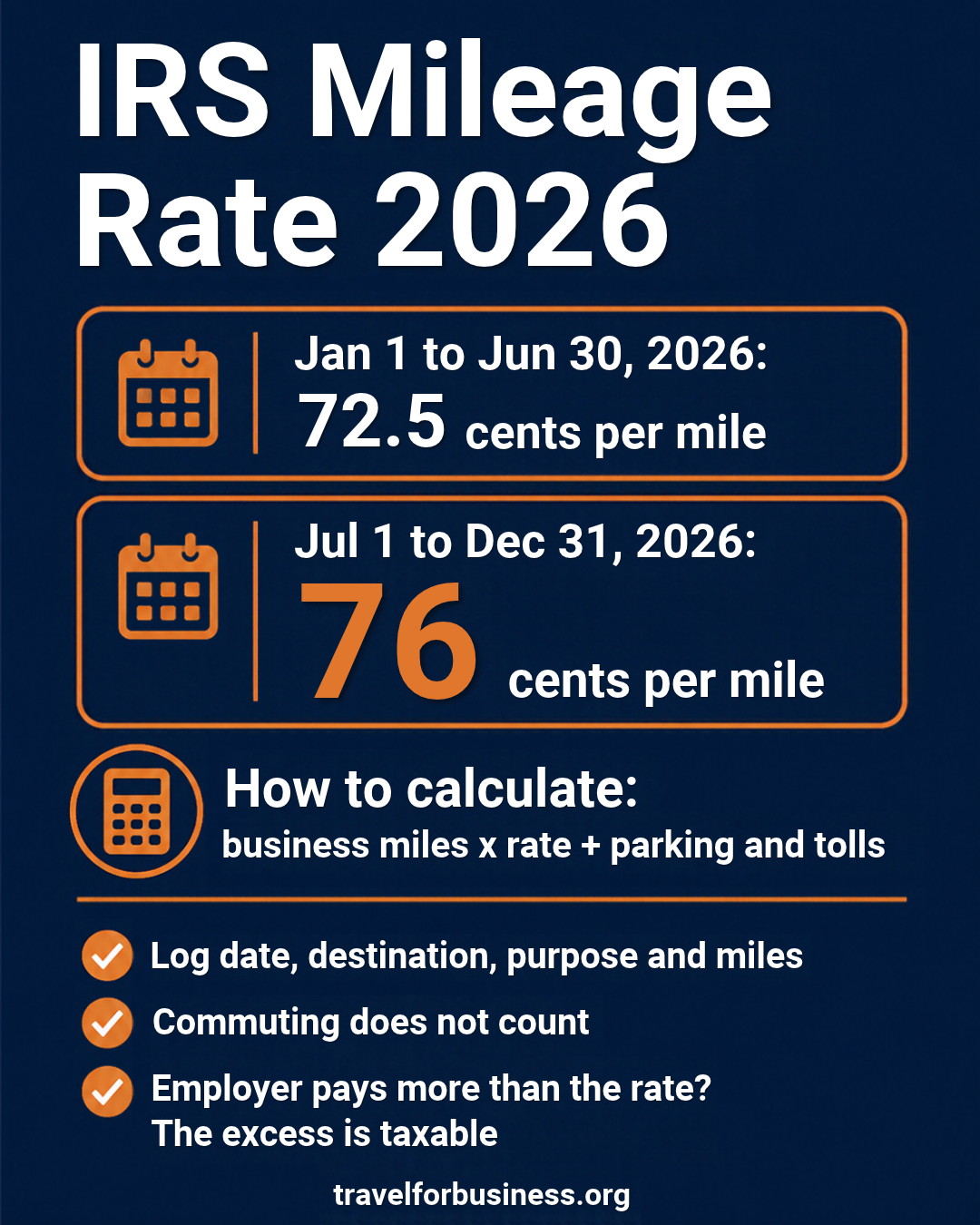
- IRS business rate 2026: 72.5 cents per mile for drives from January 1 to June 30, and 76 cents per mile from July 1 to December 31, 2026.
- Formula: business miles x rate, plus business parking and tolls.
- Tax: tax-free for employees under an accountable plan, up to the IRS rate. Anything above it is taxable wages.
- Commuting never counts: home to your regular office is personal mileage.
- Best low-tech tool: a glovebox Adams vehicle mileage log book, or a GPS mileage app if you drive a lot.
What Is Mileage Reimbursement?
Mileage reimbursement is the amount your employer pays you for using your own car for work. Instead of collecting receipts for fuel, insurance, tires and depreciation, you report the business miles you drove and your employer pays a fixed amount per mile.
Most U.S. companies use the IRS standard mileage rate as that amount, for one simple reason: a reimbursement up to the IRS rate, paid under an accountable plan, is tax-free for the employee and fully deductible for the company. The rate is meant to cover all the costs of running the car, both fixed (depreciation, insurance, registration) and variable (fuel, oil, maintenance), according to the IRS.
Mileage reimbursement is separate from your business travel per diem. A per diem covers lodging and meals; mileage covers the car. On an overnight trip by car you can receive both.
The IRS Standard Mileage Rate for 2026
The IRS set the 2026 rates in December 2025 in Notice 2026-10: 72.5 cents per mile for business, up 2.5 cents from 70 cents in 2025. Then fuel prices jumped. AAA data quoted by the Journal of Accountancy shows regular gasoline rising from $2.819 per gallon on January 8 to $3.890 on July 15, about 38%. The IRS responded with Announcement 2026-11, the first midyear increase since 2022.
| Purpose | Jan 1 to Jun 30, 2026 | Jul 1 to Dec 31, 2026 | 2025 |
|---|---|---|---|
| Business | 72.5 cents | 76 cents | 70 cents |
| Medical and moving (military) | 20.5 cents | 23.5 cents | 21 cents |
| Charitable | 14 cents | 14 cents | 14 cents |
Three details matter in practice:
- The date of the drive decides the rate. A drive on June 30 uses 72.5 cents, a drive on July 1 uses 76 cents. If you submit one log for June and July, split it.
- All vehicle types use the same rate. Gasoline, diesel, hybrid and fully electric cars, vans, pickups and panel trucks all get the same cents per mile (IRS).
- Check for back pay. The midyear change was announced on July 13, so trips in the first weeks of July may have been paid at the old rate. CalChamber advises employers to pay the difference.
How to Calculate Mileage Reimbursement
The calculation itself is simple:
Reimbursement = business miles x IRS rate + business parking and tolls
Parking fees and tolls for a business trip are not part of the per-mile rate, so they are reimbursed or deducted on top (IRS Topic 510). Parking at your regular office is not.
Worked example
In September 2026 you drive four times from your office to a client 42 miles away and back, and pay $20 in parking in total:
- Business miles: 4 trips x 84 miles = 336 miles
- Mileage: 336 x $0.76 = $255.36
- Parking: $20.00
- Total: $275.36, all tax-free under an accountable plan
The same trips in May, at 72.5 cents, would give $243.60 for the miles.
Calculate Your Mileage Reimbursement
Pick the period of your drives, enter the distance and number of trips, and add your company rate if you know it. The calculator converts kilometers, subtracts a normal commute if your policy requires it and shows whether part of your reimbursement is taxable.
Mileage Reimbursement Calculator
Enter your business drives, pick the period and compare the IRS rate with what your employer pays. The calculator shows the tax-free amount, any taxable excess and what a self-employed driver can deduct.
$0.00
Loading the checkerEstimate only, not tax advice. Rates from IRS Notice 2026-10 and Announcement 2026-11. Kilometers are converted at 1 km = 0.621371 miles. Your employer’s policy decides what you are paid.
What Counts as Business Mileage?
The rate is the easy part. Most disputes are about which miles count. The IRS rules in Publication 463 and Topic 510 come down to this:
- Counts: driving from your office to a client, a supplier, a job site, a conference or the airport for a business flight.
- Counts: driving from home to a temporary work location, if you also have a regular work location.
- Counts: driving between two workplaces on the same day.
- Does not count: driving between your home and your regular office. That is commuting, even if you take a work call on the way.
- Does not count: personal detours during a business trip, such as a stop for dinner with friends.
Many employers add their own rule: when you drive from home straight to a client, they subtract your normal commute distance. That is company policy, not an IRS requirement, but it is common. The calculator has a field for it.
Renting a car for the trip? Then mileage reimbursement does not apply. You claim the rental and fuel at actual cost, the same way you would a flight. Our guide on how business travel works explains how those costs are handled.
Is Mileage Reimbursement Taxable?
For employees, mileage reimbursement is tax-free when your employer pays it under an accountable plan. That means (IRS Publication 463):
- The miles were driven for business.
- You substantiate each drive: date, destination, business purpose and miles. The IRS safe harbor is to do this within 60 days.
- You return any advance you did not use, within 120 days under the safe harbor.
Two situations make (part of) it taxable:
- Your employer pays more than the IRS rate. At 80 cents per mile in the second half of 2026, the 4 cents above 76 is wages and belongs on your W-2.
- There is no log. A flat monthly payment without mileage records is not a reimbursement under an accountable plan. It is a car allowance and fully taxable.
What if your employer pays less than the IRS rate, or nothing at all? On a federal return you cannot deduct the difference. The deduction for unreimbursed employee expenses was suspended in 2018, and the One Big Beautiful Bill Act made that permanent (University of Illinois Tax School). A few groups are excepted, such as Armed Forces reservists, certain state and local officials, performing artists and eligible educators (IRS).
Do Employers Have to Reimburse Mileage?
There is no federal law that requires a private employer to pay the IRS rate. The rate is a tax ceiling, not a minimum. But some states go further:
- California requires employers to reimburse all expenses employees necessarily incur for their job. Using the IRS rate generally satisfies that obligation for vehicle costs (CalChamber HRWatchdog).
- Illinois has required employers to reimburse necessary business expenses since January 1, 2019 (Epstein Becker Green).
Outside those states, the travel policy decides. If you drive often and your company pays below the rate, raise it with your manager: the gap is a real cost to you and you cannot deduct it.
Mileage for the Self-Employed
Freelancers and business owners do not get reimbursed; they deduct. You can choose between two methods (IRS):
- Standard mileage rate: business miles x the IRS rate, plus parking and tolls. Simple, and you only need a mileage log.
- Actual expenses: the business share of fuel, insurance, repairs, registration, lease payments and depreciation. More work, sometimes a larger deduction for expensive or heavily used cars.
The catch is the first year. For a car you own, you must use the standard mileage rate in the first year the car is used for business if you want to use it in later years. For a leased car, once you choose the standard rate you must keep it for the entire lease, including renewals. When you use the standard rate, 35 cents of each 2026 business mile counts as depreciation and lowers the car’s tax basis (Notice 2026-10).
For the rest of your travel costs, see can I write off travel as a business expense and how to prove a trip is for business.
Mileage Reimbursement vs Car Allowance vs FAVR
| Mileage reimbursement | Car allowance | FAVR plan | |
|---|---|---|---|
| How it works | Miles x rate | Fixed monthly amount | Fixed part plus variable rate per mile |
| Taxable for employee | No, up to the IRS rate | Yes, as wages | No, if the rules are met |
| Mileage log needed | Yes | No | Yes |
| Fair for low mileage drivers | Yes | Overpays | Yes |
| Fair for high mileage drivers | Yes | Underpays | Yes |
| Admin | Low | Lowest | High |
FAVR (fixed and variable rate) plans suit companies with a large field team. They are based on actual local costs and have their own IRS limits: for 2026 the maximum standard vehicle cost is $61,700 (Notice 2026-10). Expense platforms can calculate mileage automatically; our comparison of Navan, Perk and SAP Concur shows how the big tools handle it.
Tools That Make Mileage Logs Easier
No log, no tax-free reimbursement. The IRS wants the date, destination, business purpose and miles of each drive, written down at or near the time of the trip. Pick the tool that you will actually use.
1. Adams Vehicle Mileage Log Book: Simple and Audit-Proof
A pocket-size paper log that lives in the glovebox. Write the date, odometer readings, destination and purpose before you drive off. It needs no battery, no app permissions and no subscription, and a handwritten log made at the time of the trip is exactly what an auditor wants to see.
Trade-offs: you have to remember to fill it in, and you total the miles yourself at the end of the month.
Check the Adams Vehicle Mileage Log Book on Amazon
2. Mileage Tracking Apps: MileIQ, Everlance and Driversnote
If you drive for work several times a week, an app saves time. Apps like MileIQ, Everlance and Driversnote detect drives automatically with your phone’s GPS, and you classify each drive as business or personal with a swipe. MileIQ’s free plan covers up to 40 drives per month and Everlance’s free plan up to 30 automatic trips, according to a 2026 comparison by MileageWise. Driversnote offers an optional iBeacon that starts tracking when you get into your own car.
Trade-offs: continuous GPS tracking uses battery, and you still need to add the business purpose to each drive.
3. Epson WorkForce ES-50: Scan Parking and Toll Receipts
Parking and tolls come on top of the mileage rate, but only with a receipt. A small USB scanner turns a stack of parking slips into a PDF for your expense report in a few minutes. We use the same scanner in our per diem guide.
Check the Epson WorkForce ES-50 on Amazon
How to Choose the Right Mileage Policy
If you write the travel policy for your company, these questions decide the setup:
- Rate: pay the IRS rate and update it when the IRS does. That is fair, tax-free and, in California, generally compliant.
- Commute rule: decide whether you subtract the normal commute when employees drive from home to a client, and put it in writing.
- Deadline: require logs within 60 days, in line with the IRS safe harbor.
- Rental car threshold: for long trips a rental car is often cheaper than paying mileage. Many policies require a rental above a set distance per day.
Mileage Reimbursement Tips for Business Travelers
- Log the drive the same day. Reconstructing a month of trips from your calendar is where errors start.
- Use the route distance, not the distance you happened to drive while lost. Most policies cap at the shortest practical route.
- Split your log at June 30 for 2026 trips, because the rate changed on July 1.
- Keep parking and toll receipts separately; they are paid on top.
- Check the new rate every December. The IRS usually announces the next year’s rate in the last weeks of the year.
Final Verdict
Mileage reimbursement for business travel is a fixed amount per business mile, and for 2026 that amount is 72.5 cents for the first half of the year and 76 cents from July 1. Paid at or below the IRS rate with a proper log, it is tax-free; paid above it, the excess is wages. Commuting never counts, parking and tolls always come on top, and the self-employed should choose the standard rate in the first year they use a car for business if they want to keep the option.
The one thing that makes or breaks all of this is the log. A paper mileage book in the glovebox or an app on your phone both work, as long as you fill it in when you drive.
Related Articles
- Per Diem Explained: How Business Travel Per Diems Work
- Can I Write Off Travel as a Business Expense?
- How to Prove a Trip Is for Business
- How Does Business Travel Work?
- Navan vs Perk vs SAP Concur
Frequently Asked Questions
Question: What is the IRS mileage rate for business travel in 2026?
Answer: 72.5 cents per mile for business drives from January 1 to June 30, 2026, and 76 cents per mile from July 1 to December 31, 2026. The IRS raised the rate midyear in Announcement 2026-11 because of higher fuel prices.
Question: Is mileage reimbursement taxable income?
Answer: Not for employees, as long as the employer pays it under an accountable plan, you log each drive and the rate does not exceed the IRS rate. Any amount above the IRS rate is taxable wages.
Question: Does my employer have to pay the IRS mileage rate?
Answer: No federal law requires it. The IRS rate is the maximum that can be paid tax-free. California and Illinois require employers to reimburse necessary business expenses, and in California the IRS rate generally satisfies that.
Question: Can I deduct mileage if my employer does not reimburse me?
Answer: Not on your federal return as an employee. The deduction for unreimbursed employee expenses was suspended from 2018 and made permanent by the One Big Beautiful Bill Act. Self-employed people can deduct business mileage on Schedule C.
Question: Is driving from home to the office business mileage?
Answer: No. Driving between your home and your regular workplace is commuting and never counts. Driving from home to a temporary work location, such as a client site, can count if you also have a regular workplace, but many employers subtract your normal commute.
Question: Can I claim parking and tolls on top of the mileage rate?
Answer: Yes. Business parking fees and tolls are not included in the standard mileage rate, so they are reimbursed or deducted separately. Parking at your regular workplace is not deductible.