
Affiliate Disclaimer: “TravelForBusiness.org participates in affiliate programs, including Amazon Associates, and may earn a commission from qualifying purchases at no extra cost to you.”
If you’re running business travel in 2026, your real enemy isn’t airfare—it’s fragmentation: bookings in one place, receipts in another, card data somewhere else, and reporting that shows up after the month is already closed.
Before we get into the platform battle, one quick “unsexy” win: if your travelers still email photos of receipts (or lose them), a portable receipt scanner can clean up expense backup fast—especially for field teams and frequent travelers. Check out this Portable receipt scanner [Portable receipt scanner].
This guide compares Navan with the most common alternatives travel managers and finance teams weigh today: Perk (formerly TravelPerk), SAP Concur, and Amex GBT Egencia—with a simple recommendation at the end based on your company size, workflow complexity, and duty-of-care needs.
1. Brand Comparison Overview
Navan (formerly TripActions) positions itself as a unified travel, expense, and payments platform—designed to feel consumer-easy for travelers while giving admins policy and spend control. (Navan)
It’s also a vendor with real scale signals: Navan states it powers travel programs at 10,000+ companies, and it has highlighted third-party-commissioned ROI claims via a Forrester TEI study (more on how to treat that data later). (Navan)
And, for buyers concerned about vendor longevity, Navan’s IPO took place in late October 2025, raising approximately $923 million, according to Reuters reports. (Reuters)
The short version of the market
- Navan: best known for an all-in-one approach (travel booking, expense, and payments/corporate cards). (Navan)
- Perk (TravelPerk): strong in policy-driven booking and travel operations, with transparent booking-fee style pricing and add-ons. (perk.com)
- SAP Concur: the enterprise standard for many organizations already living inside SAP-heavy finance stacks; typically modular and highly configurable. (concur.com)
- Amex GBT Egencia: a TMC-style ecosystem with heavy emphasis on service and global travel counselor support. (Egencia)
At-a-glance comparison (who wins what)
Navan tends to win when you want one app to drive adoption and reduce expense friction fast.
Perk tends to win when your team wants a modern booking layer with clear add-ons, and you like a “platform + fee” model. (perk.com)
Concur tends to win when complexity, controls, and integrations outweigh “pretty UX,” especially at scale. (concur.com)
Egencia tends to win when your differentiator is the depth of human support across regions and languages. (Egencia)
If you’re building the program from scratch, see “Complete Guide to Travel Management Companies”
2. Feature-by-Feature Analysis
Travel booking experience and inventory
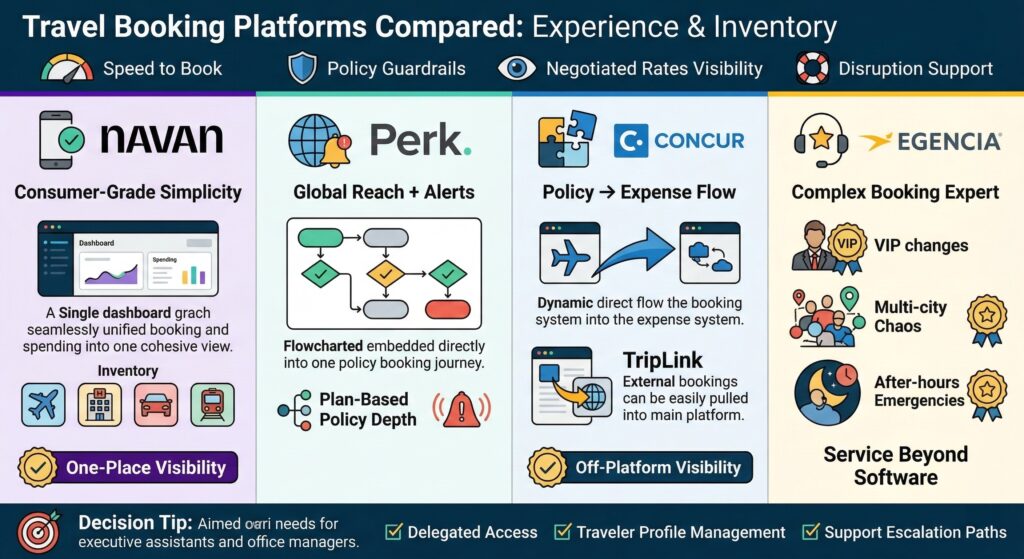
What matters: speed to book, policy guardrails, visibility into negotiated rates, and traveler confidence during disruptions.
- Navan emphasizes a consumer-grade booking experience plus “one place” visibility across booking and spending. It also markets broad coverage of inventory (flights, hotels, cars, trains). (Navan)
- Perk highlights global inventory and travel alerts, with policy/approval built into the booking experience and plan-based policy depth. (perk.com)
- Concur often shows up as “book within policy, then feed the data into Concur Expense,” plus TripLink for pulling in off-platform bookings for visibility. (concur.com)
- Egencia typically shines when bookings get complicated (VIP changes, multi-city disruptions, after-hours changes) because the experience extends beyond the tool into service delivery. (Egencia)
Decision tip: If EAs and office managers do a lot of booking on behalf of executives, prioritize (1) delegated access, (2) traveler profile management, and (3) support escalation paths.
“What does a travel manager do?”
Policy controls, approvals, and budget guardrails
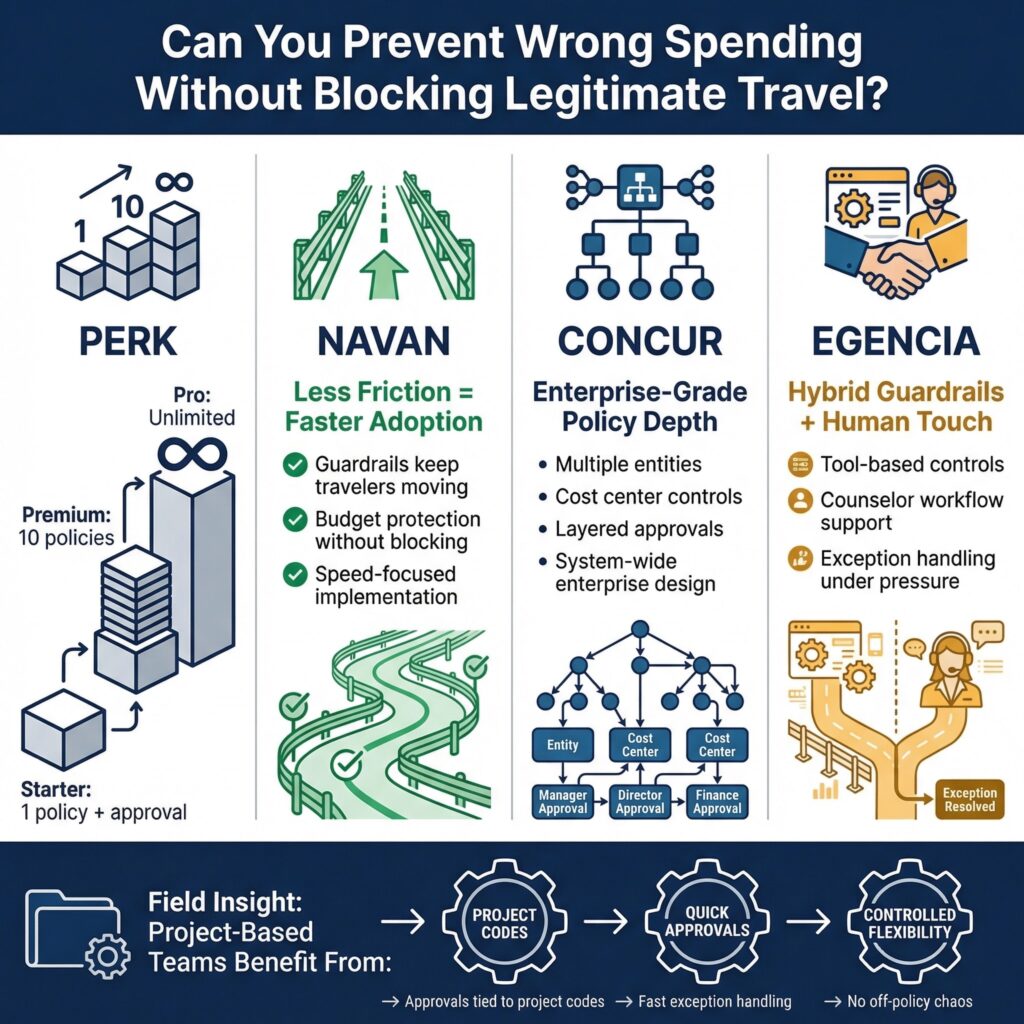
What matters: can you prevent the wrong spending without blocking legitimate travel?
- Perk is very explicit: Starter includes 1 policy + approval, Premium includes 10 policies, and Pro supports unlimited—and it’s all clearly tied to plans. (perk.com)
- Navan leans on guardrails that keep travelers moving while protecting the budget; if you’re implementing fast, this “less friction” approach can matter for adoption. (Navan)
- Concur is usually strongest when you need policy depth across entities, cost centers, and approval layers—often because the whole system is designed around enterprise controls. (concur.com)
- Egencia programs often pair tool-based guardrails with counselor workflows (especially where approvals and exceptions happen under pressure). (Egencia)
Field teams note: project-based consultants and service teams benefit when approvals are tied to project codes, and exceptions are handled quickly, without off-policy chaos.
Expense capture, reconciliation, and close-readiness
This is where most travel programs bleed time.
- Navan sells the unified promise: bookings, card transactions, and expenses flow together, with automation and virtual cards as part of the model. (Navan)
- Concur remains a known quantity for receipt capture and expense reporting, with mobile capture baked in and a huge ecosystem of partners. (concur.com)
- Perk supports “expense integrations” as part of its offering; for many teams, it’s a booking-led approach with downstream expense connectivity (your exact setup matters). (perk.com)
- Egencia commonly integrates into the accounting/expense landscape as both the travel layer and a service wrapper.
Practical add-on: If your team constantly travels with loose receipts (taxis, tips, client meals), get everyone standardized on packing cubes (less chaos in the bag) and a receipt workflow.

“How does business travel work?”
Payments and corporate cards
If your travel program includes corporate cards, virtual cards, or vendor-paid travel, payments become strategic.
- Navan offers physical and virtual card solutions, as well as market spend control and streamlined reconciliation, all within the same platform. (Navan)
- Perk promotes cards as add-ons (e.g., Perk Cards) with spending limits and cash-back messaging. (perk.com)
- Concur typically integrates with corporate card programs and finance systems; its strength depends on your bank/card landscape and implementation, which can vary significantly based on the specific financial institutions and card providers involved. (concur.com)
- Egencia often complements existing card programs while providing service and program structure, which enhances the ability to track expenses and improve reporting accuracy.
Reporting and program visibility
What matters: can you answer “Where did money go?” fast enough to act?
- Navan markets unified visibility across booking and spend, which can simplify reporting if adoption is high. (Navan)
- Perk includes travel reporting and offers plan-based reporting depth; Pro highlights custom reporting. (perk.com)
- Concur is built for finance-grade reporting, but it may require more setup to produce “clean” outputs.
“What are the 4 C’s of corporate travel management?”
Traveler support and duty of care
Duty of care isn’t just emergencies—it’s disruptions, rebooking, and knowing who is where.
- Egencia is extremely explicit about service coverage: 24/7/365 support, with 2,500+ consultants, multilingual coverage, and broad country coverage (per its customer service page). (Egencia)
- SAP Concur frames duty of care as cross-team and partner-enabled, which means it involves collaboration across different teams and partners, including tracking locations via bookings and pulling outside bookings back into the program via TripLink. (concur.com)
- Perk offers duty-of-care as an add-on via providers and emphasizes alerts and policy controls, which are essential for ensuring traveler safety and compliance with organizational policies during travel. (perk.com)
- Navan positions duty-of-care benefits through unified data and support experience; your outcomes depend heavily on traveler adoption and policy adherence, which can be enhanced by effective communication strategies and training programs for travelers.
3. Performance Benchmarks (what to measure in a real pilot)
Ignore vanity demos. Run a pilot and benchmark what matters:
The 7 benchmarks that actually move outcomes
- Adoption rate (active travelers ÷ travelers who should be using it)
- Policy compliance (in-policy bookings ÷ total bookings)
- Time to book (median time from search → confirmed booking)
- Time to submit expenses (median days after trip end)
- Receipt match rate (auto-matched ÷ total transactions)
- Rebooking time during disruptions (median minutes to resolution)
- Traveler satisfaction (CSAT or simple post-trip pulse)
What we can use as directional “proof”
- User-review benchmarks: Capterra lists Navan at 4.6/5 (209 reviews) and Perk (TravelPerk) at 4.7/5 (421 reviews), with both pages “last updated” Jan 6, 2026; SAP Concur appears as 4.3/5 in the same comparison context. (Capterra)
- Scale claims: Navan states it supports travel programs at 10,000+ companies. (Navan)
- Commissioned ROI study (use carefully): Navan publishes results from a Forrester Consulting TEI study it commissioned, citing outcomes such as “16% saved on travel” and “booking in under five minutes,” while explicitly noting that results may vary and are not guaranteed. Treat this as directional, not a promise. (Navan)
4. Pricing Comparison (what you’ll really pay)
Pricing is where most “Navan comparison” discussions get messy—because each vendor packages differently.
Navan pricing (more transparent than most)
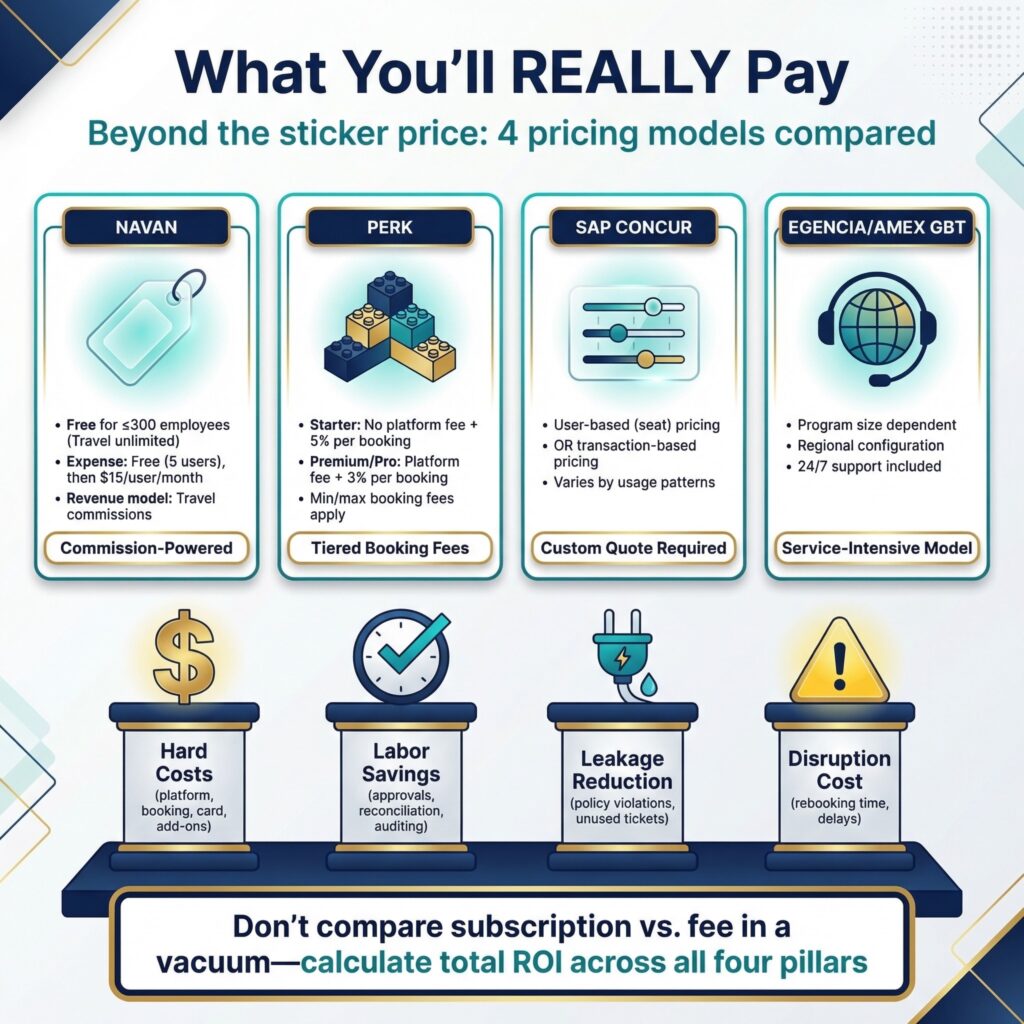
Navan publishes a clear line for smaller organizations: for companies with 300 or fewer employees, Navan Travel has no trip limit, and Navan Expense is free for the first 5 monthly expensing users, then $15 per user/month; larger companies are pushed to demo/enterprise pricing. (Navan)
Navan also states the model is powered by travel provider commissions for the “Navan Business” tier. (Navan)
Perk pricing (platform + booking fee model)
Perk lists no platform fee for Starter with +5% per booking, and Premium/Pro with a platform fee plus +3% per booking, with minimum/maximum booking fees called out. (perk.com)
SAP Concur pricing (models vary)
SAP Concur explicitly states that T&E software pricing typically falls into user-based (seat) and transaction-based models, and that the structures differ by provider and usage patterns. (concur.com)
Translation: you’ll almost always need a scoped quote.
Egencia / Amex GBT pricing (program + service realities)
Egencia pricing usually depends on program size, service configuration, and region—because a lot of value sits in support delivery. Egencia and Amex GBT are very explicit about 24/7 traveler support coverage, which often influences cost structure and ROI. (Egencia)
Total-cost reality check: Don’t compare “subscription vs fee” in a vacuum. Compare:
- hard costs (platform + booking + card + add-ons),
- labor savings (approvals, reconciliation, auditing),
- leakage reduction (out-of-policy + unused tickets),
- and disruption cost (time and rebooking).
5. User Experience Review (traveler vs admin)
Travelers (the adoption battle)
- Navan typically wins when travelers don’t feel like they’re “using finance software.” The core promise is: book fast, spend normally, and the system figures out the paperwork. (Navan)
- Perk wins when travel feels straightforward, policies are clear, and support is accessible—especially for teams spread across regions with different needs. (perk.com)
- Concur can feel heavier, but for some cultures (high compliance, formal approvals) that’s not a bug—it’s the point.
Admins (control without chaos)
Admins care about:
- policy setup time,
- how exceptions are handled,
- how clean the data exports are,
- and whether travelers bypass the tool.
If your travelers keep bypassing the system, it’s usually because the tool makes their day harder, such as by being difficult to navigate or not integrating well with their existing workflows.
Traveler productivity Standardize the “road warrior kit” so travelers stop improvising (and expensing duplicates). Check out this Business carry-on.
6. Winner and Recommendations
There isn’t one universal winner. There’s a winner for your constraints.
Choose Navan if…
You want the best shot at fast adoption with a unified travel + expense + payments story—and you like the clarity of published small-business pricing rules (especially if you’re ≤300 employees). (Navan)
Best for: mid-market companies, fast-growing teams, and organizations trying to eliminate “tool hopping.”
Choose Perk (TravelPerk) if…
You want a modern travel platform with clearly defined plan-based policy depth and a transparent booking-fee structure, plus optional add-ons such as duty-of-care providers and cards. (perk.com)
Best for: companies that prefer modularity and clarity, as well as teams with strong travel patterns to Europe, including those that frequently use rail services and need to manage VAT (value-added tax) workflows.
Choose SAP Concur if…
You’re an enterprise with complex approvals, reporting requirements, and finance governance—and you want pricing aligned to seat-based or transaction-based models depending on your usage. (concur.com)
Best for: large organizations, SAP-heavy ecosystems, and compliance-first cultures.
Choose Amex GBT Egencia if…
Your biggest pain is not booking—it’s support and disruption handling at scale, across languages and regions, with experienced counselors available 24/7/365. (Egencia)
Best for: global teams, executive-heavy travel, and service-sensitive industries.
The simplest decision checklist (copy/paste for stakeholders)
Use this in your selection meeting:
- Are we optimizing for adoption (traveler happiness) or control (financial governance)?
- Do we need travel and expense unified, or is integration “good enough”?
- Is 24/7 counselor support a must-have or a nice-to-have? (Egencia)
- What’s our preferred pricing style: seat-based or transaction-based? (concur.com)
- What would a successful pilot prove in 30 days (time-to-book, policy compliance, receipt match rate)?
If you want one sentence to close your internal debate:
Navan wins when you want one app to drive adoption and speed; Concur wins when controls and complexity dominate; Egencia wins when service depth is the product; and Perk wins when you want transparent plan-based policies and fees.
For frequent travelers (optional but high ROI): If you want fewer damaged bags and fewer last-minute “my zipper broke” emergencies, standardize a durable spinner for your travelers. Check the price of the Travelpro Maxlite 5 Carry-On Spinner.
“What are the 5 basic functions of a travel management agency?”